
Syringe Leak Testing Method
ISO 7886-1 ISO 8537
Syringe leak testing is a critical procedure that ensures the integrity, safety, and performance of syringes used in medical and pharmaceutical applications. According to ISO 7886-1 і ISO 8537, testing for air leakage and plunger separation is mandatory for sterile single-use syringes, including insulin syringes. This guide will walk you through standardized procedures, apparatus requirements, and essential testing insights to help professionals and QC teams achieve compliance and product reliability.
 Importance of Syringe Leak Testing
Leakage in syringes may result in medication delivery failure, contamination risks, or user injury. As a result, syringe leak testing is an essential part of quality assurance in the manufacturing of medical devices. These tests not only validate structural sealing but also confirm that the plunger stopper maintains an airtight connection under vacuum pressure.
Standards Referenced:
- ISO 7886-1: Sterile hypodermic syringes for single use.
- ISO 8537: Syringes for insulin with or without needle.
These standards define the air leakage past the plunger stopper і separation of the stopper from the plunger as two key failure criteria.
Syringe Functionality Testing and Air Leakage for Plunger Stopper
Syringe functionality testing, particularly focusing on air leakage for plunger stopper, ensures the syringe maintains vacuum integrity during aspiration. This section outlines standardized procedures based on ISO guidelines and recommends reliable instrumentation to carry out the test accurately.
Required Equipment
To conduct reliable syringe leak testing, the following components are necessary:
- Vacuum Generator and Manometer: For creating and monitoring vacuum conditions up to 88 kPa below atmospheric pressure.
- Clamp System: To fix the plunger at its nominal volume position.
- Female Conical Fitting (ISO 80369-7 or ISO 594-1): For standard connection.
- Distilled Water (ISO 3696 Grade 3): At 18–28 °C as testing medium.
- Bottle Trap: To prevent contamination or backflow during aspiration.
Step-by-Step Testing Procedure
- Fill Syringe: Draw in water to at least 25% of nominal capacity.
- Set Volume: Pull plunger to nominal graduated line and clamp it securely.
- Connect Fitting: Attach the nozzle to a female conical fitting in accordance with ISO standards.
- Generate Vacuum: Apply controlled vacuum to reach −88 kPa.
- Leak Inspection:
- Visually inspect for air bubbles around the plunger seal.
- Record the manometer reading drop after 60 seconds.
- Plunger Stopper Check: Inspect for separation from the plunger shaft.
If any air leakage або detachment is observed, the syringe fails the functionality test.
Reporting Requirements
According to ISO 7886-1 and ISO 8537, the test report must include:
- Syringe identity and nominal volume.
- Date of testing.
- Air leakage observation results.
- Detachment result of the plunger stopper.
- Change in vacuum pressure during the test.
Why Choose Клітинні інструменти SLT-02 for Syringe Leak Testing
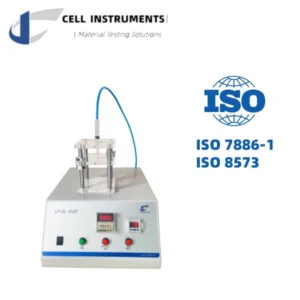
For labs and manufacturers looking to streamline their testing process with high precisionв "The Cell Instruments SLT-02 Syringe Leak Tester offers a compliant, automated solution that simplifies:
- Air leakage detection
- Stopper retention testing
- Vacuum control with integrated manometer
- Data recording and report generation
SLT-02 fully meets the apparatus requirements described in ISO 7886-1 and ISO 8537. With customizable interfaces and a modular clamp system, it’s ideal for R&D labs, QC departments, and production lines.
Enhancing Syringe Quality Through Proper Testing
Proper syringe leak testing not only meets regulatory expectations but ensures patient safety and brand credibility. Implementing correct testing practices, guided by standards like ISO 7886-1 і ISO 8537, helps manufacturers detect manufacturing defects early and reduce costly recalls.
For professionals in the pharmaceutical, medical deviceі diagnostic packaging industries, robust testing processes are non-negotiable. As device complexity increases, so does the need for precision instrumentation і standardized testing methodologies.
Висновок
The integrity of medical syringes hinges on rigorous syringe leak testing procedures. Adhering to ISO 7886-1 and ISO 8537 ensures safety, consistency, and regulatory compliance. Incorporating the SLT-02 Syringe Leak Tester from Клітинні інструменти into your workflow will enhance testing accuracy, reduce manual errors, and promote high product standards.
Whether you’re a QC technician, R&D engineer, or compliance auditor, understanding and executing syringe leak testing protocols effectively is essential for delivering safe and functional medical products.
 UK
UK  EN
EN  AR
AR  BG
BG  CS
CS  DA
DA  DE
DE  EL
EL  ES
ES  ET
ET  FI
FI  FR
FR  HU
HU  ID
ID  IT
IT  JA
JA  KO
KO  LT
LT  LV
LV  NB
NB  NL
NL  PL
PL  PT
PT  RO
RO  RU
RU  SK
SK  SL
SL  SV
SV  TR
TR