
ISO 8537 defines critical performance tests for sterile single-use insulin syringes, including injectability, syringe leakage, vacuum leak resistance, glide force performance, and dead space measurement. These tests evaluate sealing integrity, piston operation force, aspiration performance, and residual volume accuracy to ensure syringe safety and dosing reliability. Advanced testing systems help manufacturers achieve consistent quality control, regulatory compliance, and improved product performance in pharmaceutical and medical device applications.
Sterile insulin syringes must deliver accurate doses, maintain sealing integrity, and provide smooth piston movement during clinical use. ISO 8537, the international standard for sterile single-use insulin syringes with or without needles, defines critical performance and safety requirements for manufacturers and quality control laboratories.
The standard includes several essential functional evaluations, such as the injectability test, syringe leakage test, vacuum leak test pharmaceutical, syringe glide force testing, ve dead space measurement. These tests help manufacturers verify syringe reliability, minimize dosing errors, and maintain compliance with global medical device regulations.
ISO 8537 Requirements for Syringe Quality
ISO 8537 focuses on the performance characteristics of sterile single-use insulin syringes. The standard evaluates:
- Air leakage resistance
- Liquid leakage resistance
- Piston operation force
- Needle and nozzle connection integrity
- Residual volume (dead space)
- Structural integrity during aspiration and compression
These performance parameters directly influence injection accuracy, sterility assurance, and user experience.
Unlike simple visual inspections, ISO 8537 testing requires controlled laboratory procedures and precision instrumentation capable of generating repeatable mechanical force, vacuum pressure, and measurement accuracy.
Injectability Test According to ISO 8537
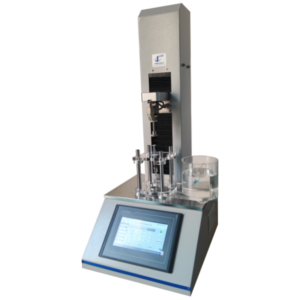
Bu injectability test evaluates the operational force required to initiate and maintain piston movement during fluid delivery. In ISO 8537 Annex C, the syringe is filled with distilled water to 50% of its nominal capacity before testing.
The procedure measures two critical parameters:
- Kopma kuvveti — the initial force required to start plunger movement
- Sürükleme kuvveti — the sustained force needed to maintain piston travel
Excessive force may indicate:
- Poor lubrication
- Defective elastomeric seals
- Barrel dimensional inconsistency
- Inadequate manufacturing control
Insufficient force may reduce dosing precision and compromise handling stability.
SSR-01 Şırınga Kayma Direnci Test Cihazı
Syringe Leakage Test for Compression Integrity
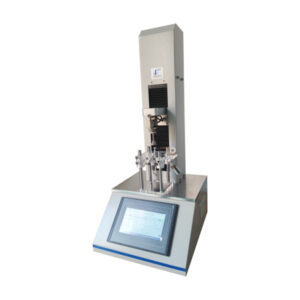
Bu syringe leakage test described in ISO 8537 Annex E verifies liquid sealing performance under internal pressure conditions.
During the procedure:
- The syringe is filled above nominal capacity.
- Air is expelled completely.
- The nozzle or needle tip is sealed.
- A side load is applied to create maximum plunger deflection.
- Internal pressure reaches 300 kPa for 30 seconds.
The operator then examines:
- Piston seal leakage
- Nozzle/hub leakage
- Needle/barrel union leakage
- Unintended piston movement
This test simulates real clinical handling conditions where side loads and internal pressure may occur simultaneously.
Leakage failures may result from:
- Poor elastomer sealing
- Inaccurate molding tolerances
- Weak hub assembly
- Inadequate bonding performance
SPPT-01 Şırınga Sıvı Kaçak Test Cihazı
Vacuum Leak Test Pharmaceutical Applications in ISO 8537
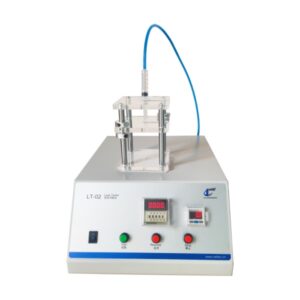
Bu vacuum leak test pharmaceutical procedure in ISO 8537 Annex B evaluates air leakage past the syringe piston during aspiration.
The syringe is partially filled with distilled water and connected to a reference conical fitting. The system gradually generates a vacuum reaching 88 kPa below atmospheric pressure.
The examiner then:
- Inspects for air leakage
- Observes pressure stability for 60 seconds
- Checks whether the rubber stopper separates from the plunger
This test is particularly important because aspiration performance directly affects:
- Accurate insulin dosing
- Air bubble prevention
- Sterility maintenance
- Injection consistency
A stable vacuum without pressure drop indicates effective sealing integrity.
SLT-02 Şırınga Hava Kaçağı Test Cihazı
Syringe Glide Force Testing for Piston Performance
Syringe glide force testing is one of the most important usability evaluations in ISO 8537 compliance testing.
Smooth piston travel ensures:
- Comfortable injection experience
- Accurate medication delivery
- Stable injection speed
- Reduced hand fatigue
The test records the continuous force profile while the plunger moves through the barrel.
Typical analysis includes:
- Maximum glide force
- Average glide force
- Force fluctuation
- Stick-slip behavior
Irregular force curves often indicate:
- Silicone oil distribution issues
- Surface roughness defects
- Piston deformation
- Barrel geometry variation
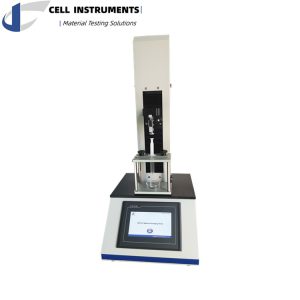
Cell Instruments provides force testing systems capable of generating real-time force-displacement curves for detailed syringe performance analysis. These systems support R&D optimization and batch quality verification.
MST-01 Tıbbi Şırınga Test Cihazı
Dead Space Measurement in ISO 8537
Dead space measurement evaluates the residual liquid volume remaining inside the syringe after complete plunger depression.
ISO 8537 Annex D determines dead space by:
- Weighing the empty syringe
- Filling the syringe with distilled water
- Expelling the liquid completely
- Reweighing the syringe
- Calculating the residual water mass
Low dead space is critical for:
- Accurate insulin dosing
- Reduced drug waste
- Improved therapeutic consistency
This parameter becomes especially important for high-value biologics and low-dose injectable formulations.
Precision balances with 0.001 g resolution are commonly required for compliant testing.
Manufacturers often combine dead space analysis with dimensional inspection and injection force testing to achieve comprehensive syringe performance validation.
SSS
What is ISO 8537?
ISO 8537 is an international standard that specifies requirements and test methods for sterile single-use insulin syringes with or without needles.
Why is syringe glide force testing important?
Syringe glide force testing ensures smooth piston movement, stable injection performance, and accurate drug delivery during clinical use.
What pressure is used in the ISO 8537 syringe leakage test?
ISO 8537 Annex E requires an internal pressure of 300 kPa maintained for 30 seconds during leakage evaluation.
What does the vacuum leak test pharmaceutical procedure evaluate?
The vacuum leak test pharmaceutical method evaluates air leakage past syringe piston seals and verifies plunger-stopper attachment integrity under negative pressure conditions.
Why is dead space measurement critical for insulin syringes?
Dead space measurement helps minimize residual drug volume, improving dosing accuracy and reducing medication waste.
What instruments are commonly used for ISO 8537 Test mi?
Common instruments include universal testing machines, vacuum leak testers, pressure leakage systems, precision balances, and automated force analyzers.
 TR
TR  EN
EN  AR
AR  BG
BG  CS
CS  DA
DA  DE
DE  EL
EL  ES
ES  ET
ET  FI
FI  FR
FR  HU
HU  ID
ID  IT
IT  JA
JA  KO
KO  LT
LT  LV
LV  NB
NB  NL
NL  PL
PL  PT
PT  RO
RO  RU
RU  SK
SK  SL
SL  SV
SV  UK
UK  HE
HE  TH
TH  VI
VI