
Understanding ISO 21182 and Why Friction Matters
ISO 21182:2025 is the international standard for determining the static and dynamic coefficient of friction of light conveyor belts. The standard provides a consistent methodology for evaluating how conveyor belt surfaces interact with contact materials under controlled conditions.
In modern conveying systems, friction performance directly influences:
- Product transport stability
- Inclined conveying capability
- Energy consumption
- Belt tracking behavior
- Product positioning accuracy
- Production efficiency
Zanesljiv conveyor belt coefficient of friction test helps manufacturers, quality control laboratories, and conveyor system designers verify whether a belt surface provides the required grip or slip characteristics for its intended application.
Because light conveyor belts are used in industries ranging from food processing and packaging to logistics and pharmaceuticals, accurate ISO 21182 coefficient of friction testing plays an important role in both product development and quality assurance.
What Does ISO 21182 Measure?
ISO 21182 evaluates two important friction characteristics:
| Parameter | Opis | Significance |
|---|---|---|
| Static Coefficient of Friction (μS) | Friction force required to initiate movement | Indicates belt grip at startup |
| Dynamic Coefficient of Friction (μD) | Friction force during continuous sliding | Indicates friction during operation |
The standard recognizes that the friction behavior of a conveyor belt’s carrying surface can vary significantly depending on the belt material, coating, texture, and intended application.
Typical applications include:
- PVC conveyor belts
- PU conveyor belts
- Rubber-coated belts
- Food-grade conveyor belts
- Textile-reinforced conveyor belts
- Specialty patterned conveyor belts
Test Principle of ISO 21182 Coefficient of Friction Testing
The test is based on measuring the force required to move a metallic test panel across the conveyor belt surface under a specified normal load.
Dynamic Friction Measurement
For dynamic friction testing:
- A conveyor belt specimen is fixed to a horizontal test table.
- A metallic test panel and specified weight are placed on the belt surface.
- The panel is pulled at a controlled speed.
- Friction force is continuously recorded.
- The median friction force during steady-state movement is used to calculate μD.
The dynamic coefficient is calculated using:
μD=FDFN\mu_D=\frac{F_D}{F_N}
Kje:
- FD = dynamic friction force
- FN = normal force
Static Friction Measurement
For static friction testing:
- The test panel is positioned on the specimen.
- A pulling force is gradually applied.
- The force required to initiate movement is recorded.
- The first peak force (break-away force) is used for calculation.
The static coefficient is calculated using:

Kje:
- FS = static friction force
- FN = normal force
The static coefficient generally exceeds the dynamic coefficient because additional force is required to overcome initial surface adhesion.
ISO 21182 Test Procedure
Okoljske razmere
Testing should be performed under controlled atmospheric conditions according to ISO 18573 Atmosphere B requirements.
Important environmental factors include:
- Temperature stability
- Relative humidity control
- Consistent specimen conditioning
These controls help ensure repeatable and comparable results.
Priprava vzorca
The specimen is:
- Cut from the full belt thickness
- Prepared in either longitudinal or transverse direction
- Securely clamped to the testing table
- Free from contamination or damage
Dynamic COF Test Settings
According to ISO 21182:
| Parameter | Requirement |
|---|---|
| Pulling Speed | 1000 ± 20 mm/min |
| Alternative Speed | Minimum 500 ± 20 mm/min |
| Travel Distance | 300 mm |
| Data Evaluation Zone | Last 200 mm of travel |
Static COF Test Settings
| Parameter | Requirement |
|---|---|
| Pulling Speed | 100 ± 10 mm/min |
| End Point | Initial movement of test panel |
The significantly slower speed allows accurate identification of the break-away force.
Equipment for ISO 21182 Coefficient of Friction Testing
Dedicated COF Testing Machine
For laboratories performing routine friction coefficient measurement, a dedicated COF testing machine provides efficient and repeatable testing.
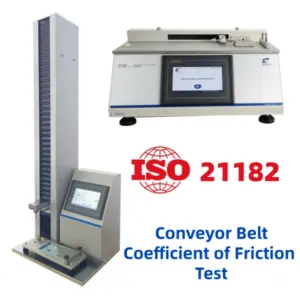
Cell Instruments COF-01
Spletna stran Tester koeficienta trenja COF-01 can be adapted for conveyor belt friction evaluation and offers:
| Značilnost | Benefit |
|---|---|
| Sistem krmiljenja s programirljivim logičnim krmilnikom (PLC) | Stable operation and repeatability |
| HMI z zaslonom na dotik | Easy parameter setup |
| Static & Dynamic Testing Modes | Supports both friction measurements |
| Precision Motion System | Consistent pulling speed |
| Automated Data Collection | Reduced operator variability |
| Force Curve Display | Easy identification of friction peaks |
Key specifications include:
- Load Cell: 5 N (customizable)
- Accuracy: 0.5% F.S.
- Test Speed: 100 mm/min and 150 mm/min standard configurations
- Sled Weight: 200 ± 1 g
- RS-232 Data Output (optional)
Universal Testing Solution
For laboratories seeking greater flexibility, the TST-01 Universal Testing Machine with COF Fixture offers an alternative approach.
Med prednosti spadajo:
- Adjustable speed from 1–500 mm/min
- Multiple testing capabilities
- Fixture interchangeability
- Real-time force-displacement curve analysis
- Custom test method development
This solution is particularly useful for R&D laboratories that perform tensile, peel, puncture, and friction testing on various materials.
ISO 21182 vs Other COF Standards
| Standard | Aplikacija |
|---|---|
| ISO 21182 | Light conveyor belts |
| ISO 8295 | Plastic films and sheets |
| ASTM D1894 | Plastične folije in plošče |
| TAPPI T549 | Papir in karton |
| ASTM D4918 | Paper friction testing |
While the basic friction measurement principle remains similar, each standard uses different specimen configurations, test conditions, and result interpretation methods tailored to specific materials.
Choosing the Right Friction Testing Solution
When selecting equipment for conveyor belt coefficient of friction test applications, laboratories should consider:
- Required test speed range
- Static and dynamic COF capability
- Data acquisition requirements
- Compliance with ISO procedures
- Future testing needs
- Laboratory throughput
Dedicated COF testers are often ideal for routine quality control, while universal testing platforms provide greater flexibility for research and product development environments.
By implementing standardized ISO 21182 coefficient of friction testing, manufacturers can better understand conveyor belt surface performance, improve process reliability, and ensure consistent product quality across a wide range of industrial applications.
 SL
SL  EN
EN  AR
AR  BG
BG  CS
CS  DA
DA  DE
DE  EL
EL  ES
ES  ET
ET  FI
FI  FR
FR  HU
HU  ID
ID  IT
IT  JA
JA  KO
KO  LT
LT  LV
LV  NB
NB  NL
NL  PL
PL  PT
PT  RO
RO  RU
RU  SK
SK  SV
SV  TR
TR  UK
UK  HE
HE  TH
TH  VI
VI