
ASTM F2338
Método de descomposición en vacío
La integridad de los envases es fundamental en industrias como la farmacéutica, la de productos sanitarios y la alimentaria. Incluso la fuga más pequeña puede comprometer la esterilidad, reducir la vida útil o provocar el fallo del producto. ASTM F2338 es la norma mundialmente reconocida que proporciona un método no destructivo para detectar fugas en diversos sistemas de envasado.
¿Qué es la norma ASTM F2338?
ASTM F2338, formalmente titulada Método de ensayo normalizado para la detección no destructiva de fugas en embalajes por el método de decaimiento en vacío, define un método preciso y sensible para la detección de fugas. El método aplica un vacío controlado alrededor de un envase y supervisa los cambios de presión en una cámara de pruebas.
Si existe una fuga, los gases escapan del envase a la cámara, provocando una desintegración del vacío. Esta técnica está muy extendida porque es:
- No destructivo - paquetes permanezcan intactos para su uso o distribución posteriores.
- Alta sensibilidad - capaz de detectar fugas invisibles a simple vista.
- Aplicable a muchos tipos de envases - diseños flexibles, rígidos, porosos y no porosos.
- Eficaz - adecuado tanto para estudios de laboratorio como para el muestreo en la línea de producción.
La norma ASTM F2338 es especialmente importante para blísteres farmacéuticos, productos sanitarios estériles, bandejas selladas para alimentos y envases electrónicos donde la prevención de fugas es esencial para la seguridad del producto.
Comprender el método de descomposición en vacío
El método de descomposición en vacío es el núcleo de la norma ASTM F2338. El proceso implica:
- Colocación del envase en una cámara de pruebas sellada.
- Aplicar vacío hasta alcanzar un nivel de presión definido.
- Aislar la cámara de la fuente de vacío.
- Control de la estabilidad de la presión con un transductor de alta precisión.
Un aumento de la presión indica que hay una fuga de aire o vapor. La sensibilidad de la prueba depende de:
- Diseño y estanqueidad de la cámara
- Precisión del transductor de presión
- Parámetros de ensayo como el nivel de vacío y la duración
- Características del envase (rígido frente a flexible, poroso frente a no poroso)
Esto hace que el método sea versátil en todas las industrias, ya que los parámetros pueden adaptarse a sistemas específicos de producto-envase.
Aplicaciones del comprobador de la descomposición en vacío de envases
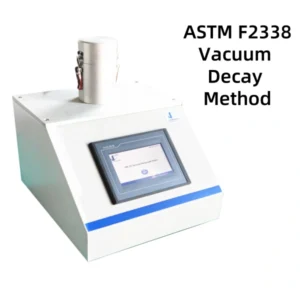
Usando un comprobador del deterioro del vacío de los envases proporciona confianza en la integridad del producto. Las aplicaciones más comunes son:
- Envases médicos y farmacéuticos - garantizar la esterilidad de jeringuillas, viales, blísteres y bolsas intravenosas.
- Alimentación y bebidas - mantener la frescura y evitar la contaminación microbiana en bandejas, bolsas y botellas.
- Electrónica y productos químicos de uso diario - evitar la entrada de humedad o gases que podrían afectar a productos sensibles.
Dado que el método no es destructivo, los fabricantes pueden realizar Prueba en línea 100% o pruebas estadísticas por lotes sin desperdiciar productos.
Por qué elegir el MLT-01 de Cell Instruments
Para las empresas que buscan una detección de fugas fiable según ASTM F2338, el Cell Instruments MLT-01 Microprobador de fugas es una solución avanzada. Sus principales ventajas son:
- Alta sensibilidad con una capacidad de detección de hasta 1-3 μm.
- Tamaños de cámara flexibles adaptados a las distintas formas de envasado.
- Interfaz PLC y HMI para un control preciso y sencillo.
- Ciclo de pruebas eficiente con pasos de llenado, asentamiento y medición.
- Cálculo del índice de fuga efectivo para un análisis preciso de los datos.
Al integrar el MLT-01 en los procesos de control de calidad, los fabricantes pueden reducir significativamente el riesgo de que lleguen al mercado envases defectuosos.
Importancia de ASTM F2338 en la garantía de calidad
El cumplimiento de la norma ASTM F2338 garantiza que los envases cumplen estrictos requisitos de seguridad y normativos. Entre sus ventajas se incluyen:
- Aceptación normativa - de confianza de la FDA, la EMA y las autoridades mundiales.
- Mayor seguridad para los consumidores - prevenir la contaminación y la retirada de productos.
- Ahorro de costes - reducir los residuos y evitar las devoluciones por fallos del envase.
- Optimización del proceso - proporcionando información sobre el rendimiento de la estanquidad y la idoneidad de los materiales.
En resumen, adoptar la norma ASTM F2338 y utilizar herramientas avanzadas como la MLT-01 permite a las empresas reforzar sus programas de garantía de calidad cumpliendo las normas internacionales.
ASTM F2338 establece el punto de referencia para las pruebas no destructivas de fugas de envases mediante la método de descomposición en vacío. Gracias a su precisión y adaptabilidad, protege productos en industrias en las que la seguridad y la fiabilidad no pueden verse comprometidas. Al emplear un comprobador del deterioro del vacío de los envases como el Instrumentos celulares MLT-01, Las empresas obtienen una potente herramienta para detectar microfugas, optimizar procesos y garantizar el cumplimiento de las normas mundiales.
Para los fabricantes de envases, dispositivos médicos, productos farmacéuticos y alimentos, la integración de las pruebas ASTM F2338 no es sólo una buena práctica, sino un paso vital para salvaguardar la calidad y la confianza del consumidor.
Preguntas frecuentes (FAQ)
1. ¿Para qué se utiliza la norma ASTM F2338?
ASTM F2338 es un método de ensayo no destructivo utilizado para detectar fugas en los envases. Se aplica ampliamente en las industrias farmacéutica, de dispositivos médicos, alimentaria y electrónica para garantizar la integridad del producto y el cumplimiento de la normativa.
2. ¿Cómo funciona el método de descomposición en vacío?
El método de descomposición por vacío coloca un envase en una cámara de prueba sellada, aplica vacío y, a continuación, controla la presión de la cámara. Cualquier aumento de presión indica que hay una fuga de gas del envase.
3. ¿Puede la norma ASTM F2338 detectar fugas en envases porosos?
Sí, la norma ASTM F2338 puede probar envases de barrera porosa, pero la superficie porosa debe enmascararse o bloquearse para evitar señales falsas causadas por la migración de gas a través del material.
4. ¿Por qué se recomienda el MLT-01 de Cell Instruments para los ensayos ASTM F2338?
El MLT-01 ofrece una alta sensibilidad (hasta 1-3 μm), cámaras personalizadas y un funcionamiento preciso controlado por PLC, lo que lo hace fiable para detectar incluso las fugas más pequeñas cumpliendo las normas ASTM F2338.
 ES
ES  EN
EN  AR
AR  BG
BG  CS
CS  DA
DA  DE
DE  EL
EL  ET
ET  FI
FI  FR
FR  HU
HU  ID
ID  IT
IT  JA
JA  KO
KO  LT
LT  LV
LV  NB
NB  NL
NL  PL
PL  PT
PT  RO
RO  RU
RU  SK
SK  SL
SL  SV
SV  TR
TR  UK
UK