
Thin plastic films and flexible materials are frequently exposed to sudden impacts during manufacturing, transportation, storage, and end-use. A package dropped during shipping or a sharp object striking a protective film can lead to unexpected failure if the material lacks sufficient impact resistance. ASTM D3420 provides a standardized method for evaluating the impact resistance of plastic films and sheets by measuring the energy required to rupture a specimen using a pendulum. For laboratories, manufacturers, and quality control professionals, ASTM D3420 offers a reliable approach to compare materials, optimize formulations, and ensure consistent product performance.
Whether you manufacture flexible packaging, protective films, industrial laminates, or specialty polymer sheets, understanding ASTM D3420 testing can help improve product durability and reduce field failures.
What Is ASTM D3420?
ASTM D3420 is the standard test method for determining the pendulum impact resistance of plastic film. The test measures the amount of energy absorbed by a specimen when struck by a pendulum-mounted impact head until rupture occurs.
Unlike slow tensile or compression tests, this method evaluates a material’s response to a rapid dynamic load, making it especially valuable for applications where accidental impacts may occur.
The test is commonly known as the Spencer impact test, since it is performed using the Spencer pendulum impact principle.
Typical materials include:
- Plastik filmler
- Flexible packaging films
- Laminated structures
- Composite films
- Plastic sheets
- Foils
- Specialty barrier materials
How the Spencer Impact Test Works
Bu spencer impact test uses a calibrated pendulum that swings from a known height. The specimen is securely clamped over a circular opening before the pendulum strikes the center using a hemispherical impact head.
The instrument determines the energy absorbed by the specimen during rupture by comparing the pendulum’s initial and residual energy.
The measured value represents the impact resistance of the material under standardized conditions.
Key measurement principles include:
| Parametre | Açıklama |
|---|---|
| Impact Energy | Energy required to rupture the specimen |
| Pendulum Mass | Selected according to required test range |
| Impact Head | Standard hemispherical striker |
| Numune Kelepçesi | Holds the specimen securely during testing |
| Result | Energy absorbed during impact |
Because ASTM D3420 controls specimen geometry, pendulum energy, and impact conditions, laboratories can compare results with confidence.
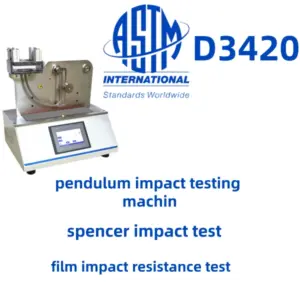
Pendulum Impact Testing Machine – ASTM D3420
A modern pendulum impact testing machine automates the testing process while ensuring high repeatability and operator safety.
The Cell Instruments PIT-01 Pendulum Impact Tester incorporates industrial-grade control technology and precision mechanics for accurate film impact resistance test applications.
Major Features
- PLC-controlled testing system
- Intuitive HMI touch screen
- Pnömatik numune sıkıştırma
- Otomatik sarkaç serbest bırakma
- High-resolution energy measurement
- Otomatik istatistiksel hesaplamalar
- Built-in micro printer
- Optional RS232 communication software
- Stable industrial-grade construction
These features improve testing efficiency while minimizing operator influence.
ASTM D3420 Test Procedure
A typical ASTM D3420 test includes the following steps:
- Prepare specimens according to the standard.
- Condition specimens under controlled laboratory conditions.
- Select the appropriate pendulum energy.
- Secure the specimen using the pneumatic clamp.
- Release the pendulum automatically.
- Record the absorbed impact energy.
- Repeat multiple tests.
- Calculate average values and evaluate variability.
Modern instruments automatically collect multiple measurements and generate statistical reports.
Film Impact Resistance Test Applications
A film impact resistance test provides valuable information across numerous industries.
Esnek Ambalaj
- Food packaging films
- Vacuum pouches
- Stand-up pouches
- Retort packaging
- Barrier laminates
Tıbbi Ambalaj
Medical device packaging must withstand accidental impacts during transportation while maintaining sterile barrier integrity.
Uygulamalar şunları içerir:
- Sterile pouches
- Medical films
- Pharmaceutical packaging
- Protective covers
Industrial Films
- Agricultural films
- Construction membranes
- Protective films
- Surface protection films
- Geomembranes
Consumer Products
- Shrink films
- Stretch films
- Shopping bags
- Trash bags
- Household packaging
Advantages of Pendulum Impact Testing
Compared with other impact evaluation methods, a pendulum impact testing machine offers several advantages.
High Repeatability
Automated release and pneumatic clamping minimize operator variation.
Direct Energy Measurement
The absorbed impact energy provides a clear indicator of material toughness.
Fast Testing
Each test requires only a short time, making it suitable for production quality control.
Suitable for Thin Materials
Unlike some heavy-impact methods, the pendulum system is optimized for thin films and flexible sheets.
Excellent Material Comparison
Manufacturers can easily compare:
- Different resin grades
- Film thicknesses
- Laminate structures
- Processing conditions
- Supplier materials
Interpreting ASTM D3420 Results
Higher absorbed energy generally indicates better resistance to sudden impact.
However, engineers should interpret results together with other mechanical properties.
Typical evaluation may include:
| Property | Common Test Method |
|---|---|
| Çekme Dayanımı | ASTM D882 |
| Tear Resistance | ASTM D1922 |
| Dart Impact | ASTM D1709 |
| Delinme Direnci | ASTM F1306 |
| Coefficient of Friction | ASTM D1894 |
| Conta Mukavemeti | ASTM F88 |
| Pendulum Impact | ASTM D3420 |
Combining these tests provides a more complete understanding of material performance.
Typical Technical Specifications
The PIT-01 Pendulum Impact Tester offers specifications suitable for laboratory and industrial testing.
| Öğe | Şartname |
|---|---|
| Impact Energy | 1 J, 2 J, 3 J |
| Çözünürlük | 0.001 J |
| Impact Head | Ø25.4 mm, Ø19 mm, Ø12.7 mm |
| Numune Kelepçesi | Pneumatic |
| Clamp Diameter | Ø89 mm, Ø60 mm |
| Numune Boyutu | 100 × 100 mm or Ø100 mm |
| Gaz Temini | 0.6 MPa |
| Güç Kaynağı | AC 110–220 V, 50 Hz |
Related Testing Standards
Although ASTM D3420 is specifically designed for pendulum impact resistance, laboratories often perform additional tests to fully characterize packaging materials.
Common companion standards include:
- ASTM D1709 — Falling dart impact resistance
- ASTM D882 — Tensile properties of thin plastic films
- ASTM D1922 — Elmendorf tear resistance
- ASTM F1306 — Slow rate puncture resistance
- ASTM D1894 — Coefficient of friction
- ASTM F88 — Seal strength testing
- NF T54-116 — Pendulum impact resistance
Selecting multiple complementary tests provides a comprehensive understanding of material durability under various loading conditions.
Why Choose Cell Instruments for ASTM D3420 Testing?
 Cell Instruments develops advanced mechanical testing equipment for packaging materials, plastics, medical packaging, pharmaceuticals, and industrial products.
Beyond standard instruments, we provide:
- Customized fixtures
- Multi-station testing systems
- Automated testing solutions
- Special specimen holders
- Software customization
- Technical application support
Our engineering team helps laboratories select the most appropriate testing configuration based on specific material characteristics and quality requirements.
Sıkça Sorulan Sorular
What does ASTM D3420 measure?
It measures the energy required to rupture plastic film using a pendulum impact method.
Is ASTM D3420 suitable for multilayer films?
Yes. It is widely used for monolayer and multilayer flexible packaging materials.
What is the difference between ASTM D3420 and ASTM D1709?
ASTM D3420 uses a pendulum impact method, while ASTM D1709 evaluates impact resistance using a falling dart.
What industries commonly use ASTM D3420?
Packaging, plastics, pharmaceuticals, medical devices, agriculture, construction materials, and industrial films all benefit from ASTM D3420 testing.
 TR
TR  EN
EN  AR
AR  BG
BG  CS
CS  DA
DA  DE
DE  EL
EL  ES
ES  ET
ET  FI
FI  FR
FR  HU
HU  ID
ID  IT
IT  JA
JA  KO
KO  LT
LT  LV
LV  NB
NB  NL
NL  PL
PL  PT
PT  RO
RO  RU
RU  SK
SK  SL
SL  SV
SV  UK
UK