
Film Pendulum Impact Testing Method
ASTM D3420
Spletna stran ASTM D3420 standard is a widely recognized test method for evaluating the impact resistance of plastic film using a pendulum-style apparatus. For industries like packaging, medical devices, food, pharmaceuticals, and electronics, this test is critical to ensure that films can withstand dynamic mechanical stress during handling, shipping, or application.
This article outlines the principles of ASTM D3420, its relevance, procedures, and how Cell Instruments’ PIT 01 Pendulum Impact Tester provides reliable and repeatable results in compliance with the standard.
ASTM Standards for Impact Testing of Plastics
Plastic films are subject to diverse mechanical stresses depending on their application. To evaluate their durability, ASTM has developed several standardized methods. Among them, ASTM D3420 specifically measures dynamic toughness, providing data closer to real-use conditions than static tensile tests.
Spletna stran Spencer Impact Test, originally developed as Procedure B within ASTM D3420, uses a smaller-diameter impact head and a larger clamping aperture. It remains a widely adopted variation due to its ability to replicate common packaging failures.
Other standards like ASTM D1709 and ASTM D4272 also assess impact performance, but ASTM D3420’s pendulum method stands out by delivering repeatable energy-to-break data across different film types and thicknesses.
Film Pendulum Impact Testing Method
In the ASTM D3420 method, a specimen is clamped between two rigid plates, each with a defined aperture. A hemispherical pendulum head is released from a known height, impacting and rupturing the center of the film.
-
Procedure A uses a 60 mm aperture and a 25.4 mm diameter impact head.
-
Procedure B (Spencer Impact Test) employs an 89 mm aperture with a 19.0 mm impact head.
Spletna stran energy absorbed by the film during rupture is read on a calibrated analog or digital scale and recorded in Joules or cm·kgf. No correction is made for energy absorbed by fragments, as the effect is minimal.
This test is especially relevant for packaging engineers, quality control labs, and film manufacturers who need reliable, real-world toughness data for thin films used in flexible packaging, barrier films, or sealing layers.
Key Advantages of ASTM D3420 Impact Resistance of Plastic Film
-
Measures dynamic strain behavior under conditions similar to actual use.
-
Useful for comparative testing of different resins, formulations, or manufacturing processes.
-
Ideal for QA/QC workflows, ensuring batch consistency in film toughness.
-
Supports R&D in developing stronger, puncture-resistant materials for demanding applications.
Because many packaging failures are caused by sudden dynamic forces (e.g., drops, mechanical handling), film pendulum impact testing offers critical predictive insights.
Film Pendulum Impact Testing Equipment Required
A compliant setup includes:
-
A pendulum impact tester with variable energy settings (0.5–5.0 J recommended).
-
Calibrated digital or analog energy indicator.
-
Specimen clamps (preferably O-ring type) to minimize slippage.
-
Micrometer for accurate film thickness measurement.
-
Sample cutter for precise film preparation.
To ensure consistent and valid results, specimens must be conditioned to 23 ± 2°C and 50 ± 10% RH, and the apparatus zeroed and calibrated according to standard procedures.
Why Choose Cell Instruments’ PIT 01 for ASTM D3420 Testing
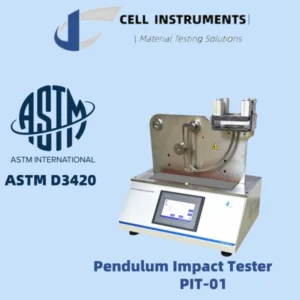 Spletna stran PIT 01 Pendulum Impact Tester from Cell Instruments is specifically designed to meet the stringent requirements of ASTM D3420. It supports both Procedure A and Procedure B (Spencer Impact Test), providing versatile capability for labs testing a variety of plastic films.
Key features include:
-
Precision pendulum release mechanism to minimize friction and error.
-
Multiple energy range configurations via auxiliary weights.
-
Optional digital readout system for automatic energy calculation.
-
Ergonomic sample clamping with minimal slippage.
Whether for regulatory compliance, new material development, or routine quality checks, the PIT 01 ensures confidence in your impact resistance data.
Spletna stran ASTM D3420 pendulum impact resistance test plays a vital role in assessing the performance of plastic films under dynamic stress. Its relevance spans from embalaža za živila to medical pouches, where understanding how a material behaves under sudden force is essential.
Choosing the right testing equipment is as critical as understanding the standard. With Cell Instruments’ PIT 01, laboratories gain a reliable, compliant, and easy-to-use solution for performing high-precision film pendulum impact testing.
Frequently Asked Questions (FAQs)
1. What materials can be tested using ASTM D3420?
Primarily plastic films up to 0.25 mm thick, but films up to 0.40 mm can also be tested depending on clamp compatibility.
2. How does ASTM D3420 differ from ASTM D1709?
ASTM D3420 measures total energy to puncture using a pendulum, while ASTM D1709 uses free-falling darts to evaluate failure initiation energy.
3. What is the Spencer Impact Test?
It is a variation of ASTM D3420 Procedure B, using a smaller head and larger aperture to simulate real-world packaging punctures.
4. Why is pendulum impact testing important?
It provides realistic insights into how films perform under sudden stress, crucial for packaging, medical, and industrial applications.
5. How does PIT 01 by Cell Instruments support ASTM D3420?
The PIT 01 tester complies fully with ASTM D3420 requirements, supports multiple energy scales, and ensures accurate, repeatable impact data.
 SL
SL  EN
EN  AR
AR  BG
BG  CS
CS  DA
DA  DE
DE  EL
EL  ES
ES  ET
ET  FI
FI  FR
FR  HU
HU  ID
ID  IT
IT  JA
JA  KO
KO  LT
LT  LV
LV  NB
NB  NL
NL  PL
PL  PT
PT  RO
RO  RU
RU  SK
SK  SV
SV  TR
TR  UK
UK