
What Is ISO 15359?
ISO 15359 is an international standard that specifies a coefficient of friction test method for paper and board using the horizontal plane principle. The standard evaluates both the статический коэффициент трения и кинетический коэффициент трения between two paper or paperboard surfaces under controlled laboratory conditions.
For manufacturers of paper packaging, folding cartons, labels, corrugated products, and specialty papers, friction characteristics directly affect material handling, feeding performance, stacking behavior, printing operations, and packaging line efficiency. ISO 15359 provides a standardized approach for quantifying these friction properties and ensuring consistent product performance.
Unlike many friction tests that only measure initial sliding resistance, ISO 15359 also evaluates friction behavior after controlled wear cycles, offering a more realistic assessment of how paper surfaces behave during actual converting and packaging operations.
Why Is the Coefficient of Friction of Paper Important?
The coefficient of friction of paper significantly influences manufacturing efficiency and product performance throughout the supply chain.
Key Quality Considerations
| Приложение | Impact of Friction |
|---|---|
| Printing Operations | Sheet feeding reliability |
| Carton Manufacturing | Folding and converting performance |
| Packaging Lines | Product transport and handling |
| Label Production | Dispensing consistency |
| Paper Stacking | Stability during storage and transport |
| High-Speed Processing | Reduction of jams and misfeeds |
When friction is too high:
- Sheets may stick together
- Feeding systems may experience jams
- Machine efficiency may decrease
When friction is too low:
- Stacks may become unstable
- Sheets may slip excessively
- Handling and transport issues may occur
Therefore, monitoring the coefficient of friction is an important quality control parameter for paper and board manufacturers.
Principle of the ISO 15359 Coefficient of Friction Test Method
The coefficient of friction test method described in ISO 15359 uses a sled-and-plane configuration.
Two test specimens are mounted:
- One specimen is fixed to a horizontal table
- The second specimen is attached to a sled of known mass
The test measures:
- The force required to initiate movement (static friction force)
- The force required to maintain movement (kinetic friction force)
The coefficient of friction is calculated by dividing the measured friction force by the normal force generated by the sled weight.
Принцип теста
A paper surface is placed in contact with another paper surface under controlled pressure. The instrument records:
- Initial peak force before movement
- Peak force during repeated sliding
- Average force during continuous sliding
These measurements are then converted into friction coefficients according to ISO 15359 formulas.
Types of Friction Values Measured in ISO 15359
ISO 15359 evaluates three different friction characteristics.
Static Coefficient of Friction at First Slide (μs1)
This value represents the friction resistance before any wear occurs between the surfaces.
It reflects:
- Initial handling characteristics
- Sheet separation performance
- Feeding behavior in printing and packaging equipment
Static Coefficient of Friction at Third Slide (μs3)
After repeated sliding cycles, the paper surfaces experience slight wear and surface modification.
The third-slide measurement evaluates:
- Friction stability
- Surface durability
- Performance after repeated contact
Kinetic Coefficient of Friction (μk)
The kinetic coefficient measures resistance during continuous sliding motion.
This parameter is particularly important for:
- High-speed converting operations
- Packaging machine performance
- Continuous web transport systems
ISO 15359 Test Procedure
First-Slide Static Friction Test
For measuring μS1:
- Mount specimens on the table and sled.
- Align machine direction (MD) or transverse direction (TD) with the pulling direction.
- Lower the sled onto the test surface at approximately 3 mm/s.
- Allow the sled to remain in contact for 1–20 seconds.
- Increase the pulling force gradually.
- Record the force required to initiate movement (FS1).
- Repeat until at least six valid results are obtained.
Third-Slide Static and Kinetic Friction Test
For measuring μs3 and μk:
- Conduct the first slide as described above.
- Continue sled movement according to ISO 15359 travel requirements.
- Return the specimens to the starting position.
- Repeat the sliding cycle two additional times.
- Запись:
- Third-slide initiation force (FS3)
- Average kinetic friction force (FK) between 40 mm and 60 mm travel
- Perform at least six valid replicate tests.
This approach enables assessment of both initial and worn-surface friction characteristics.
Equipment Used for ISO 15359 Testing
A suitable ISO 15359 testing system should provide:
- Precise force measurement
- Controlled sled movement
- Adjustable test speeds
- Stable horizontal test plane
- Data acquisition and statistical analysis
- Repeatable motion control
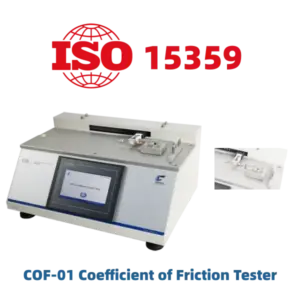
Recommended Solution: COF-01 Coefficient of Friction Tester
The COF-01 Тестер коэффициента трения is designed for friction evaluation of:
- Бумага и картон
- Пластиковые пленки
- Flexible packaging materials
- Labels
- Coated substrates
Key capabilities include:
- Static and kinetic COF measurement
- Работа под управлением ПЛК
- Touchscreen HMI interface
- Precision ball screw drive system
- Automated data collection
- Custom sled configurations
- Дополнительная интеграция программного обеспечения
The instrument supports friction testing requirements commonly used in ISO and ASTM friction standards.
Alternative Solution: TST-01 Tensile Tester with COF Fixture
For laboratories seeking multifunctional testing capability, the TST-01 COF/Tensile Tester with COF Fixture combines:
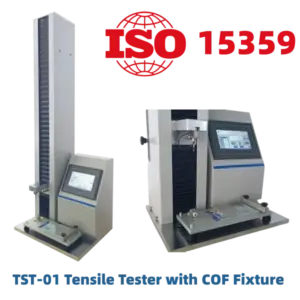
- Coefficient of friction testing
- Tensile testing
- Peel testing
- Tear testing
- Seal strength testing
К преимуществам относятся:
- Adjustable speeds from 1–500 mm/min
- Multiple fixture compatibility
- High-precision force measurement
- Flexible laboratory utilization
This solution is particularly attractive for R&D laboratories and quality control departments managing multiple material tests on a single platform.
 RU
RU  EN
EN  AR
AR  BG
BG  CS
CS  DA
DA  DE
DE  EL
EL  ES
ES  ET
ET  FI
FI  FR
FR  HU
HU  ID
ID  IT
IT  JA
JA  KO
KO  LT
LT  LV
LV  NB
NB  NL
NL  PL
PL  PT
PT  RO
RO  SK
SK  SL
SL  SV
SV  TR
TR  UK
UK  HE
HE  TH
TH  VI
VI