
ISO 13937-1 specifies the Elmendorf pendulum method for determining the tear force required to propagate a pre-cut tear in textile fabrics. The test measures the energy absorbed during tearing and provides valuable information about fabric durability and resistance to damage. Widely used for woven fabrics and many nonwoven materials, the method supports quality control, product development, material comparison, and compliance testing across textile, industrial, and technical fabric applications.
What Is ISO 13937-1?
ISO 13937-1: Textiles — Tear Properties of Fabrics — Part 1: Determination of Tear Force Using Ballistic Pendulum Method (Elmendorf) specifies a method for measuring the force required to propagate a pre-cut tear in a fabric.
The standard evaluates the energy needed to continue a tear over a fixed distance after a sudden force is applied. The resulting value provides an indication of the fabric’s ability to resist tearing during practical use.
The method is widely recognized as one of the most important fabric tear strength test procedures used in textile quality control.
Primary Applications
The method is primarily suitable for:
- Woven fabrics
- Nonwoven fabrics (in many cases)
- Technical textiles
- Industrial fabrics
- Coated fabrics
- Protective textiles
The method is generally not suitable for:
- Knitted fabrics
- Highly elastic woven fabrics
- Very loose constructions
- Highly anisotropic materials where tear direction changes significantly
Elmendorf Tear Resistance Test Principle
De Elmendorf tear resistance method measures the work required to continue a tear that has already been initiated.
The testing system consists of:
- A calibrated pendulum
- Fixed clamp
- Moving clamp
- Specimen cutting knife
- Tear force measurement mechanism
How the Test Works
- The specimen is securely clamped between fixed and moving jaws.
- A precise slit is introduced into the specimen.
- The pendulum is raised to a predetermined position.
- The pendulum is released.
- As the pendulum swings downward, it tears the specimen.
- The energy absorbed during tear propagation is measured.
- Tear force is calculated and reported in Newtons.
Because the test measures tearing energy rather than direct pulling force, it closely simulates sudden tear propagation encountered during real-world use.
ISO 13937-1 Fabric Elmendorf Tear Test Procedure
Monstervoorbereiding
Volgens ISO 13937-1, specimens are prepared with controlled dimensions and conditioned under standard textile testing environments.
Important specimen requirements include:
- Uniform fabric samples
- Representative machine and cross directions
- No visible defects
- Proper conditioning before testing
Het monster bevestigen
The specimen is mounted centrally in the clamps with:
- Long side parallel to the jaw edge
- Bottom edge aligned with jaw stops
- Secure clamping to prevent slippage
A slit of:
20 mm ± 0.5 mm
is cut into the specimen before testing.
This creates a remaining tear length of:
43 mm ± 0.5 mm
Uitvoering van de test
The operator:
- Raises the pendulum
- Verifies zero position
- Releases the pendulum
- Records the tear force reading
The selected pendulum range should produce readings between:
15% and 85% of full scale
to maintain measurement accuracy.
Number of Tests
The standard requires:
- Minimum five specimens per fabric direction
- Warp direction testing
- Weft direction testing
Interpreting ISO 13937-1 Results
The reported tear force represents the average force required to propagate the tear.
Higher values generally indicate:
- Greater tear resistance
- Improved durability
- Better resistance to accidental damage
Lower values may indicate:
- Lightweight constructions
- Reduced durability
- Potential susceptibility to tear propagation
Example Test Results
| Fabric Type | Warp Tear Force (N) | Weft Tear Force (N) |
|---|---|---|
| Cotton Woven Fabric | 18.4 | 16.7 |
| Polyester Fabric | 24.6 | 22.8 |
| Coated Technical Textile | 41.2 | 38.9 |
| Nonwoven Material | 9.3 | 8.7 |
Actual acceptance criteria vary according to product specifications and end-use requirements.
Comparing ISO 13937-1 with Other Tear Test Methods
Different tear testing standards are available depending on material type and application.
| Standaard | Methode | Typische toepassing |
|---|---|---|
| ISO 13937-1 | Elmendorf Pendulum | Woven textiles |
| ISO 13937-2 | Trouser Tear Method | Fabrics |
| ISO 13937-3 | Wing Tear Method | Textiel |
| ASTM D1424 | Elmendorf scheurproef | Textile fabrics |
| ASTM D5734 | Scheurtest voor broeken | Nonwovens |
Among these methods, ISO 13937-1 remains one of the most widely adopted standards for routine textile tear resistance evaluation.
Selecting an Elmendorf Tearing Strength Tester
When choosing an Elmendorf tearing strength tester, laboratories should evaluate:
Key Selection Criteria
- Compliance with ISO 13937-1
- Verschillende slingercapaciteiten
- Automatic force calculation
- Repeatability and reproducibility
- Data management capabilities
- Calibration convenience
- Operator safety
Modern systems significantly improve testing efficiency while reducing operator influence.
Cell Instruments SLD-01 Elmendorf Tearing Strength Tester
For laboratories performing ISO 13937-1 testen, de SLD-01 Elmendorf Tearing Strength Tester from Cell Instruments is designed to support accurate and repeatable tear resistance measurements.
Technische kenmerken
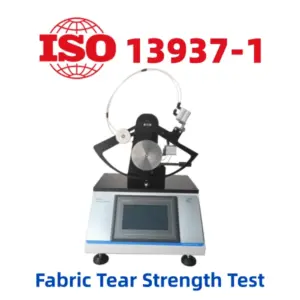
- PLC-besturing met HMI-touchscreen
- Pneumatic specimen clamping for uniform gripping force
- Automatic pendulum release to minimize operator variation
- Integrated calibration weight verification
- Automatic statistical analysis of test data
- Optional micro-printer and RS-232 communication
- Optional professional software for data analysis and reporting
- Optional paper industry units including mN and tear index
Technische specificaties
| Parameter | Specificatie |
|---|---|
| Pendulum Capacity | 200, 400, 800, 1600, 3200, 6400 gf |
| Gas Source | 0.6 MPa |
| Tearing Arm Length | 104 ± 1 mm |
| Initial Tearing Angle | 27.5° ± 0.5° |
| Voeding | AC 110–220V, 50/60Hz |
These features help laboratories achieve consistent results while meeting the requirements of ISO 13937-1 and related tear testing standards.
As tear resistance remains a critical performance characteristic for many textile products, implementing standardized fabric tear strength test procedures and utilizing a properly designed Elmendorf tearing strength tester are essential components of an effective quality control program.
Accurate tear resistance data helps manufacturers improve product performance, optimize fabric construction, and ensure compliance with customer requirements. Whether conducting routine quality control or advanced material evaluation, selecting a reliable Elmendorf tearing strength tester is essential. Cell Instruments offers the SLD-01 Elmendorf Tearing Strength Tester, designed to support ISO 13937-1 testing with automated operation, precise control, and comprehensive data management capabilities. Contact our team to explore suitable tear testing solutions for your laboratory and application requirements.
 NL
NL  EN
EN  AR
AR  BG
BG  CS
CS  DA
DA  DE
DE  EL
EL  ES
ES  ET
ET  FI
FI  FR
FR  HU
HU  ID
ID  IT
IT  JA
JA  KO
KO  LT
LT  LV
LV  NB
NB  PL
PL  PT
PT  RO
RO  RU
RU  SK
SK  SL
SL  SV
SV  TR
TR  UK
UK  HE
HE  TH
TH  VI
VI