
Infusion Bags: Compression Testing Methods, Standards, and How to Ensure Packaging Safety
Infūzijas maisiņi are essential components in modern healthcare systems. Whether used for intravenous fluids, medications, or nutritional solutions, these flexible packaging units must perform flawlessly under pressure. One of the most critical aspects of ensuring their safety and functionality is compression testing. In this guide, we explore how to conduct infusion bags testing, the importance of using an accurate infusion bags compression tester, and how these tests align with international quality standards.
The Role of Compression Testing in Infusion Bag Safety
Every day, infūzijas maisiņi endure handling, stacking, storage, and transportation stress. If a bag ruptures or leaks under load, the consequences can range from product waste to serious risks for patients. To prevent this, manufacturers must test each packaging design to ensure it meets both internal quality benchmarks and global standards like ISO 12048 un ASTM D642.
Compression testing simulates real-world vertical pressure scenarios to determine:
Maximum load capacity
Deformation behavior under stress
Burst resistance and leakage risks
Izturība during stacking and shipping
When performed correctly, this test provides crucial data for kvalitātes kontrole, normatīvo aktu ievērošana, un product development.
Infusion Bags Testing and Compression Equipment Requirements
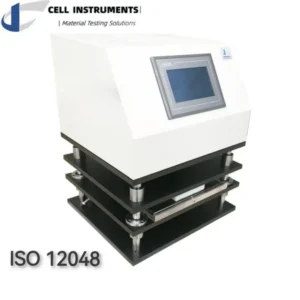
To carry out reliable infusion bags testing, the equipment must offer precision, real-time data feedback, and compliance with international testing protocols. A high-quality infusion bags compression tester like the one from Cell Instruments Co., Ltd. ensures accurate and repeatable results.
Key Equipment Features:
Upper and lower compression platens for balanced force distribution
Ar PLC vadīta sistēma for stable operation
HMI skārienekrāns for easy test configuration
Real-time force measurement and curve plotting
Automatic constant pressure compensation
Liquid containment tray to safely collect ruptured fluids
Pielāgojami plātnes izmēri to fit various bag formats
Pēc izvēles RS232 connectivity and software for data export
These features are especially critical when testing flexible film materials commonly used in infusion bags.
Testing Standards for Infusion Bags Compression
Compression testing of infūzijas maisiņi must follow industry-recognized standards to ensure international compliance. One of the most relevant is ISO 12048, which outlines test procedures for filled transport packages.
ISO 12048 and Related Standards:
Kompresijas ātrums: (10 ± 3) mm/min
Spēka precizitāte: ±2%
Platen parallelism: within 1:1000 tolerance
Kondicionēšana: 23°C, 50% RH for at least 48 hours
Data collection: Continuous force-deformation curve
Pārskatu sniegšana: Peak force, deformation, and failure mode description
By applying these standards, testers can confidently assess whether an infusion bag will withstand stacking or pressure without failing.
Benefits of Using Cell Instruments’ Infusion Bags Compression Tester
Portāls Iepakojuma saspiešanas testeris from Cell Instruments is specifically designed for medical and pharmaceutical packaging applications. It supports both maximum load un constant pressure resistance testing, providing flexibility for different use cases.
Recommended for testing:
Infusion bags and blood bags
Plastmasas infūziju pudeles
Ice packs and composite pouches
Film-wrapped pharmaceutical units
With industry-standard compliance and high measurement accuracy (±1% FS), the device is ideal for quality assurance labs, R&D departments, un certification bodies focused on packaging safety and performance.
Test Procedure Overview for Infusion Bags
Step 1: Conditioning
Stabilize samples in a climate-controlled environment at 23°C and 50% relative humidity for at least 48 hours.
Step 2: Setup
Place the bag centrally between parallel compression plates. Ensure the system is calibrated and that emergency stop features are enabled.
Step 3: Test Configuration
Choose between:
Burst mode: Compress until rupture
Constant pressure: Apply defined force over a fixed time
Set speed and load limits per the selected test standard.
Step 4: Execution and Monitoring
Start the test. The machine applies vertical pressure while logging force and displacement data continuously.
Step 5: Data Interpretation
Analyze the spēka-deformācijas līkne to determine:
Maksimālā slodze
Mode of failure (rupture, leak, deformation)
Packaging resilience
Secinājums
For medical packaging professionals, knowing how to perform infusion bags testing is essential to ensure patient safety, product quality, and regulatory approval. By using a reliable infusion bags compression tester and following standards like ISO 12048, you gain valuable insights into material behavior under stress and make better design and QA decisions.
Cell Instruments Co., Ltd. offers advanced testing solutions that are accurate, customizable, and compliant. If you work with infusion packaging, contact us today to explore how our equipment can improve your compression testing program.
 LV
LV  EN
EN  AR
AR  BG
BG  CS
CS  DA
DA  DE
DE  EL
EL  ES
ES  ET
ET  FI
FI  FR
FR  HU
HU  ID
ID  IT
IT  JA
JA  KO
KO  LT
LT  NB
NB  NL
NL  PL
PL  PT
PT  RO
RO  RU
RU  SK
SK  SL
SL  SV
SV  TR
TR  UK
UK  HE
HE  TH
TH  VI
VI