
Maintaining the integrity of packaging is crucial across various industries, from pharmaceuticals to food and beverages. The heat seal strength test method plays a vital role in ensuring that packaging remains secure, protecting the contents from contamination and damage. This article explores the key aspects of heat seal strength testing, with a focus on compliance with ASTM F2029, a standard that guides the procedure for making and evaluating heat seals.
Importance of Heat Seal Strength Testing
The quality and reliability of a heat seal are paramount in packaging, especially in industries where product safety is a top priority. Heat seals must be strong enough to prevent leaks and tampering, yet easy to open when required. The heat seal strength test method provides a quantitative measure of the force required to break a seal, offering insights into the seal’s durability and uniformity.
Key Aspects of Heat Seal Strength Testing
1. Preparation of Test Specimens
- Parauga sagatavošana: Begin by cutting samples of the material to the specified dimensions, ensuring uniformity. The cleanliness of the samples is crucial, as contaminants can affect seal quality.
- Parameter Selection: Select appropriate test parameters, including temperature, pressure, and dwell time. These settings are critical for producing consistent and reliable seals.
2. Conducting the Test
- Parauga izvietojums: Position the sample between the heated sealing bars of the tester.
- Application of Pressure: Apply the selected pressure and maintain it for the designated dwell time. Once completed, remove the sample and allow it to cool before further analysis.
- Seal Strength Measurement: After cooling, the seal strength is measured using a tensile testing machine, which pulls the sealed sample apart. The force required to break the seal is recorded, providing a quantitative measure of the seal strength.
Compliance with ASTM F2029
ASTM F2029 is the standard test method for making heat seals for determining the heat sealability of flexible webs, as measured by seal strength. This standard ensures that heat seals are made and evaluated consistently, providing reliable data across different materials and applications. The use of ASTM F2029 in testing provides a recognized benchmark, ensuring that your heat seals meet industry standards and are reliable for their intended use.
Siltuma blīvējuma izturības testēšanas pielietojums
Heat seal strength testing is essential across various industries:
- Iepakojums: Ensuring the integrity of flexible packaging materials to maintain product freshness and safety.
- Medicīniskās ierīces: Verifying the reliability of heat seals in sterile packaging, crucial for preventing contamination.
- Farmaceitiskie līdzekļi: Testing blister packs and other pharmaceutical packaging to ensure product integrity.
- Līmes: Evaluating the performance of adhesive heat seals in various applications.
- Tekstilizstrādājumi: Testing heat-sealable fabrics used in technical textiles and garments.
- Pārtika un dzērieni: Ensuring the safety of sealed food and beverage packaging.
Recommended Equipment: Cell Instruments Heat Seal Tester
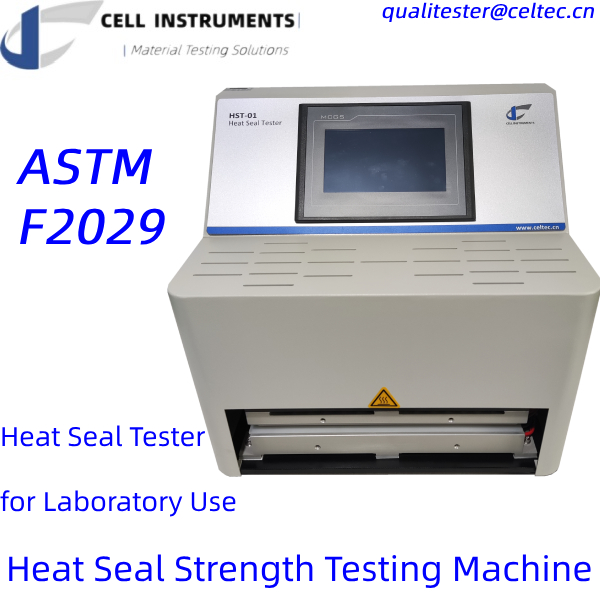
For accurate and reliable heat seal strength testing, the Šūnu instrumenti Siltuma blīvējuma testeris is an excellent choice. Designed with a focus on compliance with ASTM F2029, this tester offers precision, versatility, and customization options. It is suitable for a broad range of materials, including plastics, textiles, paper, and adhesives. Whether you need to test food packaging or the integrity of sterile medical packaging, the Cell Instruments Heat Seal Tester delivers consistent and accurate results.
Biežāk uzdotie jautājumi
- What is the purpose of heat seal strength testing?
- Heat seal strength testing ensures that packaging seals are strong enough to prevent leaks and tampering, while still being easy to open.
- Kādēļ ASTM F2029 ir svarīgs siltuma blīvējuma testēšanā?
- ASTM F2029 provides a standardized method for making and evaluating heat seals, ensuring consistent and reliable results.
- What types of materials can be tested with a heat seal tester?
- Heat seal testers can evaluate a wide range of materials, including plastics, textiles, paper, and adhesives.
- How do I ensure accurate heat seal testing results?
- Ensure accurate results by carefully preparing test specimens, selecting appropriate parameters, and using a reliable heat seal tester that complies with ASTM F2029.
- Can the Cell Instruments Heat Seal Tester be customized for specific testing needs?
- Yes, the Cell Instruments Heat Seal Tester can be customized to meet unique testing protocols or material specifications.
Saistītie produkti
Saistītais pants
Siltuma blīvējuma integritātes pārbaude
Polietilēna karstuma blīvējuma temperatūra
Plastmasas plēvju blīvējuma izturība
Siltuma blīvēšanas iekārtas laboratorijas testēšanai
Laboratorijas karstuma hermētiķis plēves testēšanai
Plastmasas plēves karstuma blīvējuma testēšana
Siltās plombas kvalitātes kontrole
 LV
LV  EN
EN  AR
AR  BG
BG  CS
CS  DA
DA  DE
DE  EL
EL  ES
ES  ET
ET  FI
FI  FR
FR  HU
HU  ID
ID  IT
IT  JA
JA  KO
KO  LT
LT  NB
NB  NL
NL  PL
PL  PT
PT  RO
RO  RU
RU  SK
SK  SL
SL  SV
SV  TR
TR  UK
UK