
ASTM D751
Coated Fabric Test Method
Coated Fabric Test Method is essential for determining the durability and performance of coated fabrics used in various industries, including textiles, packaging, and medical applications. ASTM D751 outlines standardized procedures for evaluating the integrity of coated fabrics under various stress conditions. This article will explore the key test methods specified in ASTM D751, including fabric breaking strength, elongation, bursting strength, tearing strength, and puncture resistance.
Understanding ASTM D751: Standard Test Methods for Coated Fabrics
ASTM D751 is a standard used to assess the strength and durability of coated fabrics. These materials are commonly used in applications such as tents, tarps, medical devices, and automotive upholstery, where resistance to physical stresses like tearing, stretching, and puncturing is critical.
Fabric Break Strength Test: Grab Test Method
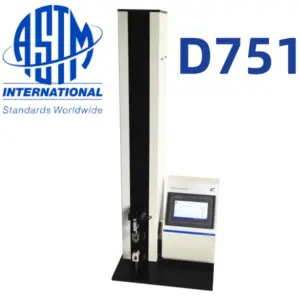
The fabric breaking strength is primarily determined using the grab test method, which measures the force required to break a fabric specimen by applying tension in a specific direction. The ASTM D751 standard requires that the specimen be clamped between two jaws of a testing machine. The specimen is then pulled until it breaks, and the maximum force applied is recorded as the fabric’s breaking strength.
Procedure:
Specimens of 102 mm (4 inches) wide and 152 mm (6 inches) long are cut from the coated fabric. The fabric is placed in the testing machine, and tension is applied at a uniform speed of 5 mm/s. The test measures both the longitudinal breaking strength (force applied along the fabric’s length) and transverse breaking strength (force applied across the fabric’s width).
Significance:
This test provides vital data on the fabric’s resistance to forces that could potentially tear the material during regular use, ensuring that the material can withstand stress during handling, shipping, and storage.
Elongation Tensile Strength: Measuring Material Stretchability
Another critical aspect of fabric performance is its ability to stretch without breaking, which is measured using the elongation tensile strength test. Elongation is the percentage increase in the length of the fabric before it breaks under tension.
Procedure:
Specimens are loaded into the testing machine, and a low initial load of 1.7 N is applied to prepare the fabric. The elongation is measured during the test, and the average elongation percentage is reported based on five individual specimens.
Significance:
Understanding elongation helps manufacturers design fabrics that maintain their integrity even under stretching or dynamic movement, which is essential for products like inflatable medical devices or flexible packaging materials.
Bursting Strength: Ball Burst and Diaphragm Burst Methods
Ball Burst Method:
A steel ball is used to apply pressure to the fabric until it bursts. This method measures the fabric’s resistance to internal pressure.
Diaphragm Burst Method:
In this method, hydraulic pressure is applied to the fabric using a diaphragm to simulate real-world conditions. The fabric’s ability to resist this pressure before rupturing is a key performance indicator.
Significance:
The bursting strength test is crucial for applications where fabrics may be exposed to high-pressure environments, such as tarps used in harsh weather conditions or inflatable products.
Tearing Strength of Fabric: Pendulum and Tongue Tear Methods
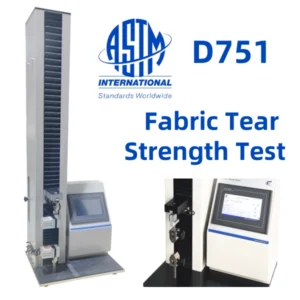
Tearing strength is another essential property for fabrics,
especially those used in applications where the material is subject to physical damage or abrasion.
ASTM D751 provides two methods for testing tearing strength:
Pendulum Method:
This method uses a pendulum to apply force to the fabric until it tears. The test measures the fabric’s resistance to tearing from a specific point.
Tongue Tear Method:
A specimen is clamped into the testing machine with a tongue cut into the fabric, and force is applied to initiate a tear.
The force required to propagate the tear is recorded.
Significance:
Tearing strength is critical for materials used in products like tents, tarps, and protective covers, which must resist rips and tears during regular use.
Puncture Resistance: Testing Fabric Durability Against Sharp Objects
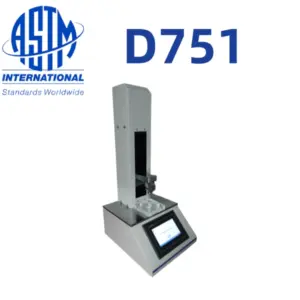
Puncture resistance is an essential test for fabrics used in environments where they may encounter sharp objects.
ASTM D751 requires a puncture resistance test using a piercing instrument shaped like a flat-tip screwdriver.
Procedure:
The fabric is mounted in a testing machine, and the piercing instrument is lowered onto the fabric at a consistent speed. The force required to puncture the fabric is measured.
Significance:
This test ensures that fabrics used in protective covers, medical devices, or packaging materials can withstand accidental punctures, protecting the integrity of the enclosed items.
Trapezoidal Tear Test: Evaluating Material Strength in Various Directions
그만큼 trapezoidal tear test is a method used to assess the fabric’s ability to resist tearing when subjected to forces applied at an angle. This test is particularly important for fabrics that are used in construction, automotive, or military applications, where the material might encounter sharp or uneven forces.
Procedure:
The fabric is cut into a trapezoidal shape and clamped into the testing machine. The force required to tear the fabric is recorded.
Significance:
The trapezoidal tear test measures how well the fabric can handle complex stresses, such as those encountered in dynamic environments.
ASTM D751 is an essential standard for evaluating the mechanical properties of coated fabrics, particularly in terms of breaking strength, elongation, bursting strength, and tear resistance. These tests ensure that materials used in packaging, medical devices, and other critical applications maintain their integrity under stress. By using accurate testing methods such as the grab test, ball burst, and trapezoidal tear test, manufacturers can ensure their fabrics perform well in real-world conditions.
 KO
KO  EN
EN  AR
AR  BG
BG  CS
CS  DA
DA  DE
DE  EL
EL  ES
ES  ET
ET  FI
FI  FR
FR  HU
HU  ID
ID  IT
IT  JA
JA  LT
LT  LV
LV  NB
NB  NL
NL  PL
PL  PT
PT  RO
RO  RU
RU  SK
SK  SL
SL  SV
SV  TR
TR  UK
UK