
Thin plastic films and flexible sheets are widely used in packaging, medical products, food packaging, industrial liners, agricultural films, and many other applications where tear resistance directly affects product performance and service life. A material that tears too easily may fail during manufacturing, transportation, or end use, while excessive tear resistance may influence converting operations such as easy-open packaging.
ISO 6383-2 specifies a standardized method for determining the tear strength of plastic film utilizzando il Metodo di Elmendorf, one of the most widely accepted techniques for evaluating tear propagation resistance. Rather than measuring the force required to initiate a crack, the standard evaluates the energy required to continue an existing tear under controlled conditions.
What is ISO 6383-2?
ISO 6383-2: Plastics — Film and Sheeting — Determination of Tear Resistance — Part 2: Elmendorf Method establishes a standardized procedure for measuring the force required to propagate a tear through a pre-cut specimen of thin flexible plastic film or sheeting.
Unlike tensile testing, which evaluates strength under continuous stretching, ISO 6383-2 focuses specifically on tear propagation. This provides valuable information for applications where accidental tearing may occur during handling or use.
Why Tear Resistance Matters
Il tear strength of plastic film directly influences product durability throughout its lifecycle.
By applying ISO 6383-2, manufacturers can monitor production consistency, compare material formulations, optimize film orientation, and verify compliance with customer specifications.
The Elmendorf Method Explained
Il Metodo di Elmendorf measures the energy required to propagate a tear after a specimen has already been slit.
Instead of pulling the specimen apart at a constant speed, the test uses a calibrated pendulum.
The basic principle includes:
- A specimen is prepared with a standardized precut slit.
- The specimen is clamped securely.
- A pendulum is released.
- The pendulum propagates the tear through a specified distance.
- Energy loss of the pendulum is converted into tear resistance.
Because the pendulum supplies a known amount of potential energy, the amount consumed during tearing can be accurately converted into force.
This makes the Resistenza allo strappo secondo il metodo Elmendorf test highly repeatable and suitable for routine laboratory quality control.
Elmendorf Tear Test Principle According to ISO 6383-2
The testing principle is straightforward.
A pendulum with specified geometry stores gravitational potential energy.
When released:
- The pendulum swings downward.
- It tears the specimen.
- Some of its energy is absorbed by the material.
- Remaining energy determines the tear resistance.
The result is expressed as the force required to propagate the tear, typically reported in newtons (N).
ISO 6383-2 Elmendorf Tear Test Procedure
Although laboratories should always follow the complete standard, the general testing workflow includes the following steps.
1. Instrument Preparation
Before testing:
- Verify the Tester di resistenza allo strappo Elmendorf is level.
- Check pendulum zero position.
- Confirm calibration.
- Select the appropriate pendulum capacity.
The tearing energy should typically fall between 20% and 80% of the pendulum capacity for optimum measurement accuracy.
2. Specimen Preparation
Specimens are prepared with:
- Standard dimensions
- Precisely cut slit
- Smooth edges
- Defined machine direction (MD) or transverse direction (TD)
Proper specimen preparation is essential for obtaining repeatable data.
3. Serraggio
The specimen is positioned between fixed and movable jaws.
The slit must be centered accurately between the clamps.
Poor alignment may produce invalid tear paths.
4. Pendulum Release
The pendulum is released without operator interference.
The stored energy propagates the tear through the specified distance.
The instrument records the tearing force automatically.
5. Result Evaluation
Secondo ISO 6383-2, laboratories should:
- Record individual tear resistance values
- Calculate the arithmetic mean
- Report separate values for MD and TD when required
If tearing deviates excessively from the specified path, the result should be rejected and additional specimens tested.
Selecting an Elmendorf Tear Tester
An effective Tester di resistenza allo strappo Elmendorf should provide repeatable measurements while minimizing operator influence.
Important selection criteria include:
- Capacità dei pendoli multipli
- Struttura meccanica stabile
- Accurate pendulum release
- Reliable specimen clamping
- Calcoli statistici automatici
- Calibration verification
- Data export capability
- Compliance with international standards
For laboratories performing routine testing of plastic films, automation features can significantly improve testing efficiency and repeatability.
Cell Instruments SLD-01 Elmendorf Tear Tester
For laboratories conducting ISO 6383-2 test, il Cell Instruments SLD-01 Elmendorf Tear Tester is designed to provide accurate and repeatable measurements for the tear strength of plastic film and other flexible materials.
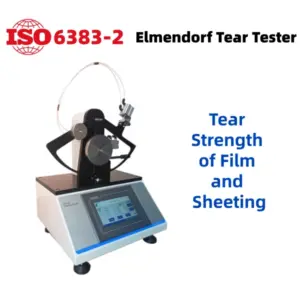
Key technical features include:
- Controllo tramite PLC con interfaccia HMI touchscreen for intuitive operation and stable industrial performance.
- Bloccaggio pneumatico del campione to ensure consistent gripping pressure and reduce operator variability.
- Sgancio automatico del pendolo for improved repeatability.
- Integrated calibration weight for verifying multiple force ranges.
- Automatic statistical analysis to display average results efficiently.
- Optional professional software for advanced reporting and data management.
- Optional micro-printer and RS-232 interface for traceability and data export.
- Optional paper-industry units including mN and tear index outputs.
Available pendulum capacities include 200, 400, 800, 1600, 3200, and 6400 gf, enabling the instrument to accommodate a broad range of film tear resistance values.
These features make the SLD-01 suitable for quality control laboratories, production facilities, research institutes, and third-party testing organizations seeking reliable compliance with ISO 6383-2 and similar tear testing standards.
If your laboratory requires accurate ISO 6383-2 tear resistance testing, selecting a reliable Tester di resistenza allo strappo Elmendorf is essential for obtaining repeatable and traceable results. The Cell Instruments SLD-01 Elmendorf Tear Tester combines automated operation, precise pendulum control, pneumatic clamping, and intelligent data processing to support efficient quality control and research. Explore our material testing solutions to identify the right configuration for your plastic film testing applications.
 IT
IT  EN
EN  AR
AR  BG
BG  CS
CS  DA
DA  DE
DE  EL
EL  ES
ES  ET
ET  FI
FI  FR
FR  HU
HU  ID
ID  JA
JA  KO
KO  LT
LT  LV
LV  NB
NB  NL
NL  PL
PL  PT
PT  RO
RO  RU
RU  SK
SK  SL
SL  SV
SV  TR
TR  UK
UK  HE
HE  TH
TH  VI
VI