
Understanding ASTM D6636 in Geomembrane Testing
ASTM D6636 defines a standardized method to evaluate the ply adhesion strength of reinforced geomembranes. Engineers and quality control professionals rely on this method to assess how strongly different layers (plies) bond within composite geomembranes.
Reinforced geomembranes often consist of multiple layers, including coatings and internal fabrics. The integrity of these layers directly affects durability, waterproofing performance, and long-term reliability in demanding environments such as landfills, mining sites, and water containment systems.
Unlike general tensile tests, ASTM D6636 focuses specifically on interlayer bonding, making it a critical index test for material acceptance and quality assurance.
Geomembrane Ply Adhesion Strength Test
El geomembrane ply adhesion strength test under ASTM D6636 measures the force required to separate bonded plies using a 180° peel configuration.
Core Principle
Operators manually separate the specimen for a short distance (typically 25–50 mm), then mount it in a tensile testing machine. The system pulls the plies apart at a constant speed while recording force and displacement.
Key Testing Conditions
- Peel angle: 180°
- Velocidad de prueba: 50 mm/min
- Environment: 21°C ± 2°C, 50–70% RH
- Measurement length: ≥100 mm
These controlled conditions ensure repeatability and comparability across laboratories.
Geomembrane Peel Test Procedure and Data Interpretation
Procedimiento paso a paso
- Prepare the specimen and pre-separate the plies.
- Clamp both ends securely to avoid slippage or twisting.
- Maintain a consistent 180° peel angle.
- Start the test and record force continuously.
- Observe failure mode (adhesive separation or material tearing).
Important Considerations
- Uniform tension distribution ensures valid results.
- Tearing instead of peeling indicates adhesion exceeds material strength.
- Multiple test points improve statistical reliability.
Result Interpretation
The test calculates adhesion strength using:
- Force per unit width (N/m or lb/in)
Higher values indicate stronger bonding between layers.
Critical Insight:
If repeated tearing occurs, the actual adhesion strength exceeds measurable limits. This scenario often reflects excellent bonding performance but requires careful reporting.
Ply Adhesion Testing Equipment
Fiable ply adhesion testing equipment plays a decisive role in achieving accurate and repeatable results.
Recommended Solution: Cell Instruments Tensile Tester
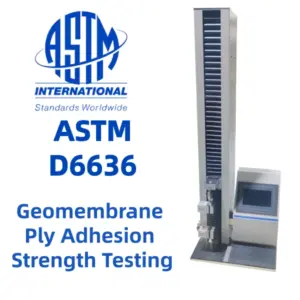
For ASTM D6636 applications, the Instrumentos celulares Probador de tracción TST-01 provides a robust and flexible testing platform.
Why It Fits ASTM D6636 Requirements
- Precise Speed Control (1–500 mm/min)
Ensures compliance with the standard 50 mm/min requirement. - High Accuracy (0.5% FS)
Delivers dependable force measurements for adhesion calculations. - Stable Mechanical System
Ball screw drive guarantees smooth and consistent peel motion. - Multi-Fixture Capability
Admite 180° peel tests, tensile tests, and additional material evaluations. - Real-Time Data Visualization
PLC and HMI interface enable operators to monitor curves and detect anomalies instantly.
Practical Advantage
Using a dedicated tensile tester reduces variability caused by manual handling and improves data reproducibility, which is essential for compliance and certification.
Why ASTM D6636 Matters for Quality Control
ASTM D6636 serves as a benchmark for evaluating manufacturing consistency and product reliability.
Aplicaciones clave
- Incoming material inspection
- Production quality monitoring
- Product development and comparison
- Compliance verification between suppliers and buyers
Industry Value
Manufacturers and buyers often agree on minimum adhesion thresholds. This standard ensures both parties can objectively verify whether materials meet contractual specifications.
Ensure accurate geomembrane performance evaluation with ASTM D6636 testing. Using a precision tensile tester, operators can measure ply adhesion strength through controlled 180° peel testing under standardized conditions. This method provides reliable data for quality control, product development, and compliance verification. Upgrade your testing capability with advanced equipment designed for stability, repeatability, and efficiency to meet modern material testing demands.
Preguntas frecuentes (FAQ)
1. What does ASTM D6636 measure?
It measures the force required to separate bonded layers in reinforced geomembranes using a 180° peel test.
2. What is the standard test speed in ASTM D6636?
The method specifies a constant speed of 50 mm/min throughout the test.
3. What happens if the specimen tears during testing?
Tearing indicates that adhesion exceeds the material strength. The result should be reported accordingly.
4. Why is a 180° peel angle used?
A 180° configuration provides consistent stress distribution and reliable adhesion measurement.
5. What equipment is required for ASTM D6636?
A tensile testing machine with peel fixtures, such as the Cell Instruments TST-01, is essential for accurate testing.
 ES
ES  EN
EN  AR
AR  BG
BG  CS
CS  DA
DA  DE
DE  EL
EL  ET
ET  FI
FI  FR
FR  HU
HU  ID
ID  IT
IT  JA
JA  KO
KO  LT
LT  LV
LV  NB
NB  NL
NL  PL
PL  PT
PT  RO
RO  RU
RU  SK
SK  SL
SL  SV
SV  TR
TR  UK
UK  HE
HE  TH
TH  VI
VI