
Burst Strength: Bursting Strength Tester
ASTM F1140 ASTM F2054
Einführung
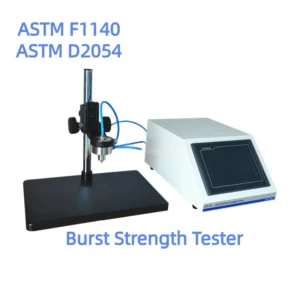 Burst strength is a critical measure of package integrity and durability, indicating a package’s ability to withstand internal pressure without failure. For manufacturers, underst
anding burst strength is essential to ensure that materials, seals, and overall package designs comply with regulatory standards and protect the end-user. Following standardized methods such as ASTM F1140 Und ASTM F2054 allows businesses to evaluate packaging consistently and reduce the risk of costly recalls, product contamination, or compromised sterility.
Test a Pack Burst Tester: Key Methods and Applications
Mit einem test a pack burst tester, quality control and R&D teams can perform detailed assessments of flexible and rigid packaging. Key testing methods include:
- Burst Test (ASTM F1140 Method A): Internally pressurizes the package until it fails, measuring the maximum pressure at rupture.
- Creep Test (ASTM F1140 Method B1): Maintains internal pressure for a set duration to observe deformation tendencies and potential weaknesses.
- Creep to Failure (ASTM F1140 Method B2): Holds pressure until the package fails, providing insight into the time-dependent strength of materials and seals.
These testing methods are widely used across medical device packaging, pharmaceutical packs, food and beverage pouches, Und consumer goods packaging, ensuring consistent safety and regulatory compliance throughout production and distribution.
Equipment and Apparatus
A professional burst strength testing apparatus must include:
- High-accuracy pressure sensors to capture precise internal pressure data.
- Controlled pressurization systems capable of both steady and increasing pressure rates.
- Flexible configurations for open and closed packages, suitable for both in-process and finished product testing.
- Restraining plates for evaluating seal integrity according to ASTM F2054, limiting package expansion while testing seal strength.
Der Cell Instruments Burst Tester provides all these capabilities with high repeatability, supporting laboratories and production lines in conducting reliable burst strength tests on a wide range of packaging types.
Sampling and Conditioning
Reliable testing depends on proper sampling and conditioning:
- Select a sufficient number of specimens to ensure statistically representative results.
- Avoid indiscriminate removal of packages with minor visual defects, as this may bias results.
- Condition packages according to ASTM E171, maintaining consistent temperature and humidity prior to testing.
- Document all environmental factors if testing outside standard conditions to ensure accurate comparison.
Schritt-für-Schritt-Prüfverfahren
Open Package Test: Place the package without restricting its natural expansion, initiate pressurization, and monitor for failure points. Record the internal pressure at burst and the type of failure (material or seal).
Closed Package Test: Insert the pressurization device at the center of the fully sealed package. Gradually increase internal pressure until rupture occurs. Document the pressure and location of failure to assess overall package integrity.
ASTM F2054 Seal Testing: Using restraining plates, the package is pressurized while restricting expansion. The seal area is left unrestricted to determine minimum burst strength, providing rapid and reliable evaluation of seal performance during manufacturing.
Best Practices for Reliable Results
- Maintain consistent pressurization parameters, rate, and setup across all samples.
- Datensatz package preparation, conditioning, and failure type for accurate comparison.
- Combine burst and creep testing to evaluate both immediate and long-term package performance.
- Test both in-process samples and finished products to ensure full lifecycle validation
Branchenübergreifende Anwendungen
Burst strength testing ensures packaging safety and compliance in:
- Medizinische Geräte: Sterile pouches, syringes, and blister packs.
- Pharmazeutika: Unit-dose packs, foil-sealed bags, and sachets.
- Food & beverages: Flexible pouches, vacuum-sealed packaging, and portion-controlled packs.
- Consumer goods: Daily chemical products, electronics, and personal care packaging.
Abschluss
Der burst strength test is an essential tool for maintaining packaging integrity, protecting end-users, and ensuring compliance with ASTM F1140 Und ASTM F2054 standards. Using a reliable test a pack burst tester, such as the Cell Instruments Burst Tester, allows manufacturers to achieve precise, repeatable, and standard-compliant results. By integrating burst strength testing into production workflows, companies can enhance quality control, improve product safety, and safeguard brand reputation—ensuring that every package reaches the customer in optimal condition.
 DE
DE  EN
EN  AR
AR  BG
BG  CS
CS  DA
DA  EL
EL  ES
ES  ET
ET  FI
FI  FR
FR  HU
HU  ID
ID  IT
IT  JA
JA  KO
KO  LT
LT  LV
LV  NB
NB  NL
NL  PL
PL  PT
PT  RO
RO  RU
RU  SK
SK  SL
SL  SV
SV  TR
TR  UK
UK