
Flexible packaging materials often experience repeated bending, folding, squeezing, and deformation during manufacturing, transportation, storage, and end use. These mechanical stresses can gradually weaken the material structure and reduce its functional performance. ISO 7854 provides a standardized approach for evaluating the resistance of coated fabrics and flexible sheet materials to repeated flexing and crumpling actions, helping manufacturers understand durability behavior under simulated handling conditions.
Den ISO 7854 crumple flex test is widely used to assess how flexible materials respond to repeated mechanical deformation. By applying controlled folding and flexing movements, the test reveals changes in material appearance, coating integrity, and structural durability. For laboratories and quality control departments, selecting a reliable flex tester designed for repeatable ISO 7854 evaluation is essential for obtaining meaningful test data and improving material reliability.
For manufacturers of coated films, flexible laminates, synthetic materials, and industrial fabrics, ISO 7854 testing provides valuable information during material development, supplier evaluation, and production quality control.
Why ISO 7854 Testing Is Important for Flexible Materials
Flexible materials are designed to withstand movement and deformation, but repeated mechanical stress can create gradual damage that is not always visible during normal inspection. A material may maintain acceptable appearance after a single bending action but experience performance degradation after hundreds or thousands of repeated flexing cycles.
The purpose of ISO 7854 is to simulate these repeated mechanical stresses in a controlled laboratory environment. The test helps engineers evaluate:
- Resistance to repeated folding and flexing
- Coating adhesion and surface durability
- Formation of cracks, wrinkles, or surface damage
- Changes in physical appearance after mechanical fatigue
- Suitability of materials for demanding applications
A standardized crumple flex test allows manufacturers to compare different material formulations, evaluate processing improvements, and select materials with better long-term durability.
For industries where material failure can affect product protection or service performance, flex resistance testing becomes an important part of product validation.
Understanding the ISO 7854 Crumple Method
Den ISO 7854 crumple method evaluates material durability by repeatedly deforming a specimen through controlled mechanical movements. Instead of applying a simple single-direction bend, the test creates complex deformation patterns similar to real-world handling conditions.
During practical use, flexible materials rarely experience only one type of stress. Packaging films, coated sheets, and flexible substrates may be compressed, folded, twisted, and stretched simultaneously. The ISO 7854 approach reproduces these repeated deformation effects to provide a more realistic assessment of material endurance.
The general testing concept includes:
- Preparing test specimens according to the required dimensions.
- Installing the specimen into the testing device.
- Applying repeated crumpling or flexing movements.
- Completing a defined number of cycles.
- Inspecting the specimen for damage or evaluating changes in performance.
The exact evaluation criteria depend on the material type and application requirements. Engineers may examine visible cracking, coating failure, loss of appearance, or other physical changes after testing.
Test Principle of ISO 7854 Flex Resistance Evaluation
The basic principle behind ISO 7854 testing is mechanical fatigue assessment.
When a flexible material undergoes repeated deformation, internal stresses accumulate within the material structure. These stresses may cause:
- Micro-crack formation
- Coating separation
- Surface deterioration
- Loss of flexibility
- Reduced protective performance
A laboratory flex tester applies controlled repeated movements while maintaining consistent test conditions. This reduces operator variation and allows manufacturers to compare material performance objectively.
The main factors affecting ISO 7854 test results include:
| Test Factor | Influence on Results |
|---|---|
| Material composition | Determines resistance to repeated deformation |
| Coating structure | Affects crack formation and surface durability |
| Number of cycles | Indicates fatigue resistance level |
| Flexing speed | Influences mechanical stress applied to the specimen |
| Temperature and environment | May affect material flexibility and failure behavior |
Controlling these parameters is important for generating reliable and repeatable laboratory data.
How a Professional Flex Tester Supports ISO 7854 Testing
A dedicated flex tester provides controlled mechanical movement, consistent testing conditions, and repeatable evaluation results. Compared with manual folding or bending methods, automated testing equipment improves laboratory efficiency and reduces differences caused by operator handling.
A suitable ISO 7854 testing system typically provides:
Precise Mechanical Control
The equipment controls movement speed, deformation cycles, and testing duration to maintain consistent conditions between different tests.
Repeatable Testing Performance
Automated operation ensures that every specimen experiences similar mechanical stress, improving comparison accuracy between materials.
Efficient Quality Control
For manufacturers testing multiple materials or production batches, automated flex testing reduces testing time and supports faster quality decisions.
Flexible Testing Configurations
Modern testing systems can support different specimen fixtures and customized setups based on material characteristics and application requirements.
Cell Instruments provides material testing solutions with customized fixtures and testing configurations to support different flexible material evaluation requirements.
Advantages of ISO 7854 Testing for Material Development
Implementing ISO 7854 testing provides several benefits throughout the product development process.
Material Selection
Engineers can compare different raw materials and identify structures with improved resistance to repeated deformation.
Product Improvement
Test results help R&D teams optimize:
- Film thickness
- Coating formulation
- Lamination structure
- Processing conditions
Kvalitetssikring
Manufacturers can establish testing procedures for incoming inspection, production monitoring, and final product verification.
Customer Requirement Support
Reliable flex resistance data helps demonstrate product durability and supports communication with customers requiring performance validation.
ISO 7854 Compared with Other Flex Testing Methods
Different flex testing methods evaluate different types of mechanical stress. Choosing the correct method depends on the material application and failure mode being studied.
| Prøvningsmetode | Main Evaluation Focus | Typical Application |
|---|---|---|
| ISO 7854 | Repeated crumpling and flex fatigue resistance | Flexible sheets, coated materials |
| Gelbo flex testing | Barrier performance after repeated flexing | Packaging barrier films |
| Folding endurance testing | Repeated folding resistance | Paper and sheet materials |
| Tensile testing | Strength and elongation properties | Films, plastics, composites |
ISO 7854 focuses on deformation durability rather than only measuring strength. This makes it valuable for materials that experience frequent movement during use.
Selecting the Right ISO 7854 Testing Equipment
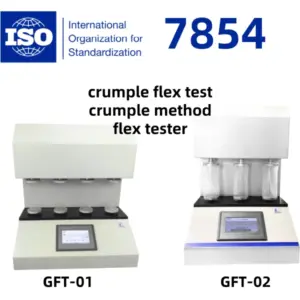
When choosing equipment for ISO 7854 evaluation, laboratories should consider several factors:
- Compatibility with required test procedures
- Accuracy of movement control
- Adjustable testing parameters
- Ease of specimen installation
- Data repeatability
- Long-term equipment reliability
A professional flex tester should provide stable mechanical operation and allow engineers to obtain consistent results for research, quality control, and production verification.
For companies with specialized materials or unique testing requirements, customized fixtures and automated testing solutions can further improve testing efficiency.
Related Standards for Flexible Material Testing
ISO 7854 is commonly considered together with other material durability and performance evaluation standards. Depending on the application, manufacturers may combine flex testing with barrier, strength, or environmental resistance testing.
Related standards may include:
- ISO 7854 – Rubber- or plastics-coated fabrics — Determination of resistance to damage by flexing
- ASTM F392 – Flex durability testing of flexible barrier materials
- ISO 8295 – Plastics — Film and sheeting — Determination of coefficient of friction
- ASTM D882 – Tensile properties of thin plastic sheeting
- ASTM D1894 – Static and kinetic coefficients of friction of plastic film and sheeting
Using multiple testing methods provides a more complete understanding of material performance.
ISO 7854 provides an effective method for evaluating how flexible materials withstand repeated mechanical deformation. Through controlled crumpling and flexing actions, manufacturers can identify material weaknesses, improve product designs, and ensure long-term performance.
En pålidelig ISO 7854 flex tester helps laboratories achieve consistent test conditions, accurate evaluation, and efficient quality control. For industries producing flexible packaging, coated materials, and technical substrates, flex resistance testing is an important tool for improving durability and maintaining product reliability.
Cell Instruments offers professional material testing solutions, including customized fixtures and laboratory systems designed to support flexible material evaluation requirements.
 DA
DA  EN
EN  AR
AR  BG
BG  CS
CS  DE
DE  EL
EL  ES
ES  ET
ET  FI
FI  FR
FR  HU
HU  ID
ID  IT
IT  JA
JA  KO
KO  LT
LT  LV
LV  NB
NB  NL
NL  PL
PL  PT
PT  RO
RO  RU
RU  SK
SK  SL
SL  SV
SV  TR
TR  UK
UK  HE
HE  TH
TH  VI
VI