
Sutherland Rub Testing Method
ASTM D5264
Ensuring that printed materials withstand abrasion during transportation, handling, and storage is critical for maintaining product quality and legibility. The Sutherland rub test provides a standardized method for evaluating the abrasion resistance of printed labels, packaging, and substrates. This article will guide you through the complete ink rub test procedure and help you understand how to determine rub resistance, in line with the ASTM D5264 standard.
Introduction to the Sutherland Rub Test
The Sutherland rub test is a widely accepted method for measuring the durability of printed materials under repeated rubbing. This test simulates real-world abrasion that might occur due to friction during shipping or consumer use. It helps assess the rub resistance of printed inks, coatings, and substrates, ensuring they meet quality and durability standards.
The test uses a device called a Sutherland Rub Tester, which applies controlled, repetitive strokes between a printed specimen and a receptor. After the test, users evaluate the specimen for print degradation and the receptor for ink transfer.
Importance of Rub Resistance in Printed Materials
In many industries—such as food packaging, pharmaceuticals, cosmetics, and logistics—the durability of printed information is non-negotiable. Labels must remain legible and free from smudging or wear.
Key reasons to evaluate rub resistance include:
- Maintaining brand appearance and regulatory information.
- Reducing product returns due to illegible labels.
- Ensuring compliance with durability specifications.
The Sutherland rub test, as defined in ASTM D5264, offers a reproducible and reliable method to measure this critical attribute.
Ink Rub Test Procedure According to ASTM D5264
Equipment and Environment
To perform a standardized rub resistance test, you need:
- Sutherland Rub Tester, such as Cell Instruments’ RT-01 Rub Tester.
- Rubber pad and receptor block.
- Pressure-sensitive tape or clamps.
- Standard substrate or unprinted sheet receptor.
Testing should occur in a controlled environment: 23 ± 1°C and 50 ± 2% relative humidity, as defined in ASTM D4332.
Sample Preparation
- Specimen Size: 76 × 152 mm (3 × 6 in.), flat and clean.
- Ink Coverage: Ensure uniform ink density across all specimens.
- Receptor Material: Choose based on the product—unprinted sheet, printed identical substrate, or pressure-sensitive tape.
- Conditioning: Let specimens rest under test conditions for at least 24 hours.
Test Setup
- Mount the specimen face-up on the rubber pad of the tester’s base.
- Attach the receptor to the weight block using clamps or tape.
- Select the appropriate weight (2 lb or 4 lb) depending on abrasion severity.
- Brush off dust with an anti-static brush.
- Set the number of strokes, typically 25–100 depending on product requirements.
- Start the test, and the tester will automatically stop after completing the strokes.
Evaluation
- Inspect the test specimen for visible print degradation.
- Analyze the receptor for ink transfer.
- Compare against a reference standard under identical conditions.
Test results must be documented with conditions and evaluation criteria for clear traceability and repeatability.
Selecting the Right Rub Tester
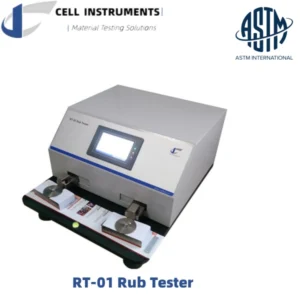
For consistent and accurate testing, using a precise and reliable instrument is essential. The RT-01 Rub Tester by Cell Instruments is designed specifically for Sutherland rub test applications, complying with ASTM D5264 and similar global standards. Its features include:
- Adjustable stroke counts and weights.
- Compatibility with various receptor types.
- Stable mechanical system for repeatable results.
The RT-01 is ideal for labs and production lines where rub durability is a key quality parameter.
Applications of the Sutherland Rub Test
The test is widely applied across industries:
- Food and beverage: ensuring barcode and expiry date readability.
- Pharmaceuticals: validating label integrity under storage and transport.
- Cosmetics and personal care: assessing ink and coating resistance to handling.
- Consumer goods and logistics: testing print durability on cartons and shipping labels.
Its ability to simulate realistic abrasion conditions makes it a critical tool in quality assurance.
Best Practices for Accurate Rub Resistance Testing
To enhance accuracy:
- Replace rubber pads periodically to avoid distortion.
- Avoid excessive strokes that may cause heat build-up.
- Use consistent ink types and densities across test specimens.
- Record environmental conditions and specimen details for traceability.
Conclusion
 The Sutherland rub test, when implemented according to ASTM D5264, provides a reliable method for evaluating the rub resistance of printed materials. It enables manufacturers and quality control professionals to ensure that product information remains intact through the product lifecycle.
For precise, repeatable, and compliant rub resistance testing, we recommend the RT-01 Rub Tester by Cell Instruments. With robust design and easy operation, it is the preferred choice for packaging, medical, and labeling industries worldwide.
 EN
EN  AR
AR  BG
BG  CS
CS  DA
DA  DE
DE  EL
EL  ES
ES  ET
ET  FI
FI  FR
FR  HU
HU  ID
ID  IT
IT  JA
JA  KO
KO  LT
LT  LV
LV  NB
NB  NL
NL  PL
PL  PT
PT  RO
RO  RU
RU  SK
SK  SL
SL  SV
SV  TR
TR  UK
UK