
ISO 12048 Compression Tester
In industries such as medical devices, pharmaceuticals, food, and logistics, packaging failure can lead to significant losses and safety risks. One of the most effective ways to prevent this is through the use of an ISO 12048 compression tester, which provides standardized, repeatable methods for evaluating the structural resilience of packaging materials. This article explains how these testers work, how they align with international standards, and how they support high-precision packaging compressive strength testing across various industries.
Understanding the Importance of ISO 12048 Compression Tester
The ISO 12048 compression tester plays a pivotal role in packaging engineering. It is specifically designed to simulate vertical stacking forces that packages endure during storage and transportation. This testing is crucial for verifying whether a packaging system can sustain compression loads without deforming, collapsing, or compromising product safety.
Unlike generic load-bearing devices, ISO 12048-compliant testers adhere to strict performance guidelines, such as:
Force accuracy within ±2%
Parallelism of platens within 1:1000
Constant test speed at (10 ± 3) mm/min
Continuous force-deformation data recording
These requirements ensure that test results are not only accurate but also internationally comparable—vital for global supply chains and regulatory audits.
Packaging Compressive Strength Testing: Core Applications and Process
Packaging compressive strength testing involves applying a vertical force to a fully packed sample until it either deforms, collapses, or reaches a predefined threshold. The goal is to assess how well a packaging design can protect its contents when stacked or under load.
This method applies to various packaging types including:
Infusion bags and blood bags
Plastic bottles and laminated film pouches
Corrugated boxes, trays, and cups
Composite medical packaging
At Cell Instruments, we offer the PCT-01 Package Compression Tester—a powerful tool engineered for this exact purpose.
Step-by-Step: Conducting a Standardized Compression Test
To ensure compliance with ISO 12048, follow these essential steps:
1. Sample Conditioning
Before testing, all specimens must be conditioned for at least 48 hours at 23°C and 50% relative humidity. This ensures consistency by stabilizing moisture content and mechanical properties.
2. Instrument Setup
Position the sample securely between parallel compression platens. Misalignment can cause stress concentrations and inaccurate readings.
3. Parameter Configuration
Set the test to one of the following endpoints:
A specified maximum load
A defined deformation level
Complete collapse
Configure the compression speed at 10 mm/min ±3 mm/min, and ensure overload protection and emergency stop features are active.
4. Test Execution
Start the test. The machine will compress the sample while recording a force-deformation curve in real time.
5. Data Analysis
Interpret results by identifying:
Peak force sustained before failure
Percent deformation
Failure mode (buckling, rupture, or leakage)
How Cell Instruments’ PCT-01 Elevates Packaging Strength Testing
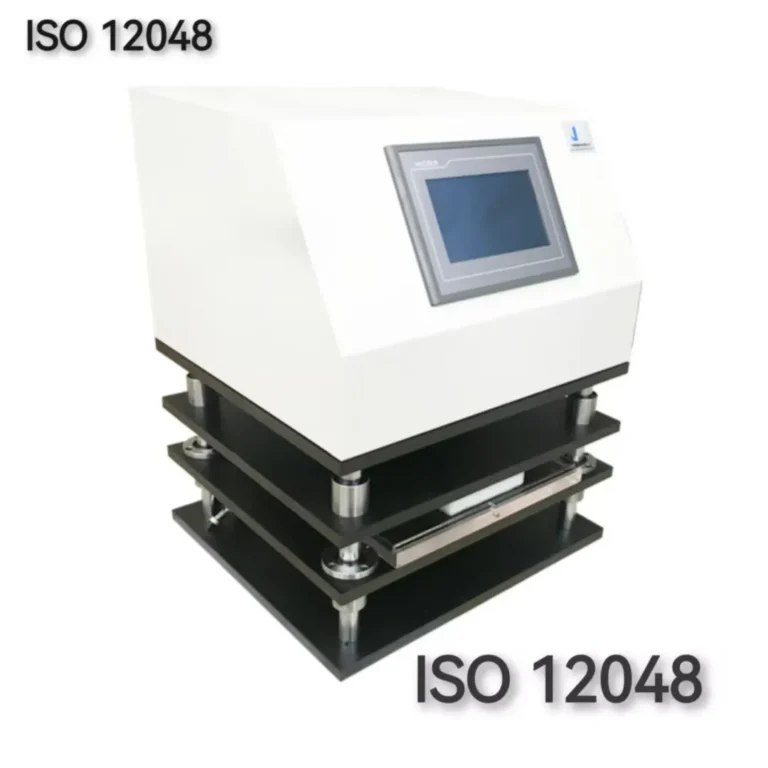
The PCT-01 Package Compression Tester from Cell Instruments offers superior performance for ISO 12048 compression tests, with tailored features that address real-world industry needs:
HMI touchscreen interface for easy parameter setting
Industrial PLC control for stability and precision
Two test modes: bursting force and constant pressure
Automatic pressure compensation for repeatable results
Built-in liquid collection tray for testing flexible packaging (e.g., infusion bags)
Customizable platen dimensions for non-standard samples
Optional RS232 port and PC software for seamless data export and analysis
This instrument supports both quality control labs and R&D teams in sectors where packaging performance directly impacts patient safety, product integrity, and regulatory compliance.
Standard References: ISO 12048 and ASTM D642
Both ISO 12048 and ASTM D642 define methodologies for compression and stacking tests. These standards are essential for:
Packaging design validation
Material comparison
Supply chain robustness
Regulatory submission
Key points from ISO 12048 include:
Continuous recording of force vs. deformation
Detailed reporting of test speed, preconditioning, and failure mode
Evaluation of structural integrity and protection performance
Adhering to these standards enhances credibility and ensures global compliance—especially for exporters or contract manufacturers.
Conclusion
An ISO 12048 compression tester is not just a tool—it’s a gateway to better packaging performance, fewer product losses, and stronger regulatory confidence. By mastering packaging compressive strength testing, companies can make data-driven decisions, optimize material usage, and enhance the durability of their packaging designs.
Cell Instruments provides world-class testing solutions that are accurate, reliable, and standard-compliant. Whether you’re developing packaging for infusion bags or shipping cartons, the PCT-01 will empower your team to achieve precise, repeatable results that stand up to global demands.
 EN
EN  AR
AR  BG
BG  CS
CS  DA
DA  DE
DE  EL
EL  ES
ES  ET
ET  FI
FI  FR
FR  HU
HU  ID
ID  IT
IT  JA
JA  KO
KO  LT
LT  LV
LV  NB
NB  NL
NL  PL
PL  PT
PT  RO
RO  RU
RU  SK
SK  SL
SL  SV
SV  TR
TR  UK
UK