
Geosynthetics Thickness Testing
ASTM D5199 & ISO 9863-1 & ASTM D5994
Bu geosynthetics thickness test is a fundamental evaluation used to determine one of the most essential physical characteristics of geosynthetic materials—thickness. Accurate thickness measurement directly impacts the material’s performance, durability, and compliance with international standards. Whether in geomembranes, geotextiles, or geocomposites, understanding the test methods and their implications ensures consistent product quality and reliable application performance.
Importance of Measuring the Thickness of Geosynthetics
Bu thickness of geosynthetics is more than a simple dimensional property—it is a key quality control indicator. Thickness affects permeability, tensile strength, puncture resistance, and mechanical stability under load. For instance, in landfill liners or drainage layers, even slight variations in thickness can influence fluid flow and containment efficiency.
Maintaining uniform thickness across production batches helps manufacturers comply with project specifications and ensures long-term field performance. Testing the thickness also supports design calculations and quality assurance processes, making it a critical step in geosynthetic evaluation.
Key Standards – ASTM D5199 & ISO 9863-1 & ASTM D5994
Accurate geosynthetics thickness test procedures are guided by established international standards such as ASTM D5199, ASTM D5994, and ISO 9863-1. Each provides a structured method to measure different types of geosynthetic materials under controlled conditions.
ASTM D5199 – Nominal Thickness of Geosynthetics
ASTM D5199 outlines standardized methods for determining the nominal thickness of geosynthetics under a specific pressure and presser foot diameter. It is widely applicable to geotextiles, geomembranes (excluding textured ones), and geonets.
- The measurement is taken as the distance between two parallel plates after applying a specified load for 5 seconds.
- The standard identifies three procedures:
- Procedure A: For geotextiles and planar drainage materials under 2 kPa pressure.
- Procedure B: For geomembranes under 20 kPa pressure.
- Procedure C: Custom settings for special materials or research applications.
This standard ensures comparability and repeatability in results, making it ideal for production and quality control environments.
ASTM D5994 – Core Thickness of Textured Geomembranes
ASTM D5994 specifically targets textured geomembranes, which have surface patterns or structures. These materials require different testing conditions because the presser foot cannot make full contact with their uneven surfaces.
- The test focuses on the core thickness, measured at the “valleys” of the textured surface using gauge points with a fixed pressure of 0.56 ± 0.05 N.
- Three measurements are taken per specimen, and the lowest reading represents the true thickness.
This method ensures that measurement focuses on the core material, eliminating distortion caused by surface irregularities.
ISO 9863-1 – Determination of Thickness Under Specified Pressure
ISO 9863-1 is an internationally recognized standard used mainly for geotextiles and related products. It prescribes measuring the thickness of specimens under defined pressures and times to ensure global uniformity.
- The method requires testing at multiple pressures, commonly 2 kPa and 20 kPa, to evaluate compressibility and load response.
- Results from ISO 9863-1 are often used for international trade and certification due to its global acceptance.
Together, these standards create a complete framework for testing all types of geosynthetics, whether smooth, textured, or composite.
Practical Testing Considerations
Several factors influence the accuracy of geosynthetics thickness test results:
- Specimen conditioning: Samples should be tested in a standard atmosphere to ensure stability.
- Applied pressure: Higher pressures may compress the material and yield smaller thickness values.
- Handling: Excessive tension or deformation during preparation can alter results.
- Instrument precision: The measurement system must have fine resolution and stable contact control.
To achieve reliable and reproducible results, laboratories and manufacturers rely on advanced testing equipment.
Recommended Instrument: Cell Instruments FTT-01 Thickness Tester
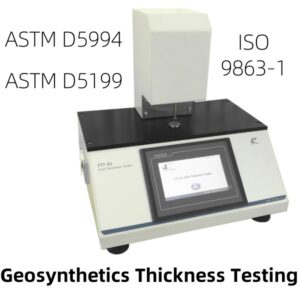
For accurate and efficient testing, the Hücre Enstrümanları FTT-01 Thickness Tester is a highly recommended solution. Designed for laboratory and production applications, it provides:
- High-precision measurement resolution (up to 0.001 mm)
- Customizable pressure range to meet ASTM D5199, ASTM D5994, and ISO 9863-1 requirements
- Automatic lifting presser foot and digital display for easy operation
- Stable contact pressure to minimize material deformation
This instrument ensures repeatable results across various geosynthetic products, from smooth geomembranes to nonwoven geotextiles. Its robust structure and intelligent control system make it suitable for research laboratories, quality control departments, and industrial production lines.
Bu geosynthetics thickness test is essential for evaluating the quality and performance of geosynthetic materials in construction, environmental, and civil engineering applications. By following standardized procedures such as ASTM D5199, ASTM D5994, and ISO 9863-1, manufacturers and laboratories can ensure accurate, consistent, and comparable results.
With advanced instruments like the FTT-01 Thickness Tester itibaren Hücre Enstrümanları, users can perform reliable measurements that support product development, quality control, and compliance with international standards.
SSS
1. Why is thickness testing important for geosynthetics?
Thickness testing determines a geosynthetic’s ability to resist stress, provide filtration, or maintain impermeability. Consistent thickness ensures the material performs its intended function effectively in construction and environmental applications.
2. What is the difference between ASTM D5199 and ASTM D5994?
ASTM D5199 is used for smooth geosynthetics such as geotextiles and non-textured geomembranes, while ASTM D5994 specifically measures the core thickness of textured geomembranes where surface irregularities affect measurements.
3. How does ISO 9863-1 differ from ASTM D5199?
ISO 9863-1 is an international standard primarily used for geotextiles, measuring thickness under defined pressures to evaluate compressibility. ASTM D5199 focuses more broadly on geosynthetics, providing multiple procedures for different material types.
4. What factors affect the accuracy of a geosynthetics thickness test?
Accuracy depends on specimen conditioning, applied pressure, material compressibility, and instrument precision. Using stable, calibrated equipment such as the FTT-01 Thickness Tester helps reduce variation and ensures reliable results.
5. Which instrument is recommended for performing standard-compliant thickness tests?
Bu Cell Instruments FTT-01 Thickness Tester is recommended because it meets ASTM D5199, ASTM D5994, and ISO 9863-1 requirements, offering high accuracy, customizable pressure, and easy operation for laboratory and industrial environments.
 TR
TR  EN
EN  AR
AR  BG
BG  CS
CS  DA
DA  DE
DE  EL
EL  ES
ES  ET
ET  FI
FI  FR
FR  HU
HU  ID
ID  IT
IT  JA
JA  KO
KO  LT
LT  LV
LV  NB
NB  NL
NL  PL
PL  PT
PT  RO
RO  RU
RU  SK
SK  SL
SL  SV
SV  UK
UK