
ISO 8113
Top Load Test
Inledning
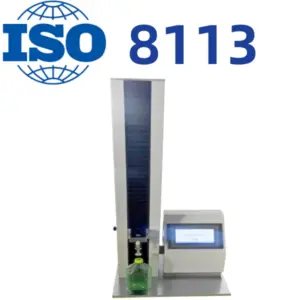
ISO 8113 specifies a method for determining the resistance of glass containers to external force along the vertical axis. This test is critical in the packaging industry, particularly for glass bottles, jars, and other containers used in food, pharmaceuticals, and beverages. Vertical load testing helps manufacturers ensure that glass containers can withstand the pressures they will face during transportation, handling, and storage without breaking or deforming.
In this article, we will discuss the top load test and its procedures as outlined in ISO 8113. We will also explore the vertical compressive force testing methods, how they are carried out, and why they are important for evaluating the strength of glass packaging materials.
What is ISO 8113: The Glass Container Top Load Test?
ISO 8113 is the standard test method used to assess the resistance of glass containers till vertical compressive forces. The test ensures that glass containers can endure external pressure, such as the weight of stacked goods, without cracking or breaking. This is particularly important for packaging used in shipping, as stacked glass containers are exposed to pressure from other packages during transportation.
Den Top Load Test is a fundamental part of this standard. The test applies a vertical load to a glass container to simulate the pressure that would be exerted on it during stacking or storage. By determining the maximum load a glass container can endure, manufacturers can design packaging that maintains the integrity of the container under typical shipping conditions.
Coated Glass Containers and Resistance to Vertical Load
Glass containers are commonly used in packaging for products like beverages, pharmaceuticals, and cosmetics. These containers must be able to resist pressure from both the internal contents and external environmental factors, especially when stacked during storage or transport.
Den resistance of glass containers is measured through the top load test under the vertical load testing method, which is part of the ISO 8113 standard. This test is designed to determine how much vertical force the glass container can withstand before it cracks, deforms, or breaks.
For this reason, it is crucial for manufacturers to test their glass containers to ensure they can endure these forces without compromising the contents inside.
Procedure for Top Load Test: Steps for Accurate Measurement
Den Top Load Test follows a specific procedure as outlined in ISO 8113:2004. Here’s an overview of the process:
1. Apparatus Setup
To perform the test, a pressing apparatus is used, which consists of two horizontal flat steel pressure plates:
- Upper Plate: Self-aligning, ensuring uniform pressure distribution across the container’s surface.
- Lower Plate: Equipped with centering marks to accurately position the container.
- Protective Cover: A cover is used to safeguard the container during testing.
Pads (such as cardboard, plastic, or rubber sheets) are placed between the glass and the metal pressure surfaces to prevent direct contact that could damage the container. These pads ensure even distribution of pressure.
2. Förberedelse av prov
The test should be conducted at an ambient temperature, with the container not differing more than 5 °C from the surrounding temperature. The glass container is placed on the lower plate with a base pad beneath it. If required, a closure may also be applied to the container’s finish.
3. Force Application
The force is applied progressively or up to a specified point for the pass test:
- Pass Test: The force is increased to a predetermined value and then removed once the specified value is achieved.
-
Total Progressive Test: The force is gradually increased until the container breaks. This method is applied to all containers in the test sample.
4. Force Measurement and Evaluation
The force applied to the container is recorded by a pointer or digital recording device with an accuracy of at least 2.5%. The results of the test are reported based on whether the container passed or failed the load requirement.
Why Vertical Load Testing is Crucial for Glass Containers
-
Glass containers are used in various industries, including food, beverages, och pharmaceuticals. These containers are often stacked during storage and transport, subjecting them to vertical compressive forces. Vertical load testingsom till exempel top load test outlined in ISO 8113, is essential for ensuring the safety and durability of glass containers.
Key Benefits of Vertical Load Testing:
- Prevention of Breakage: Ensures that containers can withstand stacking pressure without breaking.
- Packaging Integrity: Verifies the strength and durability of glass packaging materials under real-world conditions.
- Safety Assurance: Helps to avoid accidents and spills that could compromise the product or pose a risk to consumers.
Application of Vertical Load Testing in Packaging
For manufacturers in the förpackning industry, vertical load testing is crucial to ensuring that glass containers meet the necessary strength standards. The top load test method provided by ISO 8113 simulates the pressure and stress that glass containers will face in real-world conditions.
By conducting vertical load testing, manufacturers can verify that their glass containers are:
- Resistant to cracking och deformation during storage and transport.
- Capable of withstanding stacked weight without compromising the contents.
- Able to meet industry standards for packaging strength and durability.
Vertical Compressive Force and Container Integrity
Den vertical compressive force test assesses how much vertical load a glass container can handle before its structure is compromised. This test is vital for determining the container’s ability to endure external forces, particularly during transport and storage. The vertical compressive force is applied to the top of the container, and the container’s performance under this force is measured to ensure it can withstand typical shipping conditions.
Test Report and Results: What to Include
Den test report for ISO 8113 should contain the following information:
- Reference to the Standard: Mention of ISO 8113 for transparency.
- Test Apparatus Description: A detailed description of the testing apparatus used.
- Sample Information: Information about the containers tested, the number of samples, and the sampling method.
- Test Conditions: Temperature, approach speed, and any closures used during the test.
- Results:
- For pass tests, report the loading force applied and the number of containers that passed the test.
- For total progressive tests, report the force required to break each container, along with the mean value och standard deviation.
ISO 8113 provides a reliable method for testing the resistance of glass containers till vertical compressive forces, ensuring that packaging materials meet the required strength standards. The top load test och vertical load testing methods are essential for assessing the durability of glass containers used in various industries, including food, pharmaceuticals, and beverages.
For manufacturers, ensuring that their glass containers pass vertical load testing is crucial to maintaining the integrity of the product and ensuring its safe transport and storage. Cellinstrument offers a range of testing equipment that can accurately measure and assess the performance of glass containers, ensuring they meet industry standards for strength and durability.
VANLIGA FRÅGOR
Q1: What is ISO 8113 used for?
A1: ISO 8113 is used to evaluate the resistance of glass containers to vertical compressive force during stacking and transportation.
Q2: What does a Top Load Test measure in glass packaging?
A2: A Top Load Test measures the maximum vertical load a glass container can withstand before deformation or breakage.
Q3: Why is vertical load testing important for glass containers?
A3: Vertical load testing helps ensure glass containers remain intact under stacking pressure in storage and logistics.
Q4: What types of tests are defined in ISO 8113?
A4: ISO 8113 includes a pass test at a specified load and a total progressive test until container failure.
Q5: What industries commonly apply ISO 8113 testing?
A5: The standard is widely applied in beverage, food, pharmaceutical, and daily chemical packaging industries.
Q6: What role do pads play in the Container Top Load Test Method?
A6: Pads prevent direct glass-to-metal contact and help distribute vertical compressive force evenly.
Q7: Can ISO 8113 simulate real stacking conditions?
A7: Yes, ISO 8113 simulates stacking loads encountered during warehousing and transportation.
Q8: What equipment is typically used for ISO 8113 testing?
A8: A calibrated vertical load tester with self-aligning pressure plates is typically used.
Q9: How does vertical compressive force affect glass container performance?
A9: Excessive vertical compressive force can lead to cracking, loss of structural integrity, or sudden breakage.
Q10: Can ISO 8113 results support packaging design optimization?
A10: Yes, the test results help optimize container geometry and material strength for improved load resistance.
 SV
SV  EN
EN  AR
AR  BG
BG  CS
CS  DA
DA  DE
DE  EL
EL  ES
ES  ET
ET  FI
FI  FR
FR  HU
HU  ID
ID  IT
IT  JA
JA  KO
KO  LT
LT  LV
LV  NB
NB  NL
NL  PL
PL  PT
PT  RO
RO  RU
RU  SK
SK  SL
SL  TR
TR  UK
UK