
ASTM D1938
Tear-Propagation Resistance of Film and Testing Methods
Den tear-propagation resistance of film is a crucial characteristic for evaluating the durability and performance of plastic films and thin sheeting materials used in various industries. ASTM D1938, the standard test method for measuring tear resistance, uses a specific method known as the single-tear method to determine how well materials resist the propagation of a tear. This method is fundamental for understanding how materials behave under stress, ensuring that manufacturers produce robust and reliable plastic films for their applications.
ASTM D1938: Standard for Measuring Tear-Propagation Resistance
ASTM D1938 specifies a method to measure the tear-propagation resistance of plastic films and thin sheeting materials with a thickness of 1 mm (0.04 in.) or less. This test employs a constant-rate-of-grip separation machine to determine the force needed to propagate a tear in the material after a slit is introduced. Tear-Propagation Resistance of Film is crucial in industries where film products need to withstand mechanical stresses, such as packaging, medical devices, and textiles.
What Is the Tear Propagation Test for Film?
In the tear-propagation resistance test defined by ASTM D1938, a specimen of plastic film or thin sheeting is cut to a specific size and subjected to a force that propagates a tear from an initial slit. The test measures the force required to continue tearing the material. This is done by using a constant-rate-of-grip separation machine, which separates the grips holding the specimen at a controlled rate, typically 250 mm/min. The resulting data allows manufacturers to evaluate how well a material will hold up under mechanical stress.
Plastic Film Tear Method: Procedure and Testing
Preparing the Test Specimen
To start the tear test, the specimen is cut to the required dimensions, ensuring that its thickness is uniform and accurately measured. The slit is placed centrally on the specimen, and it is secured in a constant-rate-of-grip separation machine. This machine is used to apply force at a controlled rate of separation to propagate the tear.
Testförfarande
-
Specimen Placement: The film specimen is placed in the machine with the slit positioned between two clamps.
-
Krafttillämpning: The test begins by applying a controlled force at a separation rate of 250 mm/min.
-
Tear Propagation: The tear continues until it has propagated completely across the specimen.
-
Recording the Results: The force required to propagate the tear is recorded, and this data is used to calculate the rivhållfasthet.
Key Factors to Consider
-
Den rivhållfasthet for plastfilmer varies based on the material’s extensibility. More extensible materials will have different tear-propagation characteristics than less extensible materials.
-
The test must be performed under controlled conditions, such as maintaining temperature and humidity within specified ranges (23 ± 2°C and 50 ± 10% relative humidity) to ensure accurate and repeatable results.
Applications of ASTM D1938 in Industry
Den Tear-Propagation Resistance of Film is an essential property for several industries:
-
Förpackning: Materials used for packaging must resist tearing during transportation and handling, and this test ensures that films meet these durability requirements.
-
Medicintekniska produkter: Films used in medical packaging or devices must resist tearing to maintain sterility and product safety.
-
Textilier och vävnader: Testing the tear resistance of films used in textiles or protective coverings helps ensure that they will perform under stress in real-world applications.
Importance of Tear Resistance Testing
Tear resistance testing through ASTM D1938 helps manufacturers assess the durability and reliability of their products. By accurately measuring the tear propagation force, manufacturers can ensure their films meet industry standards and can withstand the mechanical forces they are likely to encounter during use. This is essential for industries where failure to meet performance standards can result in damage or safety concerns, such as medical packaging, food packaging, and safety materials.
Cell Instruments: Advanced Testing Solutions
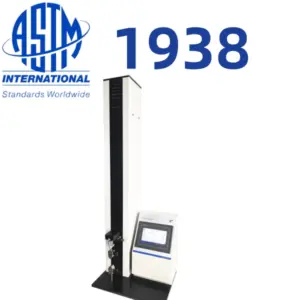
Vid Cellinstrument, we provide top-tier tensile testing machines och tear resistance testers that comply with ASTM D1938. Our equipment ensures precise measurement of tear-propagation resistance, helping manufacturers maintain high standards of product quality. Whether you’re in packaging, textiles, or medical industries, Cellinstrument is your trusted partner in testing and quality assurance.
Slutsats
ASTM D1938 is the industry standard for determining the tear-propagation resistance of plastic film and thin sheeting. By using this test method, manufacturers can ensure that their products are durable and capable of withstanding the stresses they will encounter during use. At Cellinstrument, we offer state-of-the-art testing equipment to help companies meet the demanding requirements of their industries, ensuring reliable and high-quality products.
-
VANLIGA FRÅGOR
Q1: What is ASTM D1938 and how is it used?
A1: ASTM D1938 is the standard test method for determining the tear-propagation resistance of plastic films and thin sheeting. This method uses a constant-rate-of-grip separation machine to apply force to a specimen with a slit, measuring the force required to propagate the tear. The results provide essential data for assessing the durability of materials used in packaging, medical devices, and textiles.
Q2: How does the Tear-Propagation Resistance of Film test work?
A2: Den Tear-Propagation Resistance of Film test involves placing a slit in a plastic film specimen and measuring the force needed to propagate the tear. The specimen is held between two grips, and force is applied at a controlled rate to propagate the tear. The tear force is recorded and used to assess the material’s tear resistance, which is crucial for evaluating how well a film performs under stress.
Q3: What types of materials can be tested with ASTM D1938?
A3: ASTM D1938 is designed to test plastic films and thin sheeting materials that are 1 mm (0.04 in.) thick or less. This includes a wide range of materials like woven fabrics, layered films, and airbag fabrics, provided the material does not experience brittle failure during testing. It is used to test materials that are commonly used in förpackning, Medicinsk, och textile industries.
Q4: Why is tear resistance important for plastic films?
A4: Tear resistance is critical for plastfilmer because it ensures that the material will not fail under stress. Films used in packaging, medical devices, and safety products must be able to resist tearing to maintain their integrity during transport, handling, and use. Testing tear-propagation resistance helps manufacturers select the right materials for high-performance applications.
Q5: How is the tear resistance data used in the industry?
A5: The data obtained from tear resistance testing using ASTM D1938 helps manufacturers understand how well their materials can resist tearing. This information is crucial for industries like packaging, where the strength and durability of materials directly affect the product’s ability to withstand transportation and handling. It also helps ensure that medical packaging och safety materials maintain their integrity throughout their use.
Q6: What are the benefits of using ASTM D1938 for testing plastic films?
A6: ASTM D1938 provides a standardized method for testing tear-propagation resistance, ensuring that manufacturers can accurately assess the durability of their films and sheeting. This test method is beneficial for ensuring consistency, improving product quality, and meeting industry standards for materials used in packaging, textiles, and medical devices.
Q7: How can Cell Instruments help with ASTM D1938 testing?
A7: Cellinstrument offers state-of-the-art tensile testing machines och tear resistance testers that comply with ASTM D1938. Our constant-rate-of-grip separation machines ensure precise measurement of tear-propagation resistance, allowing manufacturers to test and verify the durability of their plastic films. With our equipment, companies can ensure their products meet industry standards and perform reliably under stress.
 SV
SV  EN
EN  AR
AR  BG
BG  CS
CS  DA
DA  DE
DE  EL
EL  ES
ES  ET
ET  FI
FI  FR
FR  HU
HU  ID
ID  IT
IT  JA
JA  KO
KO  LT
LT  LV
LV  NB
NB  NL
NL  PL
PL  PT
PT  RO
RO  RU
RU  SK
SK  SL
SL  TR
TR  UK
UK