
ASTM D4533
Geotextile Trapezoidal Tear Strength Test
 ASTM D4533 is a widely recognized standard for evaluating the tear resistance of geotextiles used in civil engineering, environmental protection, and infrastructure projects. When geotextiles serve as filtration, separation, drainage, or reinforcement materials, their ability to resist tearing under load directly affects long-term performance and safety. For quality control personnel and engineers, ASTM D4533 provides a clear and practical framework to assess this property through a controlled trapezoidal tear strength test.
This article explains the intent, principles, and application of ASTM D4533, guiding readers to understand the test method and implement it correctly in laboratory practice, while highlighting how reliable instrumentation supports accurate results.
Understanding ASTM D4533 and Its Role in Geotextile Evaluation
ASTM D4533 defines an index test that measures the force required to continue or propagate a tear in woven or nonwoven geotextiles. Unlike burst or tensile tests, ASTM D4533 focuses on tear propagation, which better reflects damage scenarios such as installation stresses, punctures, or localized defects.
The standard applies to a wide range of geotextile constructions, including woven fabrics, nonwoven fabrics, knit fabrics, layered materials, and felts. Because geotextiles often experience complex stress conditions in the field, ASTM D4533 serves as an essential comparative tool for material selection, acceptance testing, and quality monitoring.
ASTM D4533: Trapezoidal Tear Strength Method
Spletna stran trapezoidal tear strength method used in ASTM D4533 introduces tension along a defined path so that a pre-cut tear propagates across the specimen width. This geotextile tearing strength test captures the maximum tearing force recorded during the test, which represents the material’s resistance to further tear growth.
In woven geotextiles, the measured tearing strength depends largely on yarn properties and their interaction within the fabric structure. In nonwoven materials, fiber orientation and bonding play a major role, as fibers gradually realign before rupture occurs. As a result, the tear test of fabric under ASTM D4533 helps differentiate materials not only by strength, but also by structural behavior.
Principle and Significance of the Trapezoidal Tear Strength Method
The trapezoidal configuration ensures stable and repeatable tear propagation. By clamping the nonparallel sides of the trapezoid and applying tension at a constant rate, the test simulates realistic tearing conditions encountered during handling and service.
ASTM D4533 proves especially useful for:
-
Comparing tear resistance between different geotextile products
-
Evaluating directional differences within the same fabric
-
Supporting acceptance testing of commercial shipments
Although ASTM D4533 does not replace design-oriented performance tests, it provides a reliable index value for quality control and material benchmarking.
Equipment Considerations for Accurate ASTM D4533 Testing
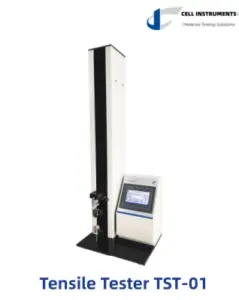
ASTM D4533 allows the use of both constant-rate-of-traverse (CRT) and constant-rate-of-extension (CRE) tensile testing machines. However, results from these two machine types may not correlate directly. In cases of dispute, CRE systems take precedence.
A modern CRE tensile tester, such as the Instrumenti za celice Napenjalni tester TST-01, offers precise speed control, stable force measurement, and flexible gripping options. These features help laboratories meet ASTM D4533 requirements while improving repeatability and operational efficiency across different geotextile types.
For testing laboratories and quality teams, combining ASTM D4533 expertise with reliable instruments from Cell Instruments Co., Ltd. strengthens technical credibility and ensures compliance with international testing expectations.
Zaključek
ASTM D4533 remains a cornerstone standard for evaluating tear resistance in geotextiles. By understanding the trapezoidal tear strength principle, following the prescribed procedure, and selecting appropriate testing equipment, laboratories can generate consistent and meaningful data.
Frequently Asked Questions (FAQ)
1. What does ASTM D4533 measure?
ASTM D4533 measures the force required to continue or propagate a tear in geotextiles using the trapezoidal tear strength method. It evaluates tear resistance after a tear has already started, making it suitable for quality control and acceptance testing.
2. What types of materials can be tested using ASTM D4533?
This standard applies to most geotextiles, including woven fabrics, nonwoven fabrics, knitted fabrics, layered materials, and felts. It is commonly used for the geotextile tearing strength test in civil and environmental engineering applications.
3. How is the trapezoidal tear strength determined?
In the trapezoidal tear strength test, a pre-cut trapezoid-shaped specimen is clamped in a tensile testing machine. The jaws separate at a constant rate until the tear propagates across the fabric. The maximum recorded force represents the tearing strength.
4. Is ASTM D4533 the same as a tensile strength test?
While both use tensile testing machines, ASTM D4533 focuses on tear propagation rather than overall tensile strength. A tear test of fabric better reflects localized damage such as cuts, punctures, or installation-related stress.
 SL
SL  EN
EN  AR
AR  BG
BG  CS
CS  DA
DA  DE
DE  EL
EL  ES
ES  ET
ET  FI
FI  FR
FR  HU
HU  ID
ID  IT
IT  JA
JA  KO
KO  LT
LT  LV
LV  NB
NB  NL
NL  PL
PL  PT
PT  RO
RO  RU
RU  SK
SK  SV
SV  TR
TR  UK
UK