
Trapezoidal Tear Test for Geotextile and Fabric Evaluation
ASTM D4533
 Stránka trapezoidal tear test is a crucial method defined by ASTM D4533 to evaluate the tearing strength of geotextiles. Used widely in civil engineering, environmental protection, and infrastructure projects, this test measures the force required to propagate a tear in woven and nonwoven fabrics. By determining the fabric tear strength, engineers and quality control personnel can ensure that geotextiles perform reliably in real-world conditions, from road construction to drainage systems.
Understanding ASTM D4533: Fabric Tear Strength and Geotextile Performance
ASTM D4533 is an index test designed to measure how geotextiles respond to tearing forces along a pre-defined path. Unlike tensile or burst tests, this standard emphasizes the propagation of a tear, offering insights into material behavior under localized stress. It applies to various geotextile materials, including:
-
Woven fabrics
-
Nonwoven fabrics
-
Knit fabrics
-
Layered fabrics
-
Felts used in geotechnical applications
Using this method, engineers can compare different materials, evaluate directional differences, and conduct acceptance testing of commercial shipments. The test provides an essential benchmark for quality control, material selection, and product certification.
ASTM D4533 Trapezoidal Tear Test Procedure Overview
To perform the trapezoidal tear test under ASTM D4533, follow these key steps:
-
Specimen Conditioning
Condition samples in a standard testing atmosphere or test thoroughly wet specimens when required. -
Specimen Preparation
Mark an isosceles trapezoid on the rectangular specimen. Introduce a controlled cut to initiate the tear. -
Machine Setup
Set the initial jaw separation to 25 ± 1 mm and select a load range placing the maximum load between 15–85% of full scale. Operate the machine at 300 ± 10 mm/min. -
Clamping and Alignment
Secure the trapezoid nonparallel sides in the jaws. Ensure proper alignment to prevent slippage or uneven stress. -
Tear Propagation and Data Recording
Start the test and continuously record the force. Identify the maximum tearing force from the force–extension curve. -
Result Evaluation
Calculate average tearing strength values for machine and cross-machine directions, excluding outliers as defined by thestandard.
Proper clamping and alignment are critical to obtaining accurate fabric tear strength results.
Trapezoidal Tear Test Equipment Considerations
ASTM D4533 permits the use of constant-rate-of-traverse (CRT) and constant-rate-of-extension (CRE) tensile testing machines. Results may differ between the two, so CRE machines are preferred in case of disputes.
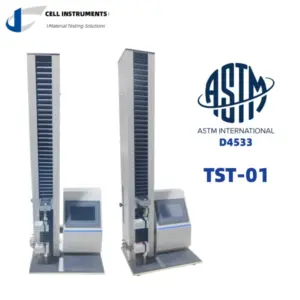
Stránka Cell Instruments TST-01 provides precise speed control, stable force measurement, and adaptable gripping options, ensuring reliable trapezoidal tear test results across diverse geotextile materials.
Tearing Strength of Geotextiles Test Practical Applications and Industry Value
Ensuring geotextile tear strength is essential for the performance and safety of civil engineering and environmental projects. The trapezoidal tear test under ASTM D4533 provides key insights into material behavior, helping engineers and manufacturers make informed decisions about selection, handling, and installation. By measuring fabric tear strength, this test ensures geotextiles withstand mechanical stresses such as punctures, localized loads, or stretching during installation.
The practical applications of ASTM D4533 span multiple industries, including:
-
Road and pavement construction: Stabilizes soil, separates layers, and reinforces surfaces. Adequate tear resistance prevents premature failures under vehicular load and construction stress.
-
Landfill lining and erosion control: Protects liners and slopes from tearing, ensuring containment integrity and reducing maintenance.
-
Drainage and filtration systems: Maintains filtration efficiency and structural support by preventing tear propagation.
Integrating trapezoidal tear strength data into quality programs enhances product consistency, reduces installation risks, and improves long-term reliability. Instruments like the Mobilné nástroje TST-01 enable precise, repeatable testing, supporting these objectives
Conclusion
Stránka trapezoidal tear test under ASTM D4533 is a cornerstone method for assessing the tearing strength of geotextiles. By understanding the test procedure, adhering to proper specimen preparation, and using accurate equipment, laboratories can produce consistent, reliable data. This ensures material quality, informs engineering decisions, and promotes safer, more durable geotechnical and civil engineering applications worldwide.
FAQ Section
- What is the purpose of the ASTM D4533 trapezoidal tear test?
Stránka trapezoidal tear test under ASTM D4533 measures the tearing strength of geotextiles by determining the force required to propagate a tear. This helps engineers evaluate material durability and quality for applications like road construction, drainage systems, and erosion control. - Which materials can be tested using ASTM D4533?
The standard applies to most geotextiles, including woven fabrics, nonwoven fabrics, layered fabrics, knit fabrics, and felts. Both dry and wet specimens can be tested, depending on the application requirements. - How is the trapezoidal tear test performed?
A rectangular specimen is marked with an isosceles trapezoid. The nonparallel sides are clamped, and tension is applied at a constant rate to propagate the tear. The maximum force is recorded as the fabric tear strength, reflecting the material’s ability to resist further tearing. -
How are test results evaluated under ASTM D4533?
Results are typically recorded for both machine and cross-machine directions. Outlier data exceeding 25% deviation from the average is discarded. The maximum tearing force for each specimen is used to calculate average fabric tear strength, providing a benchmark for material performance.
 SK
SK  EN
EN  AR
AR  BG
BG  CS
CS  DA
DA  DE
DE  EL
EL  ES
ES  ET
ET  FI
FI  FR
FR  HU
HU  ID
ID  IT
IT  JA
JA  KO
KO  LT
LT  LV
LV  NB
NB  NL
NL  PL
PL  PT
PT  RO
RO  RU
RU  SL
SL  SV
SV  TR
TR  UK
UK