
ASTM F1140
Burst Testing
 In modern industries such as medical devices, pharmaceuticals, food, and electronics, flexible packaging plays a critical role in maintaining product safety and integrity. To ensure these packages can withstand internal pressure variations, ASTM F1140 offers a set of standardized procedures for evaluating failure resistance under unrestrained conditions.
ASTM F1140 is widely recognized for testing unsealed and sealed flexible packages using internal pressurization. This test method helps identify the point at which packaging materials or seals fail under increasing or sustained pressure, simulating real-world conditions like transportation, sterilization, and altitude changes.
Internal Pressure Testing Methods: Burst, Creep, and Positive Pressure Leak Test
Burst Test: Evaluating Maximum Failure Pressure
The burst test is one of the most commonly applied methods under ASTM F1140. It involves gradually increasing the internal pressure within a package until a material or seal rupture occurs. This test is essential for determining the maximum pressure the packaging can withstand before failure.
Key considerations include:
- Use of open or closed package test setups
- Controlled rate of pressurization
- Precise recording of burst pressure and failure location
The Cell Instruments LSST-01 Open Pack is designed specifically for such applications, offering precision control and real-time data logging to enhance reliability and traceability.
Creep Test and Creep to Failure: Assessing Pressure Endurance
The creep test (Method B1) subjects the package to a specified positive pressure for a fixed period—typically 15–30 seconds—to observe if it maintains integrity without failing. Conversely, the creep to failure test (Method B2) maintains pressure until rupture, providing insight into time-to-failure performance.
These methods are particularly valuable when studying packaging materials that may not burst immediately but could deform or delaminate under constant load.
Applications include:
- Sterile barrier verification
- Evaluation of seal integrity over time
- Material comparison under static pressure
To conduct these tests accurately, you need a positive pressure leak test system with fine pressure regulation, responsive sensors, and an automated timer—all of which are integrated into Cell Instruments’ LSST-01 system.
Why the Pressure Decay Method Is Not Part of ASTM F1140
While the pressure decay method is commonly used for leak detection, it is not a specified procedure within ASTM F1140. Instead, ASTM F1140 focuses on direct pressurization failure assessments. However, integrating pressure decay as a complementary test can provide broader insights into package quality, especially when used alongside burst and creep tests.
Advantages of Using a Pouch Burst Tester Compliant with ASTM F1140
For consistent, repeatable results, a specialized pouch burst tester—like the Cell Instruments LSST-01 Open Pack—offers critical benefits:
- Dual test modes: burst and creep
- Flexible fixture design for open or sealed packages
- Accurate internal pressure control
- Data traceability via digital interface
- Conformitate with ASTM F1140 and related standards
By using the LSST-01, quality control professionals can reliably monitor package integrity across development, production, and validation processes.
Application Scenarios and Industries Benefiting from ASTM F1140 Testing
Testing in accordance with ASTM F1140 is particularly relevant for:
- Medical device packaging, especially sterile pouches
- Pharmaceutical blister packs and sachets
- Food-grade flexible packaging exposed to vacuum or high pressure
- Electronic components that must remain moisture-free
- Quality inspection agencies seeking standard-based certification testing
Instrumente celulare provides advanced solutions for all these sectors by offering not only high-performance test systems but also custom automation options tailored to specific materials and packaging geometries.
 De ce să alegeți Cell Instruments?
 De ce să alegeți Cell Instruments?
La Cell Instruments Co., Ltd., we specialize in developing precision materials testing instruments for packaging, medical, and pharmaceutical applications. Our equipment is built to meet global testing standards, including ASTM, ISO, and TAPPI, and our expert team supports clients with:
- Custom testing configurations
- Full automation integration
- On-site training and calibration
- Prompt technical support
 Concluzie
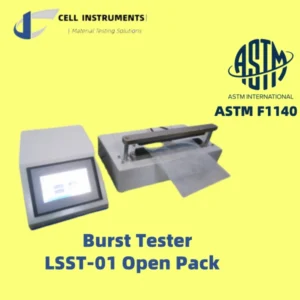
ASTM F1140 is essential for ensuring the safety and durability of flexible packaging under internal pressure. Whether performing a burst test, a positive pressure leak test, or long-term analysis using the creep or creep-to-failure methods, quality assurance depends on reliable and standards-compliant equipment. The LSST-01 Open Pack pouch burst tester de la Instrumente celulare offers the precision, adaptability, and compliance necessary to support packaging professionals across various industries.
 RO
RO  EN
EN  AR
AR  BG
BG  CS
CS  DA
DA  DE
DE  EL
EL  ES
ES  ET
ET  FI
FI  FR
FR  HU
HU  ID
ID  IT
IT  JA
JA  KO
KO  LT
LT  LV
LV  NB
NB  NL
NL  PL
PL  PT
PT  RU
RU  SK
SK  SL
SL  SV
SV  TR
TR  UK
UK