
ASTM D4833
Geomembrane Puncture Resistance Test
ASTM D4833, officially titled Standard Test Method for Index Puncture Resistance of Geomembranes and Related Products, is a widely recognized standard developed by ASTM International. This method evaluates the puncture resistance of geomembranes—a key performance property for materials used in environmental containment, construction, and civil engineering applications.
Geomembranes serve as impermeable barriers in landfills, ponds, and reservoirs, so understanding their puncture resistance is crucial to ensuring long-term durability and preventing leakage or structural failure.
Understanding the Geomembrane Puncture Resistance Test
The geomembranes puncture test described in ASTM D4833 determines how resistant a material is to puncture under controlled laboratory conditions. In this procedure, a test specimen is clamped between two circular plates and subjected to a vertical force using a solid steel rod until rupture occurs. The maximum force recorded represents the puncture resistance of the specimen.
This test is typically performed using a tensile testing machine equipped with a ring clamp and puncture rod assembly. The test speed is maintained at 300 ± 10 mm/min, ensuring consistent deformation rates across all samples. According to the standard, rupture should occur between 10% and 90% of the full-scale load to ensure valid results.
Why the Geomembranes Puncture Resistance Test Matters
The geomembranes puncture resistance test plays a pivotal role in quality control and material selection. Puncture resistance directly impacts how well a geomembrane can withstand installation stresses, contact with sharp aggregates, or pressure from backfill materials.
ASTM D4833 provides index values rather than absolute field performance data. These values allow engineers, manufacturers, and testing laboratories to compare the relative strength of different geomembrane products using standardized conditions. Consistent data improves confidence in product selection, specification compliance, and long-term performance prediction.
Key Procedure Highlights for ASTM D4833 Testing
To ensure reliable and repeatable results, laboratories should carefully follow ASTM D4833 procedures:
- Specimen preparation: The test specimen must extend to or beyond the outer edges of the clamping plates to prevent slippage.
- Load application: The test machine applies vertical force through a steel puncture rod until complete rupture.
- Data recording: The maximum force value during the test represents the material’s puncture resistance. For composite geomembranes, the initial peak force is reported, even if a second higher peak occurs later.
- Test control: The testing speed and environmental conditions must be consistent across all specimens.
These details ensure that the geomembrane puncture strength test results are accurate, comparable, and traceable.
Applications and Benefits of ASTM D4833 Testing
Understanding puncture resistance helps users predict geomembrane performance in real-world conditions. ASTM D4833 testing benefits:
- Quality assurance: Verifies material uniformity and compliance with project specifications.
- Material comparison: Enables objective evaluation among geomembrane suppliers.
- Product development: Guides formulation improvements for enhanced puncture strength.
- Regulatory compliance: Satisfies environmental and engineering project requirements.
These advantages make ASTM D4833 an essential part of the quality assurance process in geomembrane manufacturing and application.
Cell Instruments Geomembrane Puncture Strength Tester
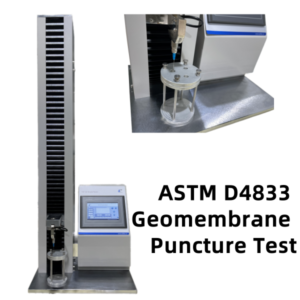
For laboratories seeking reliable and compliant testing, Instrumente celulare offers a high-precision geomembrane puncture strength tester designed specifically for ASTM D4833 testing.
This advanced testing system features:
- Precise load cell and displacement control, ensuring accurate puncture resistance measurement.
- Corpuri personalizabile suitable for various geomembrane and related materials.
- Automated data acquisition and analysis software for real-time monitoring and reporting.
By using Cell Instruments’ testing equipment, quality control professionals can efficiently determine the index puncture resistance of geomembranes and ensure their materials meet ASTM D4833 standards.
ASTM D4833 provides a standardized and reliable method for assessing the puncture resistance of geomembranes and related products. By following this test, engineers and manufacturers gain valuable insights into material integrity and durability. Utilizing high-quality testing equipment—such as that offered by Cell Instruments—ensures that test results are consistent, accurate, and compliant with international standards.
 RO
RO  EN
EN  AR
AR  BG
BG  CS
CS  DA
DA  DE
DE  EL
EL  ES
ES  ET
ET  FI
FI  FR
FR  HU
HU  ID
ID  IT
IT  JA
JA  KO
KO  LT
LT  LV
LV  NB
NB  NL
NL  PL
PL  PT
PT  RU
RU  SK
SK  SL
SL  SV
SV  TR
TR  UK
UK