
ASTM D2732 provides a standardized method to measure the unrestrained thermal shrinkage of plastic films by immersing specimens in a controlled heated medium. The test quantifies dimensional changes in both machine and transverse directions, revealing internal stress behavior and processing characteristics. Accurate execution requires controlled temperature, timing, and non-restrained conditions, typically achieved using a film shrinkage tester. The method supports material comparison, process optimization, and quality control across packaging, medical, and industrial applications.
What is ASTM D2732 and Why It Matters
ASTM D2732 defines a standardized approach to evaluate the retração térmica linear sem restrições of plastic films and sheeting with thickness ≤0.76 mm. This method helps engineers and quality control teams quantify how films behave when exposed to elevated temperatures without mechanical constraints.
During film production, processes such as extrusion and orientation introduce tensões internas. When heat is applied, these stresses release, causing shrinkage. ASTM D2732 allows you to:
- Quantify shrinkage percentage at specific temperatures
- Understand processing-induced stress behavior
- Compare materials across different production conditions
- Ensure end-use performance consistency
This makes ASTM D2732 highly relevant in industries where dimensional stability directly impacts product integrity, such as packaging and medical materials.
Shrinkage Test Method and Film Shrinkage Tester
Core Principles of the Shrinkage Test Method
O shrinkage test method outlined in ASTM D2732 evaluates how a film contracts when immersed in a heated fluid medium. The test ensures no external restraint, allowing natural shrinkage behavior.
Key procedural highlights include:
- Specimen size: 100 mm × 100 mm
- Minimum: two samples per temperature
- Immersion duration: typically 10 seconds
- Measurement directions:
- Machine Direction (MD)
- Transverse Direction (TD)
The test uses a controlled temperature bath, ensuring uniform heat transfer. After heating, samples are cooled rapidly and measured to determine dimensional change.
Role of a Film Shrinkage Tester
A professional film shrinkage tester ensures repeatability and accuracy by controlling critical variables:
- Temperature stability
- Immersion time
- Uniform heat distribution
- Non-restrained sample holding
For example, the Testador de encolhimento sem filme FST-01 from Cell Instruments provides:
- Precise temperature control (±0.3°C)
- Uniform oil bath heating
- Standardized free-shrink holder
- Automated timing for consistent dwell periods
This type of system reduces operator variability and ensures compliance with ASTM D2732 requirements, especially in high-throughput QC environments.
Step-by-Step Overview of ASTM D2732 Procedure
Preparação da amostra
- Cut specimens to 100 mm × 100 mm
- Mark orientation (MD/TD)
- Avoid introducing mechanical stress during cutting
Processo de teste
- Preheat the bath to the target temperature
- Place the specimen in a free shrink holder
- Immerse the specimen for ~10 seconds
- Remove and immediately cool in a compatible liquid
- Measure final dimensions after stabilization
Important: Avoid preheating or stretching the specimen, as this can distort results.
Shrinkage Calculation and Interpretation
The shrinkage percentage is calculated using:
Shrinkage (%)=Lo−LfLo×100\text{Shrinkage (\%)} = \frac{L_o – L_f}{L_o} \times 100
Onde:
- Lo = Original length (typically 100 mm)
- Lf = Final length after shrinkage
Interpretation Insights
- Higher shrinkage → greater internal stress release
- Temperature-dependent behavior → indicates processing characteristics
- Directional differences (MD vs TD) → reflect film orientation
Testing across multiple temperatures allows you to map the shrinkage curve, which is critical for material selection and process optimization.
Choosing the Right Film Shrinkage Tester
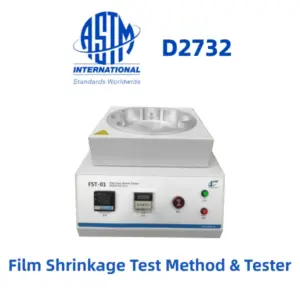
Ao selecionar um film shrinkage tester, consider:
- Temperature accuracy and uniformity
- Ease of specimen handling
- Conformidade com a norma ASTM D2732
- Automation and repeatability
O Cell Instruments FST-01 stands out for its:
- Stable PID temperature control
- Consistent fluid heating environment
- Interface amigável
- Reliable repeatability for QC labs
This makes it suitable for both R&D and routine quality inspection.
Evaluate your film performance with a reliable shrinkage test method based on ASTM D2732. Using a precision film shrinkage tester like the FST-01, you can measure shrinkage accurately under controlled thermal conditions, ensuring consistent product quality and compliance. Improve your material selection, reduce production risks, and gain confidence in your packaging or industrial film applications with repeatable, standards-based testing.
Perguntas frequentes
1. What materials can be tested using ASTM D2732?
Plastic films and sheeting up to 0.76 mm thick, including PE, PET, PVC, and multilayer laminates.
2. Why is unrestrained shrinkage important?
It reflects the material’s true thermal response, free from external mechanical influence.
3. How many temperatures should be tested?
Testing at multiple temperatures helps define the complete shrinkage profile of the material.
4. What causes variation in shrinkage results?
Factors include film orientation, thickness, heating rate, and internal stress distribution.
5. Can ASTM D2732 be used for quality control?
Yes. It is widely used in QC to ensure batch consistency and compliance with specifications.
 PT
PT  EN
EN  AR
AR  BG
BG  CS
CS  DA
DA  DE
DE  EL
EL  ES
ES  ET
ET  FI
FI  FR
FR  HU
HU  ID
ID  IT
IT  JA
JA  KO
KO  LT
LT  LV
LV  NB
NB  NL
NL  PL
PL  RO
RO  RU
RU  SK
SK  SL
SL  SV
SV  TR
TR  UK
UK