
ASTM D6693
Geomembranes Tensile Strength Test and Elongation
ASTM D6693 is a key international standard used to evaluate the tensile performance of nonreinforced geomembranes. In practical applications, geomembranes must withstand long-term tensile stresses caused by installation, settlement, temperature variation, and environmental loading. ASTM D6693 provides a standardized and repeatable method to assess tensile strength and elongation at break, ensuring that geomembrane materials meet quality and specification requirements before deployment.
This article introduces the purpose, testing concept, application scope, and industrial relevance of ASTM D6693, helping engineers and quality professionals understand how the standard supports reliable geomembrane performance.
Tensile Performance: Geomembranes Strength, Break, and Elongation
Within ASTM D6693, the geomembranes tensile strength test is designed to quantify both resistance to rupture and deformation capacity. The method evaluates break strength testing results alongside tensile elongation at break, allowing users to understand how a geomembrane behaves as it transitions from elastic deformation to ultimate failure.
These parameters are especially relevant for geomembranes subjected to tensile stresses during deployment, anchoring, welding, and service life. By linking force and extension under standardized conditions, ASTM D6693 ensures that tensile data remain comparable and technically meaningful.
Objective and Technical Positioning of ASTM D6693
ASTM D6693 functions as an index test rather than a full design simulation. Its primary objective is to produce tensile property data that can be used for:
-
Manufacturing consistency checks
-
Incoming material qualification
-
Compliance with technical specifications
-
Research and development benchmarking
The standard applies to nonreinforced geomembranes over a defined thickness range, including polyethylene and flexible polypropylene materials. ASTM D6693 explicitly recognizes that tensile results depend on preparation, test speed, and environment, and therefore stresses strict control of these variables.
How ASTM D6693 Approaches Tensile Testing
ASTM D6693 uses standardized dumbbell-shaped specimens tested at a constant crosshead speed. This approach simplifies comparison by eliminating geometric variability and focusing on material response under tension.
The method measures applied load and crosshead displacement throughout the test. From this data, tensile strength values and elongation percentages are derived. Although crosshead movement does not represent true strain distribution, ASTM D6693 accepts this limitation to prioritize repeatability and efficiency in routine testing.
This balance between practicality and technical rigor explains why ASTM D6693 remains a preferred standard for geomembrane tensile evaluation worldwide.
Key Performance Indicators Defined by ASTM D6693
ASTM D6693 outlines several critical tensile metrics that describe geomembrane behavior:
-
Tensile yield strength, when a defined yield point is present
-
Tensile break strength, indicating maximum resistance before rupture
-
Percent yield elongation, reflecting the onset of plastic deformation
-
Percent elongation at break, representing ductility at failure
These values provide insight into both strength and flexibility, two properties that must be balanced in effective geomembrane design.
Materials Covered by ASTM D6693
ASTM D6693 applies to a broad range of geomembrane materials commonly used in containment and barrier systems. Typical examples include:
-
HDPE geomembranes for landfill and mining applications
-
LLDPE geomembranes requiring higher flexibility
-
Flexible polypropylene geomembranes used in specialized containment systems
Because the standard accommodates different thicknesses and material types, ASTM D6693 supports consistent evaluation across diverse product portfolios.
Practical Applications of ASTM D6693 Data
Tensile data generated under ASTM D6693 play a crucial role in real-world decision-making. Engineers and quality managers use these results to confirm material suitability for demanding applications such as:
-
Environmental containment systems
-
Water reservoirs and canals
-
Mining leach pads
-
Industrial lining systems
In these environments, insufficient tensile strength or elongation capacity may lead to cracking, tearing, or premature failure. ASTM D6693 helps reduce such risks by establishing objective performance benchmarks.
Test Equipment Considerations for ASTM D6693
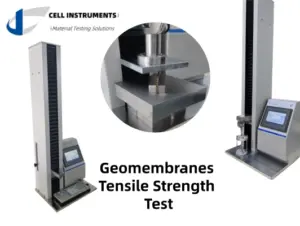
Accurate execution of ASTM D6693 requires a stable tensile testing system with precise speed control and reliable force measurement. Equipment variability can significantly influence test outcomes, especially for flexible geomembrane materials.
O Instrumentos de Célula TST-01 Universal Tensile Tester provides the control and stability needed for ASTM D6693 testing. Its adaptable load ranges and consistent crosshead motion support reliable break strength testing and elongation measurement while remaining aligned with the standard’s intent.
Value of ASTM D6693 in Quality Control Programs
ASTM D6693 strengthens geomembrane quality assurance by providing a transparent and repeatable method for tensile evaluation. When applied consistently, it allows manufacturers to demonstrate compliance, laboratories to maintain testing credibility, and end users to compare materials with confidence.
For professionals involved in geomembrane production, testing, and application, ASTM D6693 remains an essential standard that links laboratory tensile data with practical performance expectations.
Q1: What is ASTM D6693?
ASTM D6693 is a standard test method used to determine the tensile properties of nonreinforced geomembranes. It evaluates material performance through geomembranes tensile strength test, break strength testing, e tensile elongation at break.
Q2: Why is ASTM D6693 important?
This standard ensures consistent quality and reliability of geomembranes in applications like landfill liners, reservoirs, and containment systems. The data help engineers predict how materials will behave under stress and over time.
Q3: What types of materials can be tested using ASTM D6693?
ASTM D6693 applies to nonreinforced polyethylene and polypropylene geomembranes with thicknesses typically ranging from 0.25 mm to 6.3 mm.
Q4: How are tensile properties measured in ASTM D6693?
The test measures the force required to stretch and break a dumbbell-shaped specimen. The results include tensile yield strength, break strength, e alongamento na ruptura, providing insight into both resistance to rupture and material flexibility.
Q5: What equipment is recommended for ASTM D6693 testing?
A precise testador de tração like the Cell Instruments TST-01 is recommended. It ensures accurate measurement of load and extension under standardized conditions.
 PT
PT  EN
EN  AR
AR  BG
BG  CS
CS  DA
DA  DE
DE  EL
EL  ES
ES  ET
ET  FI
FI  FR
FR  HU
HU  ID
ID  IT
IT  JA
JA  KO
KO  LT
LT  LV
LV  NB
NB  NL
NL  PL
PL  RO
RO  RU
RU  SK
SK  SL
SL  SV
SV  TR
TR  UK
UK