
ASTM D5587
Trapezoidal Tear Test for Fabric
ASTM D5587 is a widely recognized standard used to determine the tearing behavior of textile materials when a tear has already been initiated. In practical applications, fabrics rarely fail from a perfectly intact edge. Instead, small cuts, defects, or stress points often exist before loading. ASTM D5587 addresses this reality by focusing on controlled tear propagation, making it highly relevant for quality control, product development, and acceptance testing across the textile supply chain.
For manufacturers and laboratories, ASTM D5587 provides a clear framework to generate comparable, repeatable data. When implemented correctly, it helps engineers and quality professionals understand how fabric structure, finishing, and fiber composition influence resistance to tearing under tensile load.
Fabric Tear Strength Standard Explained
As a fabric tear strength standard, ASTM D5587 specifies the ensaio de laceração trapezoidal performed on a constant-rate-of-extension tensile tester. Unlike tensile strength of fabric tests that evaluate uniform stretching until rupture, this method concentrates force along a defined tear path. The trapezoidal geometry ensures that stress remains localized, allowing the tear to propagate steadily across the specimen width.
The standard applies to a broad range of materials, including woven fabrics, knitted fabrics, layered structures, napped textiles, and coated or resin-treated fabrics. Both dry and wet conditions can be evaluated when required. Importantly, ASTM D5587 does not measure the force needed to start a tear; instead, it measures the force required to continue a tear, which often correlates more closely with real-use performance.
To report results, laboratories may use either the força de rutura de pico único ou o média das cinco forças de pico mais elevadas, depending on contractual or specification requirements.
Trapezoidal Tear Test Method Principle and Key Preparation Considerations
The trapezoidal tear test begins with careful specimen preparation. A rectangular fabric sample receives a marked isosceles trapezoid outline. A short slit at the center of the smallest base creates a controlled starting point for the tear. During testing, the nonparallel sides of the trapezoid are clamped in the jaws of a tensile testing machine.
Several preparation details directly affect accuracy:
-
Specimen alignment must remain consistent to avoid uneven loading
-
Clamping pressure should prevent slippage without damaging the fabric
-
Environmental conditioning at standard temperature and humidity improves repeatability
Attention to these factors strengthens confidence in ASTM D5587 results, especially when comparing data between laboratories.
Step-by-Step Overview of the ASTM D5587 Procedure
To support practical implementation, the ASTM D5587 procedure can be summarized as follows:
-
Condition specimens in a standard textile testing atmosphere unless otherwise specified.
-
Secure the specimen in the tensile tester jaws along the nonparallel sides of the trapezoid.
-
Hold the short edge taut and ensure the pre-cut slit remains centered.
-
Start the tensile tester and apply load at a constant extension rate.
-
Record the tearing force as the tear propagates, noting peak values.
-
Stop the test after the fabric has torn approximately 75 mm or completely.
-
Repeat testing for multiple specimens and directions to obtain representative data.
This structured approach ensures that ASTM D5587 results remain meaningful and comparable.
Practical Significance for Quality Control and Manufacturing
ASTM D5587 plays a critical role in acceptance testing of commercial fabric shipments. When disputes arise between suppliers and buyers, the standard offers a statistically reliable basis for comparison. By producing tension along a defined course, the trapezoidal tear test highlights differences in weave, yarn bonding, and finishing treatments that may not appear in other mechanical tests.
Industries such as technical textiles, protective fabrics, automotive interiors, and industrial packaging textiles rely on ASTM D5587 to verify durability and performance consistency.
Choosing the Right Tensile Tester for ASTM D5587
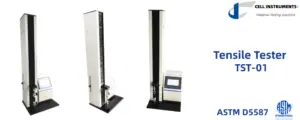
Successful application of ASTM D5587 depends on a stable and precise CRE tensile testing machine. The Cell Instruments Tensile Tester ( TST-01) supports trapezoidal tear testing through accurate speed control, consistent displacement, and reliable force measurement. Its flexible fixture compatibility allows laboratories to adapt quickly to different fabric types while maintaining compliance with standard requirements.
For organizations seeking dependable ASTM D5587 testing, selecting a robust tensile tester enhances efficiency, data quality, and long-term testing confidence.
Conclusão
ASTM D5587 provides a proven, practical method for evaluating fabric tear resistance under realistic conditions. By combining standardized specimen geometry, controlled loading, and clear reporting options, it enables manufacturers and laboratories to assess material performance with confidence. When paired with a high-quality CRE tensile tester, ASTM D5587 becomes a powerful tool for fabric quality assurance and product optimization.
Perguntas frequentes
1. What does ASTM D5587 measure in fabric testing?
ASTM D5587 measures the resistência ao rasgamento do tecido after a tear has already been initiated. It focuses on tear propagation rather than tear initiation, which makes the results more representative of real service conditions where fabrics often contain small cuts or defects.
2. How is the trapezoidal tear test different from tensile strength of fabric tests?
The trapezoidal tear test concentrates stress along a predefined tear path, allowing the tear to propagate across the specimen width. In contrast, tensile strength of fabric tests apply uniform tension until rupture, which evaluates overall strength but not resistance to continued tearing.
3. What types of fabrics can be tested according to ASTM D5587?
ASTM D5587 applies to most textile fabrics, including woven, knitted, layered, napped, pile, and coated fabrics. It also covers untreated, heavily sized, resin-treated, and specialty textiles, with provisions for testing in dry or wet conditions.
 PT
PT  EN
EN  AR
AR  BG
BG  CS
CS  DA
DA  DE
DE  EL
EL  ES
ES  ET
ET  FI
FI  FR
FR  HU
HU  ID
ID  IT
IT  JA
JA  KO
KO  LT
LT  LV
LV  NB
NB  NL
NL  PL
PL  RO
RO  RU
RU  SK
SK  SL
SL  SV
SV  TR
TR  UK
UK