
Tearing Strength of Fabric Testing
ASTM D5587
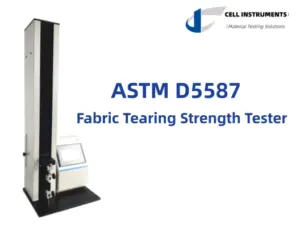
Tearing strength of fabric is a critical mechanical property that reflects how textiles resist the propagation of an existing tear under load. ASTM D5587, widely known as the trapezoidal tear strength test, provides a standardized and repeatable method to evaluate this performance. By understanding the principles, procedures, and applications of this method, quality professionals can ensure consistent fabric performance and reliable acceptance testing across industries.
Understanding Tearing Strength of Fabric
Tearing strength of fabric describes the force required to continue a tear once it has been initiated, rather than the force needed to start one. In real-world use, fabrics often fail from small cuts, notches, or defects introduced during manufacturing or handling. Measuring tearing strength of fabric therefore offers valuable insight into durability, safety, and service life.
ASTM D5587 focuses on tear propagation behavior under controlled tensile loading. The method applies tensile stress along a defined path so that the tear travels steadily across the specimen width. This approach makes the test especially useful for comparing different fabric constructions, finishes, or fabric directions.
ASTM D5587 Trapezoidal Tear Strength Test and CRE Trapezoidal Tear Principles
The ASTM D5587 trapezoidal tear strength test relies on a constant-rate-of-extension (CRE) tensile testing approach, often referred to as CRE trapezoidal tear testing. A CRE machine maintains a uniform extension rate, which improves data consistency and inter-laboratory comparability.
This method suits a broad range of textiles, including woven fabrics, knitted fabrics, coated or resin-treated fabrics, napped materials, layered structures, pile fabrics, and technical textiles such as airbag fabrics. Specimens may be tested in dry or wet conditions depending on application requirements.
Importantly, the test assumes the tear is pre-cut. As a result, tearing strength of fabric measured by ASTM D5587 does not represent tear initiation force but rather the resistance to tear propagation, which aligns closely with many end-use scenarios.
Test Procedure Overview Based on ASTM D5587
To help laboratories apply the method correctly, the key steps can be summarized as follows:
-
Specimen Conditioning
Condition specimens in a standard textile testing atmosphere, typically 21 °C and 65 % relative humidity, unless otherwise specified. -
Specimen Preparation
Mark an isosceles trapezoid on a rectangular fabric sample. Introduce a slit at the center of the short base to initiate the tear. -
Clamping and Alignment
Secure the non-parallel sides of the trapezoid in the grips of a CRE tensile tester. Proper alignment ensures the tear propagates evenly across the specimen. -
Tear Propagation and Recording
Start the test at a controlled extension rate. As the crosshead moves, the tear advances and the force fluctuates. The system records these force values continuously. -
Completion and Replication
Stop the test after the tear reaches the specified length or the specimen fully separates. Repeat the procedure for multiple specimens in each principal fabric direction to ensure statistical reliability.
Throughout the procedure, consistent speed control and accurate force measurement play a decisive role in reliable tearing strength of fabric results.
Equipment Considerations and the Role of CRE Tensile Testers
Accurate trapezoidal tear strength test results depend heavily on the performance of the tensile testing system. A stable CRE tensile tester ensures smooth extension, precise displacement control, and reliable force measurement throughout the tearing process.
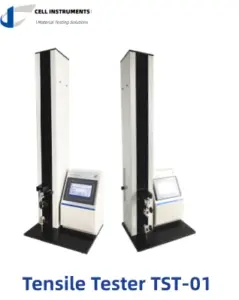
The Cell Instruments Tensile Tester (TST-01) supports ASTM D5587 testing by providing controlled extension rates, clear force–displacement visualization, and adaptable gripping solutions for textile specimens. Its flexibility allows laboratories to conduct not only tearing strength of fabric tests but also a wide range of tensile and peel evaluations across textiles, packaging materials, and medical components. This versatility aligns well with laboratories seeking long-term value and standardized testing capability.
Final Thoughts
ASTM D5587 provides a robust framework for evaluating tearing strength of fabric using the trapezoidal tear strength test. By following standardized procedures, selecting appropriate CRE testing equipment, and understanding the significance of tear propagation behavior, laboratories can generate meaningful data that supports quality assurance and product development. For textile professionals, mastering this method strengthens both technical competence and market credibility.
Frequently Asked Questions
1. What is the main purpose of the trapezoidal tear strength test?
The trapezoidal tear strength test measures the tearing strength of fabric after a tear has already started. It evaluates how well a fabric resists tear propagation under tensile loading, which closely reflects real-use conditions where small cuts or defects may already exist.
2. Why does ASTM D5587 require a CRE tensile testing machine?
ASTM D5587 specifies a constant-rate-of-extension (CRE) tensile testing machine because it provides stable, uniform crosshead movement and accurate force measurement. This consistency improves repeatability and comparability of trapezoidal tear strength test results between laboratories.
3. Which types of fabrics can be tested using ASTM D5587?
The standard applies to a wide range of textiles, including woven fabrics, knitted fabrics, napped and pile fabrics, layered structures, and coated or resin-treated materials. Both untreated and finished fabrics can be evaluated, making the method suitable for many industrial and technical textile applications.
4. How should trapezoidal tear strength test results be reported?
ASTM D5587 allows results to be reported as either the single-peak tearing force or the average of the five highest peak forces observed during testing. The chosen reporting method should be agreed upon in advance and used consistently for comparison.
5. What factors most influence tearing strength of fabric results?
Key factors include fabric structure, yarn type and density, finishing treatments, specimen preparation, and test alignment. Proper conditioning, accurate specimen marking, and the use of a reliable CRE tensile tester—such as the Cell Instruments TST-01—help ensure dependable trapezoidal tear strength test data.
 PL
PL  EN
EN  AR
AR  BG
BG  CS
CS  DA
DA  DE
DE  EL
EL  ES
ES  ET
ET  FI
FI  FR
FR  HU
HU  ID
ID  IT
IT  JA
JA  KO
KO  LT
LT  LV
LV  NB
NB  NL
NL  PT
PT  RO
RO  RU
RU  SK
SK  SL
SL  SV
SV  TR
TR  UK
UK