
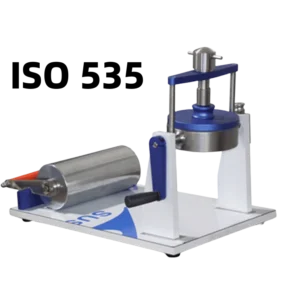
 Understanding the water absorptiveness of paper and board is essential for quality control in printing, packaging, and paper production. The Cobb tester for paper is a specialized instrument designed to measure the amount of water absorbed by a sample under standardized conditions. Following ISO 535 standards, this testing method provides reliable data to guide material selection, production processes, and product performance evaluations.
Cobb Absorption Resistance Tester: Key Features and Applications
De Cobb absorption resistance tester operates by placing a measured volume of water onto a fixed area of paper or board and timing the absorption. After a specified period, excess water is removed, and the absorbed amount is calculated. This method ensures that results are consistent, accurate, and comparable across different laboratories.
Key applications of the Cobb tester for paper include:
-
Paper Quality Assessment: Evaluating the water resistance of printing paper, packaging board, and corrugated fiberboard.
-
Process Control: Monitoring coating uniformity and surface treatments during production.
-
R&D Testing: Supporting development of new paper grades and coatings with desired absorption properties.
-
Comparative Analysis: Comparing different suppliers or batches for consistent performance in product applications.
Why Water Absorptiveness Testing Matters
Water absorption affects both the physical and functional properties of paper. High absorption can lead to ink spreading or poor barrier performance, while low absorption may indicate insufficient surface treatment. By using a Cobb tester for paper, manufacturers can:
-
Ensure Product Consistency: Maintain uniform quality across production batches.
-
Optimize Coating and Surface Treatments: Adjust processes to achieve desired absorption rates.
-
Support Compliance and Certification: Align testing with ISO 535 standards, ensuring international recognition of results.
-
Reduce Material Waste: Detect defects early and minimize rejected stock.
Testing Procedure According to ISO 535
To perform an accurate Cobb test:
-
Monstervoorbereiding: Cut paper or board to the required size (typically ≥50 g/m²) and condition under standard laboratory conditions.
-
Positioning: Place the sample under the Cobb tester’s water reservoir.
-
Water Exposure: Apply a measured volume of water and start the timer.
-
Drain Excess Water: After the specified time (commonly 60 seconds), remove surplus water.
-
Measurement: Weigh the absorbed water and calculate the Cobb value in grams per square meter (g/m²).
This method allows quality control personnel and researchers to reliably assess the water absorptiveness of paper and board, facilitating informed decisions for production and application.
Selecting the Right Cobb Tester for Paper
For laboratories and production facilities requiring precision and efficiency, the Cell Instruments COBB Absorption Tester is an ideal choice. It supports:
-
Multiple sample sizes and paper types.
-
Fast, repeatable measurements with high accuracy.
-
User-friendly operation with clear digital readouts.
-
Compliance with ISO 535 for standardized testing procedures.
Advantages of Using a Cobb Tester for Paper
-
Enhanced Accuracy: Reduces operator error and improves repeatability.
-
Time Efficiency: Faster than manual absorption measurements.
-
Comprehensive Data: Provides results suitable for reporting, audits, and product development.
-
Industry Reliability: Widely adopted across printing, packaging, and paper manufacturing sectors.
Conclusie
De Cobb tester for paper is an indispensable tool for assessing water absorptiveness according to ISO 535. By integrating this testing into production and quality control, manufacturers and laboratories can ensure high-quality, consistent paper products, optimize coating processes, and maintain international compliance. The Cobb absorption resistance tester from Cell Instruments combines precision, efficiency, and reliability, supporting professionals in achieving accurate, standardized results.
FAQs
Q1: Can the Cobb tester measure coated and uncoated papers?
A: Yes, it is suitable for both, provided the grammage meets ISO 535 requirements.
Q2: What sample size is recommended?
A: Typically, samples ≥50 g/m², avoiding highly porous papers like newsprint.
Q3: How long does a standard Cobb test take?
A: Standard exposure is usually 60 seconds, but it can be adjusted per ISO 535.
Q4: Can the results be used for certification purposes?
A: Yes, ISO 535 compliance ensures internationally recognized results.
Q5: Is operator training required?
A: Basic training ensures accurate sample handling and consistent measurement results.
 NL
NL  EN
EN  AR
AR  BG
BG  CS
CS  DA
DA  DE
DE  EL
EL  ES
ES  ET
ET  FI
FI  FR
FR  HU
HU  ID
ID  IT
IT  JA
JA  KO
KO  LT
LT  LV
LV  NB
NB  PL
PL  PT
PT  RO
RO  RU
RU  SK
SK  SL
SL  SV
SV  TR
TR  UK
UK