
Geomembrane Puncture Testing
ASTM D4883
Geomembranes play a crucial role in environmental containment applications such as landfills, reservoirs, and mining ponds. Ensuring their durability and puncture resistance is vital to prevent leaks and system failures. The geomembrane puncture test is a standardized method used to evaluate the ability of these materials to withstand mechanical stress and penetration, providing an essential indicator of performance and quality.
Importance of the Geomembrane Puncture Test
The puncture resistance of geomembranes directly affects their protective function in harsh environments. Sharp stones, construction debris, or installation stress can compromise the integrity of a liner system if the material lacks sufficient puncture strength. Therefore, performing a geomembrane puncture test helps manufacturers, engineers, and quality control specialists ensure that the material meets project-specific durability requirements and complies with international standards such as ASTM D4833.
This test also assists in comparing materials, optimizing production formulations, and improving design reliability. It is particularly important in geomembrane quality assurance programs for geotechnical and civil engineering projects.
Index Puncture Resistance of Geomembrane (ASTM D4833)
Svetainė index puncture resistance of geomembrane defined in ASTM D4833/D4833M provides a standardized way to determine the material’s resistance to localized penetration. In this method, a test specimen is securely clamped between circular plates and subjected to a puncturing force by a solid steel rod using a tensile testing machine.
Svetainė maximum force recorded before rupture represents the puncture resistance value of the geomembrane. This value serves as a comparative index, enabling users to assess material performance under consistent and reproducible conditions.
Key aspects of ASTM D4833 include:
- The specimen is clamped without tension between circular plates.
- The puncture force is applied at a constant speed of 300 ± 10 mm/min (12 ± ½ in/min).
- Svetainė puncture resistance is determined from the peak force recorded during testing.
- For composite materials, the first rupture point is reported, even if a second higher peak occurs.
This standardized test method ensures accurate and uniform data reporting across laboratories and manufacturers.
Puncture Resistance Test of Geomembrane: Procedure and Interpretation
Performing a puncture resistance test of geomembrane requires precision and consistency. A properly calibrated tensile or compression testing machine, such as the Cell Instruments Tensile Tester, ensures the test load is applied smoothly and at the correct rate.
The test procedure involves:
- Selecting an appropriate load range so that rupture occurs between 10% and 90% of full-scale load.
- Securing the geomembrane specimen centrally between the clamp plates.
- Applying the puncture rod until complete rupture occurs.
- Recording the maximum force as the puncture resistance value.
The results are used to evaluate geomembrane puncture strength and to compare materials or manufacturing batches. A higher puncture resistance indicates superior durability and suitability for demanding field applications.
Geomembrane Puncture Strength Test: Applications and Benefits
Svetainė geomembrane puncture strength test is indispensable in the design and selection of geomembranes for containment systems. It provides essential insights into:
- Material toughness and ability to resist sharp object penetration.
- Performance comparison among geomembrane types (HDPE, LLDPE, PVC, etc.).
- Quality control for manufacturers to ensure consistency in production.
- Project safety assurance, minimizing the risk of leakage or failure.
By integrating this test during material qualification and production stages, organizations can significantly improve long-term performance and environmental safety.
Recommended Testing Equipment: Cell Instruments Tensile Tester
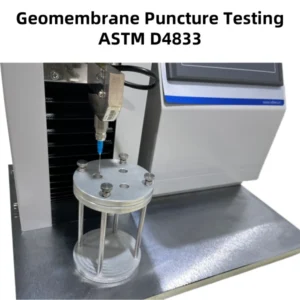 For reliable and precise geomembrane puncture testing, Cell Instruments’ Tempimo testeris offers advanced load control, stable test speed, and high-resolution data acquisition. Its design supports various geosynthetic testing fixtures, including ring clamps and puncture rods specified in ASTM D4833.
Key advantages include:
- High accuracy and repeatability of test results.
- User-friendly software for real-time data analysis.
- Compatibility with multiple test standards and sample types.
By using Cell Instruments’ equipment, laboratories and quality control departments can achieve consistent, compliant, and efficient puncture resistance evaluation for geomembranes and related products.
DUK
1. What is the purpose of the geomembrane puncture test?
The geomembrane puncture test determines the material’s resistance to puncture and penetration under controlled laboratory conditions. It provides an index value that helps assess the material’s toughness, quality, and suitability for field applications.
2. Which standard is used for testing geomembrane puncture resistance?
The most widely recognized standard is ASTM D4833 – Standard Test Method for Index Puncture Resistance of Geomembranes and Related Products, which defines the procedure, speed, and test configuration for consistent and comparable results.
3. What equipment is required for performing the geomembrane puncture test?
A tensile testing machine equipped with a ring clamp fixture and puncture rod is used. Instruments like the Cell Instruments Tensile Tester are ideal because they provide precise force control and accurate data recording in compliance with ASTM D4833.
4. What factors influence the puncture resistance of a geomembrane?
Puncture resistance depends on several factors, including material type (HDPE, PVC, etc.), thickness, formulation, temperature, and manufacturing process. Thicker and more elastic materials generally exhibit higher resistance to puncture.
5. How often should the puncture resistance of geomembranes be tested?
It is recommended to test each production batch and conduct verification tests during material qualification, installation, and quality audits. Regular testing ensures consistency and long-term reliability of geomembrane performance.
 LT
LT  EN
EN  AR
AR  BG
BG  CS
CS  DA
DA  DE
DE  EL
EL  ES
ES  ET
ET  FI
FI  FR
FR  HU
HU  ID
ID  IT
IT  JA
JA  KO
KO  LV
LV  NB
NB  NL
NL  PL
PL  PT
PT  RO
RO  RU
RU  SK
SK  SL
SL  SV
SV  TR
TR  UK
UK