
Introduction to ASTM D4595
ASTM D4595 defines a standardized procedure for determining the tensile properties of geotextiles using a wide specimen. Engineers and quality control professionals rely on this method to evaluate how geotextiles behave under tensile stress in real-world applications.
Unlike narrow strip methods, ASTM D4595 uses a wide-width tensile test method, which minimizes lateral contraction (necking). This feature ensures that test results better reflect actual field performance, especially for nonwoven and flexible geotextile materials.
The method applies to a broad range of materials, including woven, nonwoven, knitted, and layered geotextiles used in infrastructure and environmental engineering.
Tensile Properties of Geotextiles
を理解する tensile properties of geotextiles is critical for applications such as soil reinforcement, road construction, and erosion control.
ASTM D4595 evaluates several key parameters:
- 抗張力: Maximum force per unit width at rupture
- Elongation: Percentage increase in length at a given force
- Initial Modulus: Stiffness at the early stage of loading
- Secant and Offset Modulus: Material response at defined strain levels
- Breaking Toughness: Energy absorbed before failure
These values provide essential design data for engineers working on reinforced soil structures, embankments, and retaining systems.
Wide-Width Tensile Test Method Explained
の wide-width tensile test method follows a controlled procedure using a constant rate of extension (CRE) tensile testing machine.
Key Procedure Overview
- 標本の準備
The test uses a wide specimen to reduce edge effects and simulate in-field stress distribution. - クランプ
The specimen is gripped across its full width. Proper alignment is critical to avoid stress concentration. - テスト実行
The machine applies tensile force at a specified rate (typically 10 ± 3 % strain per minute) until rupture. - データ収集
The system records force and elongation continuously, generating a force-elongation curve. - 結果計算
Tensile strength is calculated as force per unit width, while elongation and modulus values derive from the curve.
Why Wide Width Matters
Traditional narrow strip tests often underestimate performance due to necking effects. ASTM D4595 eliminates this issue, making it more suitable for:
- Nonwoven geotextiles
- High-elongation materials
- Reinforcement applications
Wide Width Tensile Testing Equipment
Selecting the right wide-width tensile testing equipment is essential for accurate and repeatable results.
A high-performance tensile tester should include:
- Stable control system for precise load application
- Wide clamping fixtures to accommodate full-width specimens
- Accurate displacement measurement for elongation analysis
- Flexible speed control to meet ASTM requirements
- Data acquisition system for real-time curve analysis
Recommended Geotextiles Wide-Width Tensile Test Solution
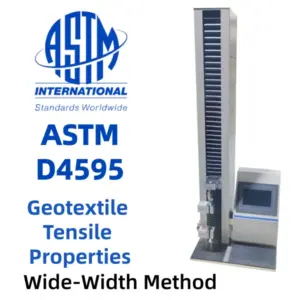
の セルインストゥルメンツ TST-01 Wide-Width Tensile Testing Equipment is well-suited for ASTM D4595 testing. It offers:
- PLC-controlled operation with intuitive touchscreen interface
- High precision displacement control (±0.01 mm)
- Adjustable speed range (1–500 mm/min)
- Robust mechanical structure for long-term reliability
- Compatibility with custom fixtures for geotextile testing
Its adaptability makes it ideal for laboratories handling diverse geotextile materials and testing conditions.
Significance of ASTM D4595 in Engineering Applications
ASTM D4595 provides reliable design parameters for geotechnical engineering projects. Engineers use the results to:
- Design reinforced roadways and pavements
- Evaluate slope stability systems
- Develop retaining wall reinforcements
- Assess embankments over soft soils
Because the test closely simulates field stress conditions, it delivers more realistic performance data compared to narrower test methods.
よくある質問
1. What makes ASTM D4595 different from grab tensile tests?
ASTM D4595 uses a wide specimen, reducing edge effects and providing more representative results than grab tests.
2. Can ASTM D4595 be used for wet geotextiles?
Yes, the standard includes procedures for testing both conditioned and wet specimens.
3. Why is specimen width important in this test?
A wider specimen minimizes necking and better simulates real-world load distribution.
4. What type of machine is required?
A constant rate of extension (CRE) tensile testing machine is required.
5. How do you handle slippage during testing?
You can modify clamps, add padding, or adjust gripping surfaces to improve performance.
 JA
JA  EN
EN  AR
AR  BG
BG  CS
CS  DA
DA  DE
DE  EL
EL  ES
ES  ET
ET  FI
FI  FR
FR  HU
HU  ID
ID  IT
IT  KO
KO  LT
LT  LV
LV  NB
NB  NL
NL  PL
PL  PT
PT  RO
RO  RU
RU  SK
SK  SL
SL  SV
SV  TR
TR  UK
UK