
Test dello strappo di Elmendorf
Il Elmendorf tear test is a widely adopted method for evaluating the tear strength of plastic films, paper, and other thin sheeting materials. It plays a critical role in assessing the durability and mechanical resistance of flexible materials used in packaging, medical, textiles, and industrial applications. This test, standardized under ASTM D1922, provides valuable data for material selection, quality assurance, and product design.
Introduzione
Tear strength measures a material’s ability to resist the propagation of a tear once it has started. This property is especially crucial in packaging applications where integrity under stress—such as during transportation or handling—is vital. A weak material may tear easily, compromising both the functionality and safety of the product it protects.
Il ASTM D1922 standard outlines the procedure for determining tear resistance using a pendulum-style tear tester—commonly referred to as the Elmendorf method. It is designed to simulate real-world tear conditions by measuring the force required to continue tearing a precut slit in a material sample. The result reflects the energy absorbed during tear propagation, which directly correlates with material strength.
Key Features :
-
Test Type: Propagation tear resistance using a pendulum method
-
Units: Measured in millinewtons (mN) or grams-force
-
Specimens: Films or sheeting ≤ 0.25 mm thick, with a pre-slit of 20 mm
-
Direction: Both machine and transverse directions are tested for anisotropic materials
-
Applicazione: Primarily used for plastic films, paper, textiles, and laminated packaging
How the Elmendorf Tear Test Works
The test involves clamping a pre-slit specimen between two jaws—one fixed, the other attached to a swinging pendulum. Once released, the pendulum tears through the remaining material, and the energy expended is measured. The resulting force gives insight into the strength of tearing and consistency of the material across samples.
Step-by-Step Process:
-
Preparazione del campione – Cut standardized samples using a die, and pre-slit them to 20 mm depth.
-
Condizionamento – Maintain standard temperature and humidity before testing.
-
Montaggio – Clamp the specimen into the test apparatus.
-
Test Execution – Release the pendulum and allow it to tear through the sample.
-
Result Recording – The energy required is displayed and recorded automatically by the system.
Equipment
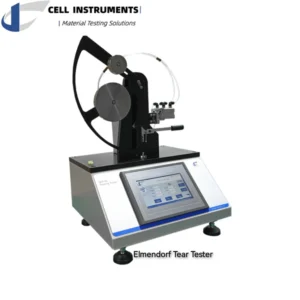
For accurate and consistent results, a reliable tester is essential. The Strumenti a cella SLD-01 is a high-performance option engineered for Elmendorf tear testing in accordance with ASTM standard.
-
Compliant with ASTM D1922 and ISO 6383-2
-
PLC control and HMI touchscreen for intuitive operation
-
Automatic pendulum release and pneumatic clamping for repeatable results
-
Data auto-statistics with real-time reporting and optional microprinter
-
Broad test range suitable for paper, film, foil, and nonwoven materials
This tear tester is particularly beneficial for quality control professionals in packaging, printing, film production, and material research labs.
Applicazioni
Il Elmendorf method is indispensable in evaluating the suitability of materials in sectors where tear resistance impacts performance and safety:
-
Imballaggio flessibile – Ensures plastic films won’t rupture during transportation or sealing
-
Medical and Pharmaceuticals – Validates film strength in blister packs, pouches, and wraps
-
Textile and Nonwoven Industries – Measures durability of fabrics and hygiene products
-
Paper and Printing – Determines resistance of coated and laminated paper to tearing
Accurate Testing Tips
To maintain accuracy and reproducibility in yourtest, consider the following:
-
Use specimens of consistent thickness and free from defects
-
Ensure pendulum bearings are clean and friction-free
-
Perform regular calibration using certified check weights
-
Follow ASTM guidelines for environmental conditioning
-
Test samples in both machine and transverse directions for anisotropic materials
Conclusione
Il Elmendorf tear test offers a simple yet powerful way to quantify the tear strength of thin materials under dynamic stress. By adhering to ASTM D1922, manufacturers and researchers can evaluate material performance with confidence.
For those seeking reliable and compliant equipment, the SLD-01 Tester a strappo da Strumenti a cella delivers precise, repeatable results that support R&D, production, and quality assurance needs.
 IT
IT  EN
EN  AR
AR  BG
BG  CS
CS  DA
DA  DE
DE  EL
EL  ES
ES  ET
ET  FI
FI  FR
FR  HU
HU  ID
ID  JA
JA  KO
KO  LT
LT  LV
LV  NB
NB  NL
NL  PL
PL  PT
PT  RO
RO  RU
RU  SK
SK  SL
SL  SV
SV  TR
TR  UK
UK