
Tablet Hardness Test
The tablet hardness test is a fundamental quality control procedure used in the pharmaceutical industry to determine the mechanical strength of tablets. It ensures that tablets maintain their structural integrity during production, packaging, transportation, and use. Insufficient hardness may lead to crumbling or breakage, while excessive hardness can impair disintegration and bioavailability.
Pharmaceutical manufacturers rely on this test to comply with regulatory requirements and ensure consistent drug performance. At Instrumen Sel, we support laboratories and production environments with advanced solutions like the MPT-02 Tablet Hardness Tester to streamline this critical testing process.
The Role of Compression Test in Tablet Hardness
A compression test measures the force required to break or deform a tablet. In tablet testing, this is commonly referred to as a tablet breaking force test. It offers insight into the mechanical robustness of the tablet, revealing potential formulation or manufacturing issues.
When hardness is too low, tablets may fracture under minimal stress, such as during bottle filling or patient handling. Conversely, overly hard tablets may resist necessary breakdown in the gastrointestinal tract, affecting drug release.
Key parameters assessed during tablet hardness testing include:
-
Maximum force needed to crush the tablet (usually in Newtons)
-
Displacement at the point of breaking
-
Test speed and force curve characteristics
Importance of Tablet Hardness in Pharmaceutical Manufacturing
Tablet hardness directly affects:
-
Product consistency and quality
-
Disintegration and dissolution rates
-
Shelf-life and transport safety
-
Regulatory compliance and patient safety
Menurut USP <1217> and other pharmacopeial standards, regular hardness testing helps manufacturers maintain process control and identify issues like granulation inconsistency or improper compression force.
Equipment for Hardness Testing
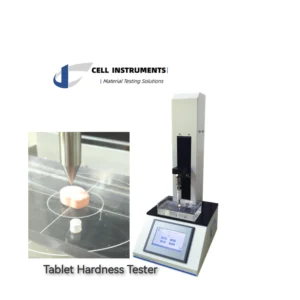
A reliable tablet hardness tester must offer precision, repeatability, and user-friendly operation. The MPT-02 Tablet Hardness Tester from Cell Instruments is designed to meet these criteria with the following advantages:
-
High accuracy (0.5% F.S.) and resolution of 0.01mm
-
7-inch HMI touchscreen for intuitive control
-
Real-time force display for dynamic data monitoring
-
Adjustable test speed up to 500 mm/min
-
Built-in microprinter and optional software for traceability
-
Multiple fixtures for different tablet shapes and strengths
This tester supports both crushing strength method dan indentation depth method, allowing comprehensive assessment based on product and regulatory requirements.
Comparing with Other Tablet Strength Tests
Aside from the tablet hardness test, several other mechanical tests evaluate tablet quality:
Friability Test
The friability test determines how easily a tablet crumbles under mechanical stress, simulating handling and transport. While hardness measures breaking force, friability reflects resistance to surface wear.
Three-Point Bending Test
Used in special cases, the three-point bending test applies force at the center of a tablet supported at both ends. It evaluates tablet strength in flexible or elongated dosage forms.
How to Conduct a Standard Tablet Hardness Test
Step-by-step guide to conducting a hardness test using MPT-02 or similar devices:
-
Preparation: Select representative tablet samples from a batch.
-
Pengaturan: Place the tablet horizontally between the press jaws.
-
Pengujian: Apply compression force at a consistent rate.
-
Data Collection: Record the force at which the tablet fractures.
-
Analysis: Compare readings with product specifications and regulatory thresholds.
It’s crucial to calibrate the device regularly to maintain measurement accuracy and compliance.
Compliance with Regulatory Standards
Tablet hardness testing aligns with international standards such as:
-
USP <1217>: Tablet Breaking Force
-
EP 2.9.8: Resistance to Crushing of Tablets
-
USing a standardized tester like MPT-02 ensures compliance with these regulatory frameworks, enhancing both audit readiness and market credibility.
Conclusion: Optimizing Drug Quality with the Right Testing Tools
A properly executed tablet hardness test plays a vital role in ensuring drug performance, patient safety, and regulatory compliance. It enables pharmaceutical professionals to optimize formulations and production parameters.
Di Instrumen Sel, we understand the critical role this test plays. Our MPT-02 provides pharmaceutical manufacturers with the precision and reliability needed for modern quality control.
For pharmaceutical labs, manufacturers, and quality control teams seeking accuracy, compliance, and efficiency—Cell Instruments is your trusted testing partner.
 ID
ID  EN
EN  AR
AR  BG
BG  CS
CS  DA
DA  DE
DE  EL
EL  ES
ES  ET
ET  FI
FI  FR
FR  HU
HU  IT
IT  JA
JA  KO
KO  LT
LT  LV
LV  NB
NB  NL
NL  PL
PL  PT
PT  RO
RO  RU
RU  SK
SK  SL
SL  SV
SV  TR
TR  UK
UK