
Trapezoidal Tear Strength Testing
ASTM D4533
The trapezoidal tear strength test is a fundamental method for evaluating the tearing resistance of woven and nonwoven materials, especially geotextiles and industrial fabrics. It helps manufacturers, researchers, and quality inspectors determine a material’s durability when subjected to tearing forces. This test, standardized in ASTM D4533, measures the trapezoid tearing strength of geotextiles and offers valuable insight into product performance during practical use.
In industries like packaging, textiles, and geotechnical engineering, understanding tear resistance ensures that materials perform reliably under mechanical stress. Companies such as Instrumen Sel provide advanced tensile testing systems that accurately perform this test for a variety of materials.
What Is the Trapezoidal Tear Strength Test?
The trapezoidal tear strength test determines the force required to propagate a tear in a sample material shaped like a trapezoid. The unique geometry allows the tear to develop in a controlled way, producing consistent results that indicate the tear tensile strength of fabric or geotextile materials.
This method is particularly useful because it simulates real-world conditions where small punctures or cuts might expand under tension. The test results reflect how well a material resists such propagation, making it a crucial metric for fabric integrity and product reliability.
ASTM D4533 – Standard Trapezoidal Tear Strength Test Method
The ASTM D4533 standard provides the official guidance for conducting the trapezoid tear strength test. The procedure applies to most woven, nonwoven, and layered geotextiles, including knitted fabrics and felts used in civil engineering and construction.
Key steps in the test include:
- Cutting the specimen into a trapezoidal shape with a small slit at the center.
- Clamping the two nonparallel sides in a tensile testing machine.
- Applying a continuous pulling force at a constant rate (typically 300 ± 10 mm/min).
- Recording the maximum tearing force from the force-extension curve.
The kekuatan maksimum obtained represents the trapezoid tearing strength. For reliable data, each sample is tested in both the machine direction (warp) dan cross-machine direction (weft).
Importance and Applications of Trapezoid Tearing Strength in Geotextiles
Memahami trapezoid tearing strength of geotextiles is vital for predicting their performance in real-world applications. In construction and environmental engineering, geotextiles serve as reinforcement, separation, or filtration layers. They must withstand mechanical stress during installation and service.
For woven fabrics, the tearing resistance primarily depends on yarn strength and alignment. In contrast, nonwoven materials rely on fiber bonding and random orientation. By comparing results in different directions, engineers can optimize the structure for maximum durability.
This test also assists quality control personnel in identifying weak points in the material, ensuring compliance with industry standards before large-scale use.
Tear Strength Test Method for Fabrics and Other Materials
The tear strength test method for fabrics not only applies to geotextiles but also to products used in packaging, medical textiles, and technical clothing. Measuring tear tensile strength helps manufacturers evaluate product safety, longevity, and overall mechanical performance.
Recommended Equipment – Cell Instruments Tensile Tester
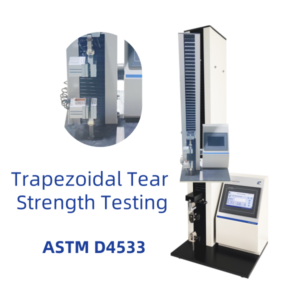
To conduct a precise trapezoidal tear strength test, laboratories need a reliable tensile testing machine capable of constant-rate load control and accurate data acquisition. Instrumen Sel offers advanced tensile testers designed specifically for geotextiles, textiles, packaging materials, and plastics.
Key features include:
- High-accuracy load cells for precise measurement of tear force.
- Programmable test speed control for ASTM D4533 compliance.
- Customizable grips and fixtures for woven and nonwoven specimens.
- User-friendly software for automatic data recording and result analysis.
These instruments not only improve testing efficiency but also help clients meet international standards and project requirements.
PERTANYAAN YANG SERING DIAJUKAN
Q1: What is the purpose of the trapezoidal tear strength test?
It measures a material’s resistance to tear propagation, helping evaluate its mechanical durability.
Q2: Which materials can be tested using ASTM D4533?
Woven, nonwoven, knitted, and layered geotextiles, as well as industrial fabrics.
Q3: Why use the trapezoidal shape for testing?
It allows controlled tear propagation and consistent results compared to irregular tear tests.
Q4: What equipment is recommended for this test?
A tensile tester with constant-rate motion, such as the models provided by Instrumen Sel, is ideal for ASTM D4533 compliance.
 ID
ID  EN
EN  AR
AR  BG
BG  CS
CS  DA
DA  DE
DE  EL
EL  ES
ES  ET
ET  FI
FI  FR
FR  HU
HU  IT
IT  JA
JA  KO
KO  LT
LT  LV
LV  NB
NB  NL
NL  PL
PL  PT
PT  RO
RO  RU
RU  SK
SK  SL
SL  SV
SV  TR
TR  UK
UK