
ASTM D7003 defines a standardized approach for evaluating the strip tensile properties of reinforced geomembranes. These materials, widely used in environmental containment systems such as landfills, mining, and water reservoirs, rely heavily on tensile strength and elongation performance.
This test method focuses on quality control, quality assurance, and comparative analysis, rather than structural design. It specifically measures how reinforced geomembranes behave under tensile stress applied along reinforcement directions.
Key highlights include:
- Evaluation of reinforced geomembranes with textile yarns
- Testing in both gépirány (MD) és transverse direction (TD)
- Measurement of peak strength, elongation, and final break properties
Maintaining standardized testing conditions—typically 21 ± 2°C and 50–70% RH—ensures reproducibility and reliability.
Geomembrane Strip Tensile Strength Test
A geomembrane tensile strength test under ASTM D7003 determines how much force a material can withstand before failure. The method requires precise specimen preparation and controlled loading conditions.
Specimen Preparation Requirements
Proper sampling is critical:
- Specimen width: 25 mm
- Length: ≥150 mm
- Minimum of 5 specimens per direction (MD & TD)
- Reinforcement yarns must remain continuous between clamps
⚠️ If reinforcement strands are interrupted, the tensile strength results may be significantly underestimated.
Geomembrane Tensile Test Method Procedure Overview
A geomembrane tensile test method follows a structured sequence:
- Set clamp spacing to 75 mm
- Align specimen centrally with reinforcement direction
- Apply tensile load at 300 mm/min
- Continue until complete failure of both reinforcement and polymer layer
- Rekord:
- Peak load
- Load at break
- Elongation values
- Terhelés-hosszabbítási görbe
Invalid results (e.g., slippage or edge break) must be discarded and retested.
Key Calculations in ASTM D7003 Testing
Tensile Strength Calculation
Tensile strength is expressed as:
- Force per unit width (kN/m)
- Calculated by dividing maximum load by specimen width
Elongation Test of Geomembranes
A elongation test of geomembranes measures deformation:
- Elongation (%) = (Grip displacement ÷ 75 mm) × 100
Statisztikai elemzés
Results must include:
- Average values
- Standard deviation
- Separate reporting for MD and TD
This ensures data reliability and consistency, especially for industrial quality control.
Importance of ASTM D7003 in Quality Assurance
ASTM D7003 plays a critical role in:
- Verifying material consistency across production batches
- Támogatás supplier qualification
- Ensuring compliance with project specifications
It is particularly valuable for industries where geomembrane integrity directly impacts environmental safety, such as landfill liners and containment systems.
Recommended Testing Solution: Cell Instruments Tensile Tester
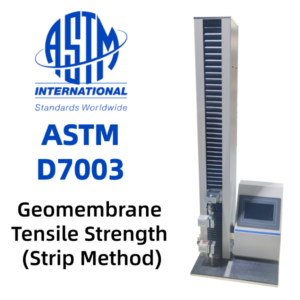
To achieve accurate and repeatable results in ASTM D7003 testing, selecting the right equipment is essential.
A Cell Instruments TST-01 Szakító tesztelő provides a robust solution:
Why It Fits ASTM D7003 Applications
- Precise speed control (1–500 mm/min) ensures compliance with required test rates
- Nagy pontosság (0,5% FS) guarantees reliable tensile data
- Stable PLC control with HMI interface allows real-time curve monitoring
- Testreszabható szerelvények support geomembrane-specific gripping needs
- Smooth displacement via ball screw system improves repeatability
Ensure accurate and repeatable geomembrane tensile testing with ASTM D7003-compliant solutions. Cell Instruments offers advanced tensile testers designed for precise control, reliable data acquisition, and flexible testing configurations. Whether you need to measure tensile strength, elongation, or failure behavior, our systems deliver consistent results for quality assurance and research. Contact us today to optimize your geomembrane testing process with professional-grade instrumentation.
GYIK
1. What is ASTM D7003 mainly used for?
It evaluates the tensile properties of reinforced geomembranes, primarily for quality control and material comparison.
2. Why is reinforcement direction important in testing?
Because tensile strength varies depending on yarn orientation, testing in MD and TD ensures accurate performance evaluation.
3. What happens if reinforcement yarns are cut during specimen preparation?
The test results may show significantly reduced tensile strength, making them unreliable.
4. Is ASTM D7003 suitable for design calculations?
Nem. Ez egy index test method, not intended for engineering design purposes.
5. Milyen felszerelésre van szükség a ASTM D7003 tesztelés?
A universal tensile testing machine with controlled speed, accurate load measurement, and appropriate grips—such as the Cell Instruments TST-01.
 HU
HU  EN
EN  AR
AR  BG
BG  CS
CS  DA
DA  DE
DE  EL
EL  ES
ES  ET
ET  FI
FI  FR
FR  ID
ID  IT
IT  JA
JA  KO
KO  LT
LT  LV
LV  NB
NB  NL
NL  PL
PL  PT
PT  RO
RO  RU
RU  SK
SK  SL
SL  SV
SV  TR
TR  UK
UK  HE
HE  TH
TH  VI
VI