
USP 1217
The Standard for Tablet Strength Testing
In pharmaceutical production, tablet integrity is not just about appearance—it directly influences efficacy, stability, and patient experience. USP <1217> establishes a comprehensive framework for evaluating tablet mechanical strength, focusing on tablet hardness, force de rupture, and structural durability. These metrics guide formulation, inform quality control, and ensure tablets can withstand manufacturing and real-world handling without failure.
Modern instrumentation—like Cell Instruments’ MPT-02 Tablet Hardness Tester—enables manufacturers to perform these tests with precision and repeatability, aligning with USP <1217> while supporting process efficiency and regulatory compliance.
Critical Testing Protocols: From Tablet Hardness Test to Friability
Tablet Hardness Test and Break Test: Why Breaking Force Matters
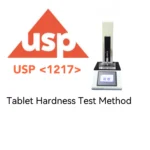
Le tablet hardness test isn’t simply about measuring surface resistance. In the context of USP <1217>, it refers to the break test—the compressive force needed to fracture a tablet. This force, also called the tablet crushing strength, offers insights into internal bonding, compression uniformity, and formulation performance.
Le MPT-02 Tablet Hardness Tester, with a digital force sensor and constant platen movement, is tailored for such analysis. It records peak force applied to a sample placed between two platens, helping users determine if the tablet meets required strength standards. The test is especially important for chewable, coated, or scored tablets, where breakage can alter drug delivery or dosage accuracy.
Friability of Tablet: Mechanical Robustness Beyond Compression
While breaking force tests the resistance to direct pressure, friability tests simulate abrasion and surface stress during handling. According to USP <1216>, which complements USP <1217>, tablets are tumbled inside a rotating drum to measure weight loss from chipping or erosion.
Friability is critical when evaluating fragile formulations or tablets with surface coatings. Excessive friability suggests that a tablet might crumble during packaging, shipping, or administration. A weight loss greater than 1.0% is typically unacceptable.
For manufacturers aiming to minimize friability issues, it’s crucial to adjust binder concentrations, optimize compression forces, or refine tablet shape. These adjustments should always be verified using a calibrated tablet tester to prevent overcorrection that might hinder disintegration.
Flexure Test and Tablet Brittleness Test: Advanced Structural Insight
Not all tablets fail in the same way. Some exhibit brittle failure, cracking under minimal stress, while others bend or deform. This is where a flexure test—often a three-point bending test—becomes valuable. It evaluates how tablets behave under bending forces, simulating handling scenarios that compress the tablet on one side while stretching it on the other.
Le tablet brittleness test evaluates fracture behavior across different strain rates. If a formulation is prone to brittle failure, it may crack during automatic feeding or blister packaging. Flexure testing is especially recommended for elongated or capsule-shaped tablets where diametral compression may not provide reliable results.
Tablet Crushing Strength Testing: Getting the Metrics Right
While USP standard discourages using “hardness” as a generic term, crushing strength remains a widely recognized descriptor for measuring the force needed to compress and fracture a tablet. Key variables in this test include platen speed, tablet geometry, and support fixtures.
Consistency is key. Results must be recorded in newtons (N), and equipment must maintain a constant loading rate. Instruments like the MPT-02 automatically adjust speed and capture real-time data, minimizing operator error and ensuring compliance with pharmacopeial protocols.
Why Tablet Testing is Critical for Your Operation
For QA teams, R&D departments, and production engineers, understanding and applying USP <1217> testing methods helps identify formulation weaknesses before tablets reach the market. Proper testing also reduces returns, supports regulatory audits, and increases confidence in product quality.
At Cell Instruments, we offer more than just reliable testers—we deliver tailored solutions for clients across pharmaceutical, medical packaging, and material science sectors. Whether you’re evaluating tablet brittleness, conducting friability tests, or validating crushing strength, our instruments support accurate, reproducible measurements every time.
Conclusion: Bring Precision to Your Tablet Testing with Cell Instruments
From break test à flexure test, and from hardness à friability, every mechanical evaluation provides critical insight into the physical performance of solid dosage forms. By following USP <1217> and integrating advanced solutions like the MPT-02 Tablet Hardness Tester, manufacturers can ensure tablets are robust, consistent, and compliant.
If you’re optimizing a production line or developing new formulations, contact Cell Instruments Co. for professional support and high-performance testing instruments that adapt to your evolving needs.
 FR
FR  EN
EN  AR
AR  BG
BG  CS
CS  DA
DA  DE
DE  EL
EL  ES
ES  ET
ET  FI
FI  HU
HU  ID
ID  IT
IT  JA
JA  KO
KO  LT
LT  LV
LV  NB
NB  NL
NL  PL
PL  PT
PT  RO
RO  RU
RU  SK
SK  SL
SL  SV
SV  TR
TR  UK
UK