
ISO 9008
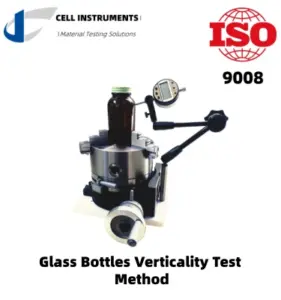
Glass Bottles Verticality Test Method
 ISO 9008 is an internationally recognized standard dedicated to evaluating the verticality of glass bottles. In high-speed filling, capping, and labeling operations, even small deviations from the vertical axis can create significant problems, including instability, misalignment, and line stoppages. ISO 9008 addresses these risks by defining a clear and reproducible test method for measuring vertical axis deviation under controlled conditions.
This article introduces ISO 9008 from a testing-method perspective, explaining why the test matters, how the test is conducted, et which application materials are involved, while highlighting best practices for reliable quality control.
Bottle Perpendicularity Tester and Vertical Axis Deviation Tester
Le glass bottles verticality test method specified in ISO 9008 focuses on the geometric relationship between the base of a bottle and the finish. Rather than isolating a single defect, the method evaluates the combined effect of multiple deformations, including base ovality, body tilt, finish offset, and finish ovality.
To achieve accurate and repeatable measurements, laboratories typically use a testeur de perpendicularité de bouteille or a vertical axis deviation tester. These devices support controlled rotation of the bottle and precise distance measurement at the finish level. By standardizing both positioning and measurement, ISO 9008 ensures that results remain comparable across different production sites and inspection laboratories.
Purpose and Significance of ISO 9008 Testing
The main purpose of ISO 9008 is to quantify how far a glass bottle deviates from an ideal vertical orientation when placed on a flat horizontal surface. This information directly supports:
-
Quality control during glass bottle production
-
Verification of compliance with customer specifications
-
Reduction of filling line disruptions
-
Improved consistency between production batches
ISO 9008 emphasizes practical performance. Bottles that fall outside the specified verticality tolerance often cause difficulties on fast filling lines, especially in automated environments where stability and alignment are critical.
Application Materials Covered by ISO 9008
ISO 9008 applies specifically to glass bottles, regardless of their intended use. The bottle perpendicularity test for these containers accommodates both round and non-round designs, provided the bottle can be centered and rotated accurately during measurement.
Because the method evaluates overall vertical performance, it remains suitable for bottles with complex shapes or decorative finishes.
Sampling and Test Considerations
ISO 9008 leaves sampling decisions to agreement between involved parties, allowing flexibility for routine inspection or dispute resolution. Regardless of sample size, preparation consistency remains critical.
Before testing, operators should confirm that:
-
Bottles rest on a clean, level surface
-
The measuring reference point remains fixed
-
No external force distorts the container during positioning
About expression of vertical axis deviation and calculation, ISO 9008 defines a simple and transparent calculation method. The vertical axis deviation equals half the difference between the maximum and minimum measured distances.
This value represents the horizontal deviation of the bottle’s centerline from an ideal vertical line. Because the calculation incorporates the full rotation, it captures the overall vertical behavior of the bottle rather than a single localized defect.
Test Report and Data Traceability
A compliant ISO 9008 test report supports traceability and audit readiness. Typical report content includes:
-
Reference to ISO 9008
-
Sample size and bottle type
-
Manufacturing or batch details
-
Type of testing apparatus used
-
Measured results
-
Tester identification and test date
Clear documentation ensures that verticality data can be reviewed, compared, and verified over time.
Instrumentation for Reliable ISO 9008 Testing
The accuracy of ISO 9008 testing depends heavily on stable instrumentation. A well-designed testeur de perpendicularité de bouteille reduces operator influence and improves measurement consistency.
Le Cell Instruments PER-01 Bottle Perpendicularity Tester supports ISO 9008 testing by providing stable bottle positioning, smooth rotation, and precise deviation readings. Its design suits both laboratory analysis and routine production inspection, helping manufacturers implement ISO 9008 efficiently without unnecessary complexity.
Conclusion
ISO 9008 provides a practical and standardized approach to assessing glass bottle verticality. By addressing real-world deformation effects and defining a repeatable test process, the standard helps manufacturers maintain filling line efficiency and packaging reliability.
When combined with appropriate instrumentation such as the Instruments cellulaires PER-01, ISO 9008 becomes a valuable quality control tool for glass bottle producers and users worldwide, supporting consistent performance across diverse applications.
FAQs About ISO 9008
1. What is ISO 9008 used for?
ISO 9008 is an international standard that defines a test method for determining the verticality of glass bottles. It provides a consistent approach for measuring how much a bottle deviates from an ideal vertical axis when placed on a flat surface.
2. Does ISO 9008 apply to all types of bottles?
ISO 9008 applies specifically to glass bottles, including both round and non-round designs. The standard allows different holding and centering methods so that bottles with varying shapes can be tested accurately.
3. Why is ISO 9008 important for filling line performance?
ISO 9008 helps identify vertical axis deviation that can cause instability on high-speed filling lines. Bottles that fail the verticality requirement may tilt, misalign with filling nozzles, or lead to capping issues.
4. What accuracy does ISO 9008 require for measurement?
The standard requires the measuring system to record deviations to an accuracy of 0.1 mm. This precision ensures reliable comparison between production batches and suppliers.
5. Is ISO 9008 suitable for quality audits and supplier verification?
Yes. Because ISO 9008 is internationally recognized, test results generated under this standard are widely accepted for audits, supplier qualification, and contractual quality agreements.
 FR
FR  EN
EN  AR
AR  BG
BG  CS
CS  DA
DA  DE
DE  EL
EL  ES
ES  ET
ET  FI
FI  HU
HU  ID
ID  IT
IT  JA
JA  KO
KO  LT
LT  LV
LV  NB
NB  NL
NL  PL
PL  PT
PT  RO
RO  RU
RU  SK
SK  SL
SL  SV
SV  TR
TR  UK
UK