
ASTM D6241 defines a standardized method for determining the static puncture strength of geotextiles and geosynthetic-related products. Engineers and quality control professionals widely use this test to evaluate how well geotextiles resist penetration forces that occur during installation and service in civil engineering projects.
Geotextiles frequently serve as separation layers, filtration media, reinforcement components, and drainage systems in roads, railways, embankments, and landfill constructions. During installation, sharp aggregates or external loads can generate localized stresses. ASTM D6241 helps manufacturers and engineers quantify how effectively a material withstands these concentrated loads.
The method measures the maximum force required to puncture a specimen using a 50 mm diameter cylindrical probe. Because the probe applies multidirectional stress to the unsupported area of the specimen, the test closely represents real-world mechanical conditions.
This test is also commonly known as the CBR puncture test, reflecting its similarity to the loading mechanism used in California Bearing Ratio testing.
Geotextiles Static Puncture Strength Test
Le geotextiles static puncture strength test described in ASTM D6241 provides an index value that characterizes a material’s resistance to localized penetration. The test does not simulate a specific field condition but offers a reliable comparative indicator for evaluating different geotextile products.
During the test:
- A specimen is clamped between circular plates without pre-tension.
- UN 50 mm steel cylindrical probe presses against the center of the specimen.
- The probe continues moving until rupture occurs.
- The instrument records the maximum force at puncture.
The resulting value reflects the ability of the geotextile to resist damage from coarse aggregates, stones, or construction equipment loads.
Manufacturers often use these data to optimize material structures, while project engineers use them to verify compliance with project specifications.
Geosynthetic Puncture Resistance Test
Le geosynthetic puncture resistance test also applies to several geosynthetic-related products, including geocomposites and geomembrane-supported structures. The method focuses on evaluating the index strength and deformation behavior of these materials under localized loading.
ASTM D6241 specifies several key testing parameters:
- Probe specification
- Cylindrical steel probe
- Diameter: 50 ± 1 mm
- Radial edge: 2.5 ± 0.5 mm
- Clamping system
- Circular clamping plates
- Internal diameter approximately 150 mm
- Designed to minimize specimen slippage
- Vitesse d'essai
Common testing speeds include:- 30 mm/min
- 50 mm/min
- 100 mm/min
The standard emphasizes proper clamping to ensure that specimen slippage remains below 5 mm, ensuring the accuracy of puncture force measurements.
Puncture Resistance Test Apparatus Required for ASTM D6241
Reliable testing requires a precision universal testing machine or tensile tester capable of applying controlled loading rates and recording force-displacement curves.
The apparatus typically includes:
- Constant-rate-of-extension testing machine
- 50 mm puncture probe
- Circular clamping plates
- Load measurement system
- Displacement measurement capability
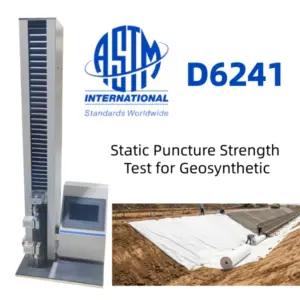
Modern testing systems also provide digital curve recording and automatic data analysis, allowing laboratories to capture peak puncture force and displacement simultaneously.
A versatile solution for this application is the Cell Instruments TST-01 Testeur de traction. The system provides stable loading control through PLC-driven architecture and a 7-inch HMI interface, allowing operators to monitor real-time force curves during puncture testing.
Its precision ball lead screw drive ensures smooth motion and repeatable speed control, which is critical for maintaining the standardized loading rates required by ASTM D6241. With adjustable speeds from 1 to 500 mm/min, laboratories can easily configure the instrument for puncture, tensile, peel, and tear testing using compatible fixtures.
Puncture Test Specimen Preparation and Sampling
ASTM D6241 provides clear guidance on specimen selection to ensure representative results.
Key requirements include:
- Specimens should be randomly distributed across the material width
- The sample edge must extend at least 10 mm beyond the clamp edge
- The material should exclude distorted areas, folds, or damaged sections
- If no historical variability data exist, laboratories should test ten specimens
For some geosynthetics manufactured with different surface structures on each side, both sides should be tested separately to obtain a complete evaluation.
Test Procedure Overview
The test procedure follows several important steps:
- Select a suitable load range so rupture occurs between 10% and 90% of full scale.
- Sécuriser l'échantillon between the clamping rings without tension.
- Align the probe with the specimen center.
- Apply the load at the specified test speed.
- Continue loading until material rupture occurs.
- Record:
- Maximum puncture force
- Displacement at rupture
- Specimen slippage (if any)
If specimen slippage exceeds 5 mm, the result should be discarded. The final puncture strength is typically reported as the average maximum force of all valid specimens.
Why ASTM D6241 Testing Matters
ASTM D6241 plays a critical role in geosynthetic material evaluation. Engineers rely on this index test to ensure geotextiles can withstand construction stresses and long-term service loads.
Key benefits of performing ASTM D6241 testing include:
- Verifying material durability
- Garantir compliance with engineering specifications
- Soutien quality control in manufacturing
- Comparaison different geotextile structures
- Reducing risk of installation damage
With accurate instrumentation and standardized procedures, laboratories can generate reliable puncture strength data that supports safer infrastructure design.
 FR
FR  EN
EN  AR
AR  BG
BG  CS
CS  DA
DA  DE
DE  EL
EL  ES
ES  ET
ET  FI
FI  HU
HU  ID
ID  IT
IT  JA
JA  KO
KO  LT
LT  LV
LV  NB
NB  NL
NL  PL
PL  PT
PT  RO
RO  RU
RU  SK
SK  SL
SL  SV
SV  TR
TR  UK
UK