
ASTM D4991
Water Immersion Leak Test
 ASTM D4991 is a widely recognized standard that defines a controlled and repeatable approach for evaluating the leakage resistance of rigid containers under differential pressure conditions. In global logistics, especially air transportation, pressure variations may compromise container integrity and result in leakage of hazardous or sensitive liquids. ASTM D4991 addresses this risk by providing a practical water immersion leak test combined with vacuum application, allowing manufacturers and quality professionals to assess container performance before shipment.
For laboratories, packaging engineers, and quality control personnel, ASTM D4991 offers a reliable framework to verify rigid container integrity testing without altering the container structure or closure system. This makes the method particularly valuable for compliance with international transport regulations such as ICAO and UN recommendations.
Scope and Purpose of ASTM D4991
The primary purpose of ASTM D4991 is to determine whether an empty rigid container can resist leakage when exposed to a pressure differential similar to those encountered during air transport. The test focuses on leak initiation, not burst strength, enabling early detection of weak points in container bodies or closures.
ASTM D4991 applies to a wide range of rigid containers, including plastic bottles, jerricans, composite containers, and other rigid packaging intended for liquid transport. However, some packaging designs, such as paper-based cap seals that deteriorate quickly in liquid environments, may not be suitable for this test method.
Key objectives of ASTM D4991 include:
-
Evaluating leakage resistance under vacuum conditions
-
Simulating pressure changes during air transport
-
Supporting compliance with international dangerous goods regulations
-
Providing visual and direct evidence of leakage behavior
Water Immersion Leak Test Method Explained
Le water immersion leak test defined in ASTM D4991 uses a transparent test chamber filled with a controlled ethylene glycol–water solution. This medium allows clear visual detection of air bubbles while minimizing evaporation and surface tension effects.
During the test, an empty rigid container is fully immersed in the solution and exposed to a gradually increasing partial vacuum. As internal pressure differs from the surrounding environment, any leakage path allows air to escape from the container, forming visible bubbles.
This method offers several advantages:
-
Direct visual confirmation of leakage
-
No need to modify container or closure design
-
Compatibility with different rigid container shapes and sizes
-
High repeatability when vacuum rate is properly controlled
Water Immersion Leak Test Method Explained
Le water immersion leak test defined in ASTM D4991 uses a transparent test chamber filled with a controlled ethylene glycol–water solution. This medium allows clear visual detection of air bubbles while minimizing evaporation and surface tension effects.
During the test, an empty rigid container is fully immersed in the solution and exposed to a gradually increasing partial vacuum. As internal pressure differs from the surrounding environment, any leakage path allows air to escape from the container, forming visible bubbles.
This method offers several advantages:
-
Direct visual confirmation of leakage
-
No need to modify container or closure design
-
Compatibility with different rigid container shapes and sizes
-
High repeatability when vacuum rate is properly controlled
Rigid Container Integrity Testing and Sample Preparation
Accurate rigid container integrity testing begins with proper specimen selection and preparation. ASTM D4991 specifies that test specimens should represent actual production containers and include the intended closures.
Important preparation considerations include:
-
Containers must be empty and thoroughly cleaned
-
Closures should be applied using the same torque or method as in real shipment
-
Containers should be tested at ambient conditions unless a specific temperature is required
-
When non-ambient testing is specified, specimens must be conditioned for sufficient time to reach thermal equilibrium
Testing multiple specimens improves result reliability, with a minimum number typically recommended to establish consistency.
Vacuum Leak Test Procedure Under ASTM D4991
Le vacuum leak test procedure is the core of ASTM D4991 and must be performed carefully to avoid false results. Once specimens are immersed, surface bubbles caused by trapped air must be removed before vacuum application.
The vacuum is then applied gradually until the specified pressure differential—typically up to approximately 95 kPa (13.8 psi)—is reached. During this phase, the operator observes the container closely.
Critical evaluation points include:
-
Isolated, non-repeating bubbles often indicate trapped surface air
-
A continuous or recurring stream of bubbles indicates leakage
-
After vacuum release, the container interior must be inspected for liquid ingress
Maintaining the vacuum for the required duration ensures that slow-developing leaks are not overlooked, especially for plastic or combination packaging.
Interpretation of Results and Practical Significance
ASTM D4991 defines leakage clearly and unambiguously. Visible bubble streams or internal liquid presence serve as direct evidence of failure. This clarity makes the standard highly practical for routine quality control and regulatory compliance.
The test establishes the pressure level at which leakage begins, allowing manufacturers to:
-
-
Improve closure design or sealing parameters
-
Compare container designs objectively
-
Reduce transportation risks and product loss
-
Support certification and compliance documentation
-
Typical Applications of ASTM D4991 Across Industries
ASTM D4991 supports leak testing in multiple industries, including:
-
Chemical and hazardous material packaging
-
Pharmaceutical and medical liquid containers
-
Food and beverage rigid packaging
-
Industrial and laboratory reagent containers
Its relevance extends beyond compliance, helping companies protect brand reputation and ensure safety during transportation.
Supporting ASTM D4991 Testing with Cell Instruments Solutions
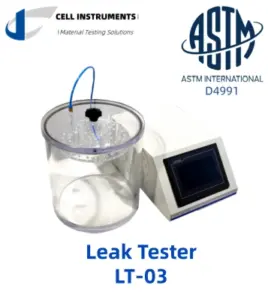
To perform ASTM D4991 efficiently and consistently, laboratories require precise control of vacuum rate, stable transparent chambers, and reliable observation conditions. Cell Instruments Leak Testers are
designed to support standardized vacuum leak testing workflows, offering stable pressure control and user-friendly operation.By integrating ASTM D4991 principles into modern testing equipment, Cell Instruments
helps laboratories achieve accurate, repeatable results while improving testing efficiency.
FAQs on ASTM D4991 Leak Testing
- What is ASTM D4991 used for?
ASTM D4991 is used to evaluate the leakage resistance of empty rigid containers when exposed to differential pressure conditions. It is especially relevant for containers used in air transport, where pressure changes may compromise container integrity and lead to leakage. - How does ASTM D4991 differ from other leak test standards?
ASTM D4991 specifically targets rigid containers and focuses on leakage initiation under vacuum conditions using a water immersion leak test. Unlike methods designed for flexible packaging, this standard allows testing without modifying the container body or closure system, making results more representative of real shipping conditions. - What types of containers can be tested using ASTM D4991?
The standard applies to rigid containers such as plastic bottles, jerricans, and composite containers intended for transporting liquids. However, containers with components that deteriorate rapidly in liquid environments, such as certain paper-based cap seals, may not be suitable. - Why is the water immersion leak test important in ASTM D4991?
The water immersion leak test provides direct visual evidence of leakage through the appearance of air bubbles. This makes it easier to identify leak points and distinguish between trapped surface air and true container leakage during vacuum application.
 FR
FR  EN
EN  AR
AR  BG
BG  CS
CS  DA
DA  DE
DE  EL
EL  ES
ES  ET
ET  FI
FI  HU
HU  ID
ID  IT
IT  JA
JA  KO
KO  LT
LT  LV
LV  NB
NB  NL
NL  PL
PL  PT
PT  RO
RO  RU
RU  SK
SK  SL
SL  SV
SV  TR
TR  UK
UK