
ASTM D1424
Elmendorf Tearing Test Method
Le ASTM D1424 standard defines the test method for measuring the tear strength of fabrics using the Elmendorf-type apparatus. This test is essential in industries like packaging, medical, and textiles, where the résistance à la déchirure of materials directly influences their performance. The Test de déchirure d'Elmendorf is commonly applied to evaluate plastic films, thin sheeting, and various fabrics. In this article, we will explore the test method, its applications, and how it can be used to assess fabric tear strength.
The Elmendorf Tear Test: What is it?
Le Test de déchirure d'Elmendorf, outlined in ASTM D1424, determines the tear propagation resistance of fabric materials. In this test, a single-rip tear is initiated from a cut in the fabric and the force required to propagate this tear is measured. The Elmendorf-type apparatus uses a falling pendulum to generate the tearing force, and the resistance to this tear is quantified based on the distance the pendulum travels. This method is crucial in determining the material’s durability and tear resistance, essential for ensuring the integrity of packaging materials and textiles in harsh environments.
ASTM D1424 Test Method: Procedure Overview
Le ASTM D1424 test method involves several key steps:
-
Préparation des échantillons: A slit is made at the center of the fabric specimen, and it is held between two clamps.
-
Tear Initiation: The specimen is subjected to a force by a falling pendulum, which causes the material to tear. The force and distance of the tear are recorded.
-
Mesures: Le resistance to tearing is recorded on a scale, and the force required to propagate the tear is calculated from the pendulum’s reading.
The test is performed under specific conditions, and results are analyzed to determine the résistance à la déchirure et tear propagation resistance of the fabric.
Key Factors Affecting the Elmendorf Tear Test
Several factors impact the results of the Test de déchirure d'Elmendorf:
-
Material Type: Different materials, such as woven fabrics, coated plastics, or napped fabrics, exhibit varying levels of résistance à la déchirure.
-
Fabric Orientation: The orientation of the fabric fibers, such as the warp et weft directions, plays a significant role in determining résistance à la déchirure.
-
Épaisseur: Thicker materials may require higher force to initiate and propagate a tear.
-
Environmental Conditions: Humidity and temperature can alter the tear resistance, which is why specimens must be conditioned avant le test.
Applications of ASTM D1424: Elmendorf Tear Test
Le ASTM D1424 test is widely used across various industries for applications where fabric tear strength is critical:
-
Conditionnement: Plastic films et thin sheeting used in packaging materials need to withstand tearing during transportation and handling. The Test de déchirure d'Elmendorf helps manufacturers assess material durability.
-
Dispositifs médicaux: Protective covers, sterile packaging, and medical textiles undergo testing to ensure they are resistant to tearing under stress.
-
Textiles and Fabrics: Textile manufacturers use the Elmendorf tear test to evaluate the strength and quality of fabrics, ensuring they are durable for everyday use or specialized applications like airbag fabrics.
Importance of Tear Propagation Resistance
Tear propagation resistance is a critical property of materials like plastic films and textiles. It measures how much force is required to continue a tear once it has started. Materials with high tear propagation resistance are more durable and less likely to tear under pressure, which is vital for ensuring product reliability.
-
High Tear Resistance: Materials used in packaging or medical devices must exhibit high tear propagation resistance to prevent failure during use.
-
Low Tear Resistance: On the other hand, materials with low tear resistance may fail prematurely, leading to product damage or contamination in critical applications.
How the Elmendorf Tear Test Helps in Product Development
Manufacturers can use the Test de déchirure d'Elmendorf à optimize material selection for various products. By understanding the tear strength of different materials, companies can:
-
Select the right material for specific applications based on tear resistance.
-
Improve product durability by ensuring the selected material has sufficient tear propagation resistance.
-
Ensure compliance with industry standards, such as ASTM D1424, for material strength and quality.
Conclusion
Le ASTM D1424 test method, using the Elmendorf-type apparatus, is a valuable tool for assessing the résistance à la déchirure of fabrics and thin films. It helps manufacturers evaluate how well their materials will perform under stress, ensuring their suitability for various applications such as packaging, medical devices, et textiles. By measuring tear propagation resistance, the Elmendorf tear test provides essential data for improving material design and ensuring product longevity.
Recommended Equipment for ASTM D1424
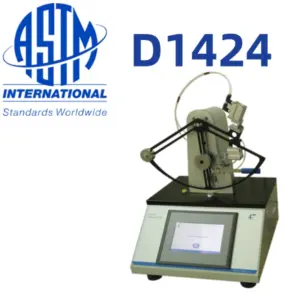
For accurate and reliable tear testing, Instruments cellulaires offers high-quality Tearing Testers designed to comply with ASTM D1424 standards. Our equipment provides precise measurements of fabric tear strength, helping industries maintain high-quality control standards. Contact us today to learn more about how our Tearing Testers can support your material testing needs.
FAQ
Q1: What is the ASTM D1424 test method used for?
Réponse: Le ASTM D1424 test method is used to measure the résistance à la déchirure of fabrics and thin sheeting using a falling-pendulum (Elmendorf-type) apparatus. This test determines the force necessary to propagate a tear in a material and evaluates its tear propagation resistance. It is commonly applied in industries like packaging, textiles, and medical devices to ensure materials are durable and resistant to tearing under stress.
Q2: What materials can be tested using the ASTM D1424 method?
Réponse: Le ASTM D1424 test method is suitable for testing a wide range of materials, including woven fabrics, layered fabrics, blankets, napped fabrics, pile fabrics, et airbag fabrics. It applies to materials with a thickness of 1 mm or less. The test is often used for evaluating plastic films et thin sheeting that are used in packaging and medical applications.
Q3: How is tear propagation resistance measured in the Test de déchirure d'Elmendorf?
Réponse: In the Test de déchirure d'Elmendorf, a single-rip tear is initiated from a cut in the material, and the force required to propagate the tear is measured. The resistance to the tear is quantified using a falling pendulum apparatus, and the data is recorded on a load-time chart. The tear propagation resistance is determined from the recorded force and the distance the pendulum travels.
Q4: What is the significance of résistance à la déchirure in materials?
Réponse: Résistance à la déchirure is a critical property that measures how resistant a material is to tearing once a tear has started. Materials with higher tear strength are less likely to fail under stress, making them suitable for demanding applications like packaging et medical devices. Testing tear strength ensures that materials can withstand physical stress and prevent failures during use, contributing to product reliability and safety.
Q5: Why is it important to perform tear tests on plastic films et thin sheeting?
Réponse: Tear tests on plastic films et thin sheeting are essential for evaluating the résistance à la déchirure et tear propagation resistance of materials used in applications such as packaging et medical device covers. These materials must withstand mechanical stress during handling, transportation, and use. By performing tear tests like ASTM D1424, manufacturers can ensure that their products maintain integrity and functionality under real-world conditions.
Q6: How does the Test de déchirure d'Elmendorf differ from other tear testing methods?
Réponse: Le Test de déchirure d'Elmendorf (as defined in ASTM D1424) uses a falling-pendulum apparatus pour mesurer tear propagation resistance, which is different from other tear testing methods that might use a fixed-speed separation or constant tension application. The Elmendorf test provides specific data on how a tear progresses in the material, which is useful for understanding the résistance à la déchirure in different material types, especially films and thin sheeting.
Q7: How can Instruments cellulaires help with ASTM D1424 testing?
Réponse: Instruments cellulaires provides specialized Tearing Testers that are designed to comply with ASTM D1424 standards. Our Tearing Testers are equipped with advanced features to accurately measure résistance à la déchirure et tear propagation resistance in various materials, including plastic films et thin sheeting. With our equipment, industries can ensure their materials meet the required quality and durability standards for different applications.
 FR
FR  EN
EN  AR
AR  BG
BG  CS
CS  DA
DA  DE
DE  EL
EL  ES
ES  ET
ET  FI
FI  HU
HU  ID
ID  IT
IT  JA
JA  KO
KO  LT
LT  LV
LV  NB
NB  NL
NL  PL
PL  PT
PT  RO
RO  RU
RU  SK
SK  SL
SL  SV
SV  TR
TR  UK
UK