
ASTM D5884
Geomembranes Tearing Strength Test
ASTM D5884 serves as a widely recognized test method for determining the tearing strength of internally reinforced geomembranes. As geomembranes continue to be used in demanding environmental and civil engineering applications—such as landfills, reservoirs, wastewater treatment structures, and mining containment—their durability against tearing becomes a critical performance indicator. This standard offers a clear and practical approach, enabling engineers, manufacturers, and quality-control professionals to evaluate how reinforced membranes behave when subjected to tearing forces.
Geomembranes Tearing Strength
The standard focuses on measuring tearing strength through tongue tear testing, a method capable of reflecting how a tear propagates across a reinforced geomembrane. While tensile strength and puncture resistance remain essential for overall performance, tearing resistance helps predict how a membrane behaves when damaged during installation or stressed under service conditions.
For geomembranes reinforced with textiles, the distribution of fibers, stress direction, and reinforcement type all influence the test results. Therefore, ASTM D5884 provides a structured and controlled process to ensure consistency between laboratories and across production batches.
Geomembranes Tongue Tear Testing Principle
ASTM D5884 evaluates the maximum load required to continue a tear initiated in the specimen. The method involves:
- Preparing specimens with a standardized tongue cut.
- Orienting specimens in both machine direction (MD) and cross-machine direction (CMD).
- Applying a controlled displacement rate until the tear propagates.
- Recording the peak load, which represents the tearing strength.
The standard emphasizes that tearing behavior depends strongly on membrane structure, stress alignment, and strain rate. For this reason, test results should be interpreted as performance under defined conditions rather than absolute indicators of field durability.
Key Steps of the ASTM D5884 Tear and Tensile Strength Test Procedure
Professionals rely on this method because its step-by-step procedure eliminates testing variability:
1. Specimen Positioning
Each specimen is clamped so the two tongues align precisely in the grips. The recommended grip separation maintains consistent tearing geometry and minimizes distortion.
2. Controlled Testing Speed
A displacement rate of 50 ± 2 mm/min ensures a stable tear propagation speed. The force curve is monitored using an autographic or digital recording device capable of capturing peak values.
3. Monitoring Tear Direction
If a specimen tears outside the intended cut direction or behaves inconsistently—typically deviating more than 25% from the average—ASTM D5884 requires retesting to maintain data integrity.
4. Data Reporting
For each direction (MD and CMD), results from five valid specimens are averaged, and the standard deviation and coefficient of variation are calculated.
Enhancing ASTM D5884 Testing with the TST-01 Tensile Tester
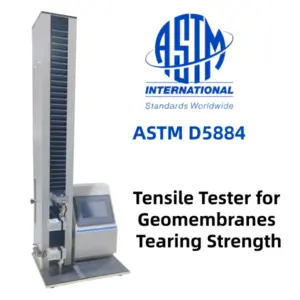
A reliable testing instrument is essential for obtaining precise and reproducible tearing strength data. The Cell Instruments TST-01 Vetotesteri offers several advantages for geomembrane laboratories:
- High-precision control with a PLC-driven system and real-time curve display
- Smooth displacement accuracy of ±0.01 mm, ideal for capturing peak tear loads
- Wide speed range from 1 to 500 mm/min, fully compatible with ASTM D5884 requirements
- Multi-fixture adaptability for tongue tear, tensile, peel, puncture, and seal strength tests
- Robust frame construction for heavy-duty materials like reinforced geomembranes
With its specialized fixtures and customizable stroke length, the TST-01 ensures stable gripping, uniform load application, and accurate tear-propagation tracking. This helps quality-control teams reduce variability and build stronger confidence in compliance reporting.
Why ASTM D5884 Matters for Industry Professionals
Professionals rely on this standard because it provides:
- Reliable comparison between different reinforcement fabrics
- Insight into directional tear behavior, crucial for material design
- Enhanced QC consistency across manufacturing cycles
- Clear guidance for laboratories conducting performance verification
Soveltamalla ASTM D5884 with properly configured equipment, producers and testing agencies can better evaluate membrane durability and select reinforcement structures that deliver long-term stability.
FAQs About ASTM D5884 and Geomembrane Tear Strength Testing
1. What is ASTM D5884?
ASTM D5884 is a standardized method for determining the tearing strength of internally reinforced geomembranes using the tongue tear procedure. It provides a consistent way to evaluate how a reinforced membrane behaves when subjected to a controlled tearing force.
2. Why is the tongue tear method used in ASTM D5884?
The tongue tear method ensures that the tear propagates predictably across the specimen. This helps evaluate directional tear performance—particularly important for reinforced geomembranes where fiber orientation influences mechanical behavior.
3. What types of geomembranes can be tested with ASTM D5884?
The method applies specifically to internally reinforced geomembranes that incorporate textile fabrics or scrims. These are commonly used in landfills, mining, containment ponds, and environmental engineering projects.
4. What does “machine direction” and “cross-machine direction” mean?
-
Machine direction (MD): The direction the geomembrane travels during manufacturing.
-
Cross-machine direction (CMD): Perpendicular to the machine direction.
ASTM D5884 requires testing in both directions because tearing strength can vary significantly with reinforcement orientation.
5. How is tearing strength calculated?
Tearing strength is the peak load recorded while the tear propagates across the specimen. ASTM D5884 requires five valid measurements in each direction and uses the average as the final result.
6. What equipment is best suited for ASTM D5884 testing?
A high-precision tensile testing machine with stable speed control and compatible gripping fixtures is required.
The Cell Instruments TST-01 Tensile Tester is frequently recommended due to its:
- Accurate speed control (1–500 mm/min)
- ±0.01 mm displacement precision
- Strong clamping and fixture versatility
- Real-time force–displacement curve display
These features help laboratories achieve reliable and reproducible tear-strength data.
7. Can ASTM D5884 predict real-world durability?
Not directly. ASTM D5884 measures tear resistance under controlled laboratory conditions. While it provides comparative and quality-control insights, real-world durability depends on installation practices, environmental exposure, and mechanical stress factors.
8. How does reinforcement affect tearing strength?
Reinforcement type, fiber distribution, and textile structure strongly influence tear propagation. Different scrims or fabric orientations may produce very different MD and CMD tearing strengths, which the ASTM D5884 test helps quantify.
9. Does Cell Instruments provide custom fixtures for ASTM D5884?
Yes. Cell Instruments can develop custom clamping fixtures and reinforcements specifically designed for tongue tear tests. This ensures proper alignment, minimal slippage, and accurate force capture for reinforced geomembranes.
 FI
FI  EN
EN  AR
AR  BG
BG  CS
CS  DA
DA  DE
DE  EL
EL  ES
ES  ET
ET  FR
FR  HU
HU  ID
ID  IT
IT  JA
JA  KO
KO  LT
LT  LV
LV  NB
NB  NL
NL  PL
PL  PT
PT  RO
RO  RU
RU  SK
SK  SL
SL  SV
SV  TR
TR  UK
UK  HE
HE  TH
TH  VI
VI