
ISO 10319 and Its Importance
ISO 10319 defines a standardized method for evaluating the tensile behavior of geosynthetics using a wide-width strip. Engineers and quality control professionals rely on this method to obtain realistic mechanical performance data that closely reflects field conditions.
Unlike narrow-strip methods, ISO 10319 uses a wider specimen, which reduces edge contraction and distributes stress more evenly. This design allows the test to better simulate in-service conditions for materials such as:
- Woven and nonwoven geotextiles
- Geogrids and geocomposites
- Knitted and metallic geosynthetics
The method focuses on key parameters such as maximum tensile force, elongation, and secant stiffness, which directly influence product selection and engineering design.
Geotextiles Tensile Properties Test: Tensile and Elongation
El geotextiles tensile properties test, tensile and elongation forms the core of ISO 10319. It quantifies how a material behaves under longitudinal force until rupture.
Key Measured Parameters
- Tensile Strength (Force per Unit Width)
Determines the maximum load a material can withstand before failure. - Elongation at Maximum Force
Indicates ductility and deformation capacity under stress. - Stress-Strain Behavior
Provides insight into stiffness and structural performance. - Secant Stiffness
Evaluates resistance to deformation at specified strain levels.
These parameters help engineers assess whether a geotextile can maintain structural integrity under load-bearing applications such as road construction, embankments, or drainage systems.
Principle of the ISO 10319 Test Method
ISO 10319 operates on a straightforward but precise mechanical principle:
- A specimen is clamped across its full width in a tensile testing machine.
- A constant crosshead speed applies tensile force.
- The specimen stretches until rupture while force and elongation are recorded.
Important technical aspects include:
- Gauge length typically set at (100 ± 3) mm
- Strain rate controlled at (20 ± 5)% per minute for most materials
- Extensometer measures deformation between two reference points
This controlled setup ensures repeatability and comparability across laboratories.
Resumen del procedimiento de prueba
Specimen Preparation and Mounting
Operators position the specimen centrally in the grips. Alignment must follow the direction of applied force to avoid measurement errors. Proper clamping prevents slippage and ensures uniform stress distribution.
Machine Configuration
Technicians adjust:
- Force range to ensure accurate break detection (±10 N)
- Speed to achieve the required strain rate
- Grip type depending on material (e.g., capstan grips for sensitive structures)
Execution of the Test
- Aplique una pre-tension force (≈1%) to define the starting point
- Run the test continuously until rupture
- Record maximum force and elongation values
For wet specimens, testing must occur within 3 minutes after removal from water to maintain consistency.
Why Wide-Width Testing Matters
The defining feature of ISO 10319 is the wide-width specimen geometry. This approach:
- Minimizes necking and edge effects
- Provides results closer to real-world performance
- Improves data reliability for engineering design
For geogrids and open-structure materials, adjustments ensure that at least one structural node participates in the test, maintaining representativeness.
Common Challenges and Best Practices
Jaw Breaks and Slippage
Breaks near the grip area can distort results. ISO 10319 recommends:
- Padding grips
- Modifying jaw surfaces
- Coating specimen ends
Specimen Variability
Geosynthetics often show inherent variability. Operators should:
- Avoid discarding results unless justified
- Monitor break locations carefully
- Ensure consistent specimen preparation
Equipment Recommendation for ISO 10319 Testing
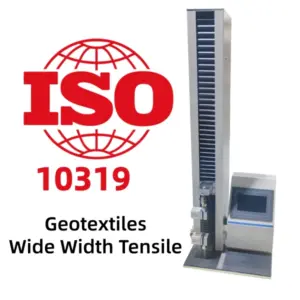
A high-performance tensile tester plays a critical role in achieving accurate and repeatable results. The Instrumentos celulares Probador de tracción TST-01 offers several advantages for ISO 10319 applications:
- PLC-controlled system with real-time curve display ensures precise monitoring
- Wide speed range (1–500 mm/min) supports standard strain rate requirements
- High displacement accuracy (±0.01 mm) improves elongation measurement
- Customizable fixtures accommodate different geotextile structures
Its robust design and flexible configuration make it suitable for both routine QC testing and advanced material analysis.
Ensure accurate evaluation of geotextile performance with ISO 10319 testing. This method measures tensile strength and elongation using wide-width specimens under controlled strain rates, delivering reliable and field-representative data. With advanced tensile testing systems like Instrumentos celulares solutions, laboratories can achieve precise control, repeatable results, and efficient workflows. Upgrade your material testing capabilities today to improve product quality, meet international standards, and strengthen your competitive advantage.
 ES
ES  EN
EN  AR
AR  BG
BG  CS
CS  DA
DA  DE
DE  EL
EL  ET
ET  FI
FI  FR
FR  HU
HU  ID
ID  IT
IT  JA
JA  KO
KO  LT
LT  LV
LV  NB
NB  NL
NL  PL
PL  PT
PT  RO
RO  RU
RU  SK
SK  SL
SL  SV
SV  TR
TR  UK
UK