
ASTM D689
Paper Tear Test
 Το paper tear strength test defined by ASTM D689 is a widely adopted standard for evaluating the resistance of paper to tearing once a crack or slit has been initiated. Rather than focusing on how paper breaks under tension, ASTM D689 emphasizes tear propagation behavior, which closely reflects real handling, converting, and end-use conditions. For paper manufacturers, converters, and quality control professionals, ASTM D689 provides a reliable and comparable framework for assessing material performance.
This article focuses on ASTM D689 as a test standard, explaining its intent, scope, technical significance, and application value within the paper industry.
ASTM D689: Paper Tear Strength, and Elmendorf Tear Tester Standardization
ASTM D689 specifies a paper tear strength evaluation method based on the Elmendorf pendulum principle. The standard defines how an Elmendorf tear tester is used to measure the force required to propagate a tear through paper over a fixed distance. By standardizing specimen preparation, environmental conditions, and result reporting, ASTM D689 ensures that tear strength data remain consistent and comparable across laboratories.
Importantly, ASTM D689 aligns technically with ISO 1974 and TAPPI T414, allowing paper producers and global buyers to reference equivalent performance metrics when verifying material quality.
Purpose and Scope of ASTM D689
ASTM D689 is designed as an index test for internal tearing resistance of paper. Its primary purpose is to provide a quantitative value that reflects fiber bonding strength and sheet structure uniformity.
According to the standard, ASTM D689:
-
Applies to most grades of paper tested in multiple plies
-
Measures tear resistance perpendicular to the paper plane
-
Supports both machine-direction and cross-direction evaluation
-
Excludes highly directional boards and papers where tear behavior becomes non-representative
By clearly defining its scope and limitations, ASTM D689 helps users select the correct test method for their specific paper products.
Significance of ASTM D689 in Internal Tearing Resistance of Paper
The paper tear strength test described in ASTM D689 plays a critical role in paper quality assessment. Tear resistance often correlates with fiber length, refining conditions, and bonding efficiency, making it a valuable indicator of overall sheet integrity.
Within quality systems, ASTM D689 supports:
-
Routine production monitoring
-
Supplier qualification and acceptance testing
-
Troubleshooting fiber or process changes
-
Performance benchmarking across paper grades
ASTM D689 results are typically interpreted alongside tensile, burst, and folding endurance tests to provide a comprehensive understanding of paper strength characteristics.
Technical Principle Defined by ASTM D689
Rather than emphasizing operational steps, ASTM D689 standardizes the measurement concept behind tear resistance. The method quantifies the energy required to continue a tear after initiation, expressed as an average tearing force.
By specifying pendulum energy ranges, specimen configuration, and calibration principles, ASTM D689 minimizes variability caused by operator technique. This focus on energy-based measurement makes the paper tear strength test especially suitable for comparative analysis between materials and production batches.
Paper Types and Applications Referenced by ASTM D689
ASTM D689 is relevant to a broad range of paper products where tear resistance influences usability and durability, including:
-
Printing and writing papers
-
Packaging and wrapping papers
-
Industrial and technical papers
-
Specialty papers requiring balanced strength properties
By applying the ASTM D689 paper tear strength test, manufacturers ensure that materials perform reliably during printing, folding, cutting, and end-user handling.
Instrumentation Considerations for ASTM D689 Compliance
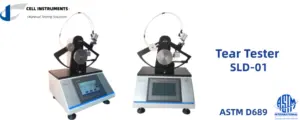
While ASTM D689 is instrument-independent, it requires the use of a compliant Elmendorf-type device capable of delivering stable pendulum energy and precise readings. Consistent instrumentation directly affects the reliability of paper tear strength data.
Το Cell Instruments Tear Tester SLD-01 is suitable for laboratories performing ASTM D689 testing, supporting standardized tear resistance evaluation with stable mechanics and repeatable measurement performance. Its configuration aligns with the intent of ASTM D689 without altering the standard’s methodology.
ASTM D689 as a Cornerstone Paper Testing Standard
ASTM D689 remains a cornerstone standard for assessing paper tear resistance because it connects laboratory measurement with real-world performance expectations. By focusing on internal tearing resistance, the standard helps manufacturers balance strength, runnability, and material efficiency.
For professionals responsible for paper quality and compliance, ASTM D689 provides a trusted, globally recognized reference that supports consistent decision-making across production, testing, and supply chains.
Συχνές ερωτήσεις
1. What is ASTM D689?
ASTM D689 is a standard test method for measuring the tear resistance of paper using an Elmendorf tear strength tester. It evaluates the internal tearing resistance of paper, helping assess quality and durability.
2. Why is a paper tear test important?
A paper tear test determines how paper withstands handling, converting, and end-use stresses. It predicts performance, ensures consistent quality, and guides material selection.
3. What does Elmendorf tear strength measure?
Elmendorf tear strength measures the force required to propagate a tear in paper. It reflects fiber bonding and the internal tearing resistance of paper, providing critical insight into paper performance.
4. Which paper types can be tested using ASTM D689?
ASTM D689 is suitable for printing, writing, packaging, industrial, and specialty papers. Highly directional boards may require alternative testing methods.
5. How is the ASTM D689 test conducted?
The test uses an Elmendorf-type tearing tester, where sheets are clamped, a tear is initiated, and the pendulum is released. The energy absorbed during tearing determines the tear resistance of paper. Tests are conducted in both machine and cross directions.
 EL
EL  EN
EN  AR
AR  BG
BG  CS
CS  DA
DA  DE
DE  ES
ES  ET
ET  FI
FI  FR
FR  HU
HU  ID
ID  IT
IT  JA
JA  KO
KO  LT
LT  LV
LV  NB
NB  NL
NL  PL
PL  PT
PT  RO
RO  RU
RU  SK
SK  SL
SL  SV
SV  TR
TR  UK
UK