
ASTM D6693
Geomembranes Tensile Strength Test and Elongation
ASTM D6693 is a key international standard used to evaluate the tensile performance of nonreinforced geomembranes. In practical applications, geomembranes must withstand long-term tensile stresses caused by installation, settlement, temperature variation, and environmental loading. ASTM D6693 provides a standardized and repeatable method to assess tensile strength and elongation at break, ensuring that geomembrane materials meet quality and specification requirements before deployment.
This article introduces the purpose, testing concept, application scope, and industrial relevance of ASTM D6693, helping engineers and quality professionals understand how the standard supports reliable geomembrane performance.
Tensile Performance: Geomembranes Strength, Break, and Elongation
Within ASTM D6693, the geomembranes tensile strength test is designed to quantify both resistance to rupture and deformation capacity. The method evaluates break strength testing results alongside tensile elongation at break, allowing users to understand how a geomembrane behaves as it transitions from elastic deformation to ultimate failure.
These parameters are especially relevant for geomembranes subjected to tensile stresses during deployment, anchoring, welding, and service life. By linking force and extension under standardized conditions, ASTM D6693 ensures that tensile data remain comparable and technically meaningful.
Objective and Technical Positioning of ASTM D6693
ASTM D6693 functions as an index test rather than a full design simulation. Its primary objective is to produce tensile property data that can be used for:
-
Manufacturing consistency checks
-
Incoming material qualification
-
Compliance with technical specifications
-
Research and development benchmarking
The standard applies to nonreinforced geomembranes over a defined thickness range, including polyethylene and flexible polypropylene materials. ASTM D6693 explicitly recognizes that tensile results depend on preparation, test speed, and environment, and therefore stresses strict control of these variables.
How ASTM D6693 Approaches Tensile Testing
ASTM D6693 uses standardized dumbbell-shaped specimens tested at a constant crosshead speed. This approach simplifies comparison by eliminating geometric variability and focusing on material response under tension.
The method measures applied load and crosshead displacement throughout the test. From this data, tensile strength values and elongation percentages are derived. Although crosshead movement does not represent true strain distribution, ASTM D6693 accepts this limitation to prioritize repeatability and efficiency in routine testing.
This balance between practicality and technical rigor explains why ASTM D6693 remains a preferred standard for geomembrane tensile evaluation worldwide.
Key Performance Indicators Defined by ASTM D6693
ASTM D6693 outlines several critical tensile metrics that describe geomembrane behavior:
-
Tensile yield strength, when a defined yield point is present
-
Tensile break strength, indicating maximum resistance before rupture
-
Percent yield elongation, reflecting the onset of plastic deformation
-
Percent elongation at break, representing ductility at failure
These values provide insight into both strength and flexibility, two properties that must be balanced in effective geomembrane design.
Materials Covered by ASTM D6693
ASTM D6693 applies to a broad range of geomembrane materials commonly used in containment and barrier systems. Typical examples include:
-
HDPE geomembranes for landfill and mining applications
-
LLDPE geomembranes requiring higher flexibility
-
Flexible polypropylene geomembranes used in specialized containment systems
Because the standard accommodates different thicknesses and material types, ASTM D6693 supports consistent evaluation across diverse product portfolios.
Practical Applications of ASTM D6693 Data
Tensile data generated under ASTM D6693 play a crucial role in real-world decision-making. Engineers and quality managers use these results to confirm material suitability for demanding applications such as:
-
Environmental containment systems
-
Water reservoirs and canals
-
Mining leach pads
-
Industrial lining systems
In these environments, insufficient tensile strength or elongation capacity may lead to cracking, tearing, or premature failure. ASTM D6693 helps reduce such risks by establishing objective performance benchmarks.
Test Equipment Considerations for ASTM D6693
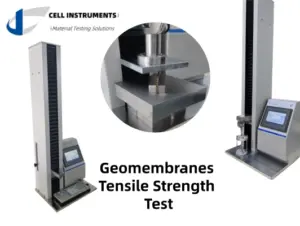
Η ακριβής εκτέλεση του ASTM D6693 απαιτεί ένα σταθερό σύστημα δοκιμής εφελκυσμού με ακριβή έλεγχο ταχύτητας και αξιόπιστη μέτρηση δύναμης. Η μεταβλητότητα του εξοπλισμού μπορεί να επηρεάσει σημαντικά τα αποτελέσματα των δοκιμών, ειδικά για τα εύκαμπτα υλικά γεωμεμβρανών.
Το Όργανα κυττάρων TST-01 Δοκιμαστής εφελκυσμού γενικής χρήσης παρέχει τον έλεγχο και τη σταθερότητα που απαιτούνται για τις δοκιμές ASTM D6693. Τα προσαρμόσιμα εύρη φορτίων και η συνεπής κίνηση της εγκάρσιας κεφαλής υποστηρίζουν την αξιόπιστη break strength testing και τη μέτρηση της επιμήκυνσης, παραμένοντας ευθυγραμμισμένη με την πρόθεση του προτύπου.
Αξία του ASTM D6693 σε προγράμματα ποιοτικού ελέγχου
Το ASTM D6693 ενισχύει τη διασφάλιση της ποιότητας των γεωμεμβρανών παρέχοντας μια διαφανή και επαναλαμβανόμενη μέθοδο για την αξιολόγηση του εφελκυσμού. Όταν εφαρμόζεται με συνέπεια, επιτρέπει στους κατασκευαστές να αποδεικνύουν τη συμμόρφωση, στα εργαστήρια να διατηρούν την αξιοπιστία των δοκιμών και στους τελικούς χρήστες να συγκρίνουν τα υλικά με εμπιστοσύνη.
Για τους επαγγελματίες που ασχολούνται με την παραγωγή, τις δοκιμές και την εφαρμογή γεωμεμβρανών, το πρότυπο ASTM D6693 παραμένει ένα βασικό πρότυπο που συνδέει τα εργαστηριακά δεδομένα εφελκυσμού με τις πρακτικές προσδοκίες απόδοσης.
Q1: Τι είναι το ASTM D6693;
Η ASTM D6693 είναι μια τυποποιημένη μέθοδος δοκιμής που χρησιμοποιείται για τον προσδιορισμό των εφελκυστικών ιδιοτήτων των μη ενισχυμένων γεωμεμβρανών. Αξιολογεί την απόδοση του υλικού μέσω geomembranes tensile strength test, break strength testing, και tensile elongation at break.
Q2: Γιατί είναι σημαντικό το ASTM D6693;
Το πρότυπο αυτό εξασφαλίζει σταθερή ποιότητα και αξιοπιστία των γεωμεμβρανών σε εφαρμογές όπως οι επενδύσεις χωματερών, οι δεξαμενές και τα συστήματα περιορισμού. Τα δεδομένα βοηθούν τους μηχανικούς να προβλέψουν πώς θα συμπεριφέρονται τα υλικά υπό πίεση και με την πάροδο του χρόνου.
Q3: Ποιοι τύποι υλικών μπορούν να δοκιμαστούν χρησιμοποιώντας το ASTM D6693;
Το πρότυπο ASTM D6693 εφαρμόζεται σε μη ενισχυμένες γεωμεμβράνες πολυαιθυλενίου και πολυπροπυλενίου με πάχος που κυμαίνεται συνήθως από 0,25 mm έως 6,3 mm.
Q4: Πώς μετρώνται οι ιδιότητες εφελκυσμού στο ASTM D6693;
Η δοκιμή μετρά τη δύναμη που απαιτείται για να τεντωθεί και να σπάσει ένα δείγμα σε σχήμα αλτήρα. Τα αποτελέσματα περιλαμβάνουν το όριο διαρροής σε εφελκυσμό, αντοχή στη θραύση, και επιμήκυνση κατά τη θραύση, παρέχοντας πληροφορίες τόσο για την αντοχή σε ρήξη όσο και για την ευελιξία του υλικού.
Ε5: Ποιος εξοπλισμός συνιστάται για τις δοκιμές ASTM D6693;
Μια ακριβής δοκιμαστής εφελκυσμού όπως το Cell Instruments TST-01. Εξασφαλίζει την ακριβή μέτρηση του φορτίου και της επέκτασης υπό τυποποιημένες συνθήκες.
 EL
EL  EN
EN  AR
AR  BG
BG  CS
CS  DA
DA  DE
DE  ES
ES  ET
ET  FI
FI  FR
FR  HU
HU  ID
ID  IT
IT  JA
JA  KO
KO  LT
LT  LV
LV  NB
NB  NL
NL  PL
PL  PT
PT  RO
RO  RU
RU  SK
SK  SL
SL  SV
SV  TR
TR  UK
UK