
Ensuring the structural integrity of medical packaging is a priority in today’s healthcare and pharmaceutical industries. Among these, the infusion bag compression test plays a critical role in validating whether soft, flexible medical packages can withstand external forces during storage, handling, or transport. This article focuses on how to conduct such tests effectively while also helping professionals understand how to measure compression strength of packaging using standard methods and advanced equipment.
Why Infusion Bag Compression Testing Matters
Το infusion bag compression test evaluates how well infusion bags resist deformation or rupture when subjected to vertical pressure. These bags are often used to deliver critical fluids intravenously and must remain intact under varying mechanical loads. Even minor damage can lead to contamination, leakage, or product waste, all of which can result in serious safety or compliance issues.
Unlike rigid packaging, infusion bags made from flexible composite films present unique challenges. They don’t fracture like glass but deform under pressure. That’s why specialized testing methods—and more importantly, precision instruments—are required to simulate real-world pressure conditions and measure how these materials behave.
How to Measure Compression Strength of Packaging
Knowing how to measure compression strength of packaging begins with understanding the testing standards and methodologies. Standards like ISO 12048 και ASTM D642 provide internationally accepted frameworks for evaluating packaging resistance under load.
Key Testing Parameters Include:
Preconditioning Requirements: Test samples must be conditioned at 23°C and 50% RH for at least 48 hours to stabilize moisture and material properties.
Test Speed: Apply compression at a controlled speed of (10 ± 3) mm/min.
Parallel Platens: Ensure both compression plates are strictly parallel to distribute force evenly.
Data Recording: Continuously record force vs. deformation to detect maximum load capacity and failure modes.
In the context of infusion bags, these standards help determine the maximum compression force a bag can sustain and the point of failure or leakage. Such data is essential for packaging validation, product safety, and regulatory compliance.
The Role of Advanced Equipment: PCT-01 Package Compression Tester
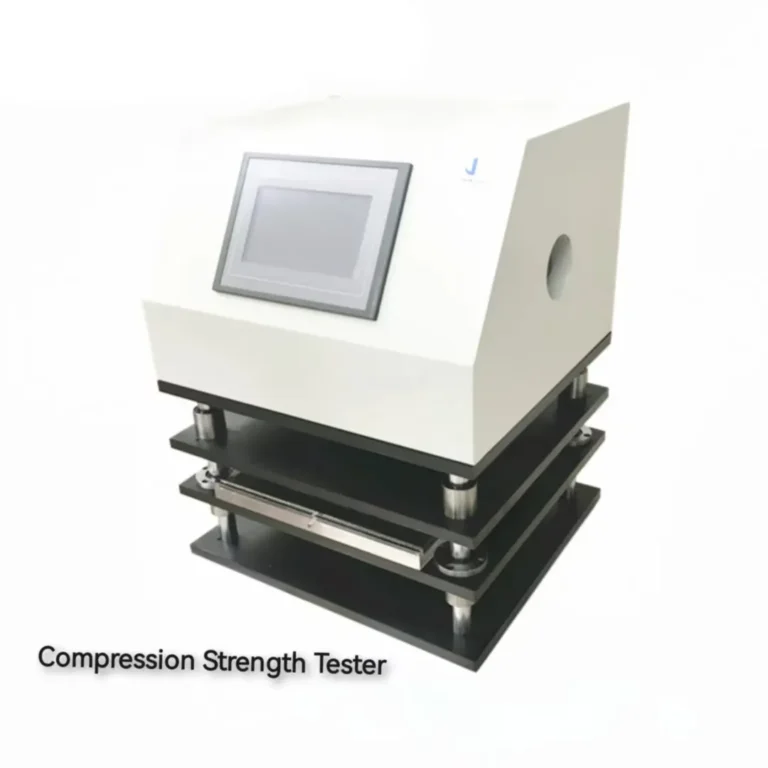
For accurate and repeatable results in infusion bag compression tests, precision instrumentation is non-negotiable. Cell Instruments’ PCT-01 Package Compression Tester is specifically designed for this type of testing, offering reliable performance και customizable test settings.
Touchscreen control with user-friendly interface
Dual test modes: maximum bursting force and constant pressure resistance
Real-time data acquisition and graphical analysis
High-precision load cells (±2% error tolerance)
Built-in liquid collection device to handle ruptured samples safely
Customizable platen sizes for various sample dimensions
Its integration with optional PC software and RS232 output makes it ideal for automated lab workflows or regulatory documentation.
Step-by-Step Guide to Conduct an Infusion Bag Compression Test
1. Sample Preparation
Ensure infusion bags are filled and sealed under typical conditions. Condition samples for at least 48 hours as per ISO 12048.
2. Test Setup
Position the infusion bag between the upper and lower platens of the PCT-01 Package Compression Tester. Use fixtures or alignment tools if necessary.
3. Test Configuration
Select appropriate test mode:
Burst Test: Measures force at the point of rupture.
Constant Pressure: Holds a set force over time to assess leak resistance.
Adjust compression speed, force limits, and holding time.
4. Execute the Test
Start the compression process. The instrument will apply force, and sensors will record real-time data, plotting a force-deformation curve.
5. Analyze Results
Review peak compression force, deformation percentage, and failure type. This helps determine whether the packaging meets regulatory or internal durability criteria.
Applications Beyond Infusion Bags
While this article emphasizes infusion bag compression testing, the principles and tools apply to various packaging types, including:
Plastic infusion bottles
Flexible film pouches
Blister packs and blood bags
Cosmetic sachets and laminated cartons
Κατανόηση του how to measure compression strength of packaging gives manufacturers confidence in supply chain durability, storage performance, και consumer safety.
Συμπέρασμα
Το infusion bag compression test is more than just a quality check—it is a safeguard for patient safety and product reliability. Understanding and applying the correct method for how to measure compression strength of packaging helps manufacturers comply with international standards while improving material efficiency and product design.
Στο Όργανα κυττάρων, we provide the tools and technical support needed to execute these tests accurately. Our PCT-01 Package Compression Tester is trusted across industries for its precision, reliability, and ease of use.
For professional guidance or to request a demo, connect with Cell Instruments Co., Ltd.—your partner in advanced materials testing solutions.
 EL
EL  EN
EN  AR
AR  BG
BG  CS
CS  DA
DA  DE
DE  ES
ES  ET
ET  FI
FI  FR
FR  HU
HU  ID
ID  IT
IT  JA
JA  KO
KO  LT
LT  LV
LV  NB
NB  NL
NL  PL
PL  PT
PT  RO
RO  RU
RU  SK
SK  SL
SL  SV
SV  TR
TR  UK
UK