
Paper Tear Strength Test by Elmendorf
ASTM D689
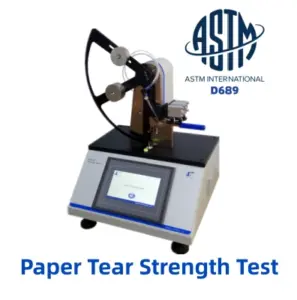
Der paper tear strength test defined in ASTM D689 is a widely accepted method for evaluating the internal tearing resistance of paper. Rather than measuring tensile failure, this test focuses on a material’s ability to resist tear propagation after an initial slit, which closely reflects real-world damage during converting, printing, and end use.
By using a calibrated Elmendorf-Reißprüfgerät, ASTM D689 provides a repeatable and comparable approach for determining paper tear strength across different grades and fiber compositions. This article explains the test method in detail, helping laboratory personnel apply the standard correctly and obtain reliable results.
Understanding ASTM D689 in Elmendorf Tear Tester Operation
ASTM D689 specifies the use of an Elmendorf-Reißprüfgerät, which operates on the principle of energy loss. When the pendulum swings through a fixed arc, it tears one or more plies of paper over a defined distance. The reduction in potential energy corresponds directly to the paper tear strength.
Unlike static force tests, this dynamic tearing method captures how fibers resist rapid crack propagation. The standard allows testing of single sheets or multiple plies, depending on material strength, ensuring the measured value falls within an optimal instrument range.
Key features of the ASTM D689 method include:
-
Tearing force applied perpendicular to the paper plane
-
Fixed tear length and controlled tear initiation
-
Measurement expressed as average tearing resistance per ply
Why ASTM D689 Matters in Paper Testing Laboratories
ASTM D689 plays a critical role in quality control and material development because paper tear strength directly influences usability and durability. Papers with insufficient tear resistance may fail during folding, binding, or packaging operations.
The standard supports:
-
Routine quality monitoring of paper production
-
Comparative evaluation between paper grades
-
Performance prediction when used alongside tensile and burst tests
Because ASTM D689 aligns with international methods such as ISO 1974 and TAPPI T414, it also enables consistent data comparison across global supply chains.
Paper Tear Strength Test and Measurement of Paper Tear Strength
Der paper tear strength test under ASTM D689 quantifies the average force required to continue a tear after it has started. This value reflects internal fiber bonding, fiber length, and sheet formation.
Important technical considerations include:
-
Directional testing in Maschinenrichtung (MD) Und cross direction (CD)
-
Use of multiple plies to ensure readings fall near 40% of full scale
-
Reporting results per single sheet, even when multiple plies are tested
The tearing resistance of paper often differs significantly between MD and CD, making directional testing essential for accurate characterization.
Sample Preparation and Testing Procedures According to ASTM D689
Proper sample preparation ensures valid and repeatable results under ASTM D689.
Konditionierung
Paper specimens must be conditioned under standard atmospheric conditions defined by relevant testing practices before testing begins.
Probeneinstellung
Sheets are stacked into the required number of plies with all wire sides oriented consistently. The specimen is centered in the clamps, and an initial slit is introduced to guide tear propagation.
Testdurchführung
The pendulum is raised to its starting position and released smoothly. As the specimen tears, the pointer records the energy consumed. The tester captures the average tearing force over the fixed tear distance.
Datenaufzeichnung
The number of plies and scale reading are recorded for each test. Results that show abnormal tear paths or deviation from the intended tear line are discarded according to standard criteria.
Common Challenges in ASTM D689 Testing and How to Avoid Them
Despite its simplicity, ASTM D689 requires careful attention to detail.
Common issues include:
-
Incorrect ply selection, leading to out-of-range readings
-
Misalignment in clamps, causing uneven tear paths
-
Inconsistent wire-side orientation, affecting repeatability
To minimize errors, laboratories should routinely verify instrument calibration, follow specimen handling requirements, and discard invalid results as defined in the standard.
Elmendorf Tear Tester Selection for ASTM D689 Compliance
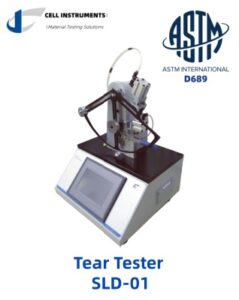
While ASTM D689 focuses on methodology rather than equipment brands, the tester must meet key performance requirements, including pendulum accuracy, stable clamping, and precise scale resolution.
Modern Elmendorf tear testers, such as the Zellinstrumente SLD-01, are designed to support ASTM D689 testing through controlled pendulum release, clear scale readability, and adaptable specimen clamping.
These features help laboratories maintain consistency when applying the standard across different paper types.
Abschluss
Der ASTM D689 paper tear strength test remains a fundamental method for evaluating internal tearing resistance in paper materials. By following the specified test procedures, ensuring correct sample preparation, and understanding the principles behind the Elmendorf tear tester, laboratories can generate accurate and comparable tear strength data.
When applied correctly, ASTM D689 provides valuable insight into paper performance, supporting quality control, product development, and compliance with industry expectations.
FAQs
Q1: What is ASTM D689 used for?
A: ASTM D689 defines the paper tear strength test using an Elmendorf tear tester. It measures the internal tearing resistance of paper and helps predict how paper will perform during converting, printing, or end-use applications.
Q2: What types of paper can be tested using ASTM D689?
A: The standard applies to most paper grades, including printing, packaging, and specialty papers. It is not suitable for highly directional boards where cross-direction tearing is critical.
Q3: How many plies should be tested?
A: The number of plies is selected so that the tearing energy falls near 40% of the instrument’s full-scale range. This ensures accurate readings without overloading the Elmendorf tear tester.
Q4: Why is sample conditioning important?
A: Paper must be conditioned under standard atmospheric conditions to stabilize moisture content. This prevents variability in tear resistance results caused by humidity or temperature fluctuations.
 DE
DE  EN
EN  AR
AR  BG
BG  CS
CS  DA
DA  EL
EL  ES
ES  ET
ET  FI
FI  FR
FR  HU
HU  ID
ID  IT
IT  JA
JA  KO
KO  LT
LT  LV
LV  NB
NB  NL
NL  PL
PL  PT
PT  RO
RO  RU
RU  SK
SK  SL
SL  SV
SV  TR
TR  UK
UK