
ASTM D624
Tear Strength Test Method of Rubber and Elastomers
ASTM D624 stands as one of the most widely used standards for evaluating rubber tear strength in conventional vulcanized rubber and thermoplastic elastomers (TPE). Manufacturers, quality control engineers, and research professionals rely on this method to understand how rubber materials initiate and propagate tears under controlled conditions.
Understanding ASTM D624 and Its Importance
Rubber components often experience tearing when exposed to concentrated stresses, sharp edges, or repeated strain. This failure mode can compromise seals, gaskets, footwear soles, medical components, or packaging elastomers. ASTM D624 provides a standardized way to measure the force required to initiate or propagate tearing through a rubber sheet.
The test applies a continuous tensile load at a specified jaw separation rate until the specimen fails completely. This process helps users evaluate intrinsic resistance to tear initiation, tear propagation, and the effect of geometry on failure behavior.
Rubber Tear Strength and Its Relationship with ASTM D624
Rubber tear strength reflects the material’s ability to withstand the development and extension of a tear. ASTM D624 test geometries intentionally expose materials to different stress concentrations, making the results highly sensitive to formulation, processing quality, and specimen orientation. Understanding this relationship helps researchers and production engineers select the correct specimen type for their application.
Rubber compounds with high tear strength often show better durability when exposed to cyclic deformation or sharp mechanical contact. Conversely, low tear strength may indicate internal defects, weak crosslinking, or poor dispersion of reinforcing fillers.
Tear Strength Test Method Under ASTM D624
Den tear strength test method follows a clearly defined process:
- Prepare and condition the specimen as specified.
- Mount the test piece with full alignment to avoid uneven loading.
- Apply a constant rate of grip separation.
- Continue loading until the specimen completely tears apart.
- Record the maximum force for Type A, B, C, or use continuous force tracing for Type T and CP.
Precise crosshead speed and consistent clamping significantly affect accuracy. Using high-quality fixtures and a calibrated tester is essential for reproducible measurements.
ASTM D624 Type A
ASTM D624 Type A uses a crescent-shaped specimen with a razor-made nick. It measures tear propagation strength, especially suitable for situations where the available rubber sheet is too small for other specimen types. The applied force acts perpendicularly to the cut, allowing researchers to observe how a pre-existing tear grows under loading.
ASTM D624 Type B
ASTM D624 Type B also uses a crescent-shaped design but includes gripping tabs to enhance stability. This configuration improves specimen handling and allows more consistent propagation results. Type B is preferred over Type A when the material size permits, providing better accuracy due to reduced slippage and better alignment.
ASTM D624 Type C
ASTM D624 Type C features a 90° angle without a pre-cut notch. This geometry assesses tear initiation strength, focusing on rupture originating from the apex. If the tear does not begin at the designed stress concentration, the test may resemble tensile failure rather than true tear testing. Type C data are useful for evaluating starting-point resistance when materials face sharp-edge impacts in service.
ASTM D624 Type T
ASTM D624 Type T, or the trouser tear specimen, includes two legs pulled apart during loading. This specimen directly measures tear propagation in a uniform direction. Continuous force recording helps users understand fluctuations in propagation resistance, making Type T popular in research and quality control applications.
ASTM D624 Type CP
ASTM D624 Type CP modifies the trouser design by adding a constrained path, ensuring the tear follows a predefined route. The thicker legs reduce unwanted elongation, providing more stable tear propagation data. Type CP can produce highly reproducible results, especially useful when evaluating tough formulations or materials with complex reinforcement structures.
Tear Strength Tester
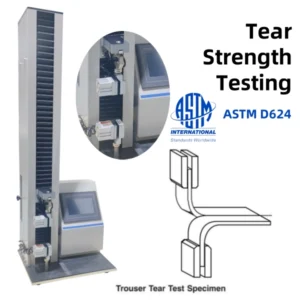
A reliable tear strength tester plays a critical role in obtaining accurate and repeatable results. The testing machine must maintain a constant grip separation rate, ensure stable alignment, and provide force measurement precision suitable for all specimen geometries. Crosshead speed requirements vary by test type, so the equipment must support precise speed control.
For laboratories seeking stable and versatile performance, the Cell Instruments TST-01 Tensile Tester offers high-accuracy force measurement, flexible fixtures, and excellent repeatability. It supports the speed requirements for Type A, B, C (500 ± 50 mm/min) and Type T, CP (50 ± 5 mm/min), making it ideal for ASTM D624 testing across various rubber and TPE products.
 DA
DA  EN
EN  AR
AR  BG
BG  CS
CS  DE
DE  EL
EL  ES
ES  ET
ET  FI
FI  FR
FR  HU
HU  ID
ID  IT
IT  JA
JA  KO
KO  LT
LT  LV
LV  NB
NB  NL
NL  PL
PL  PT
PT  RO
RO  RU
RU  SK
SK  SL
SL  SV
SV  TR
TR  UK
UK