
Complete Guide to Paper Stiffness Tester
ISO 2493-1
 Understanding ISO 2493-1 in Paper Stiffness Tester
 Understanding ISO 2493-1 in Paper Stiffness Tester
Accurate measurement of paper and paperboard stiffness is essential for ensuring optimal material performance in packaging, printing, and other industrial applications. The ISO 2493-1 standard specifies a reliable method for determining bending resistance, offering consistency and comparability across global quality control processes. This article outlines how to properly carry out testing according to ISO 2493 1 and highlights the importance of using the correct equipment, such as the WTD-01 Tester tuhosti v ohybu from Cell Instruments.
Why ISO 2493-1 Matters in Paper Tester
ISO 2493-1 provides a standardized method for measuring the bending resistance of paper and board by applying a force at a defined bending length (typically 50 mm or 10 mm) until the sample reaches a specific angle (15° or 7.5°). This approach ensures uniformity and reproducibility, essential for quality control, product development, and supplier verification.
Key benefits of using ISO 2493-1 include:
- Consistent data across laboratories
- Reliable comparison of material stiffness
- Enhanced control in converting and printing processes
For manufacturers, following ISO 2493-1 means higher product reliability and reduced failure rates in application.
Paper Stiffness Tester and the Taber Stiffness Test Method
Na stránkách Taber stiffness test method is a widely used approach for evaluating the flexural rigidity of paper and paperboard materials. It involves clamping a test piece and applying a force via a blunted knife edge at a fixed distance to bend the sample through a defined angle.
To comply with ISO 2493-1, a high-quality paper stiffness tester must feature:
- Accurate force sensors (±5% under 100 mN, ±2% above)
- Precise control of bending angle (15° or optional 7.5°)
- Adjustable clamp pressure to prevent slippage or deformation
- Repeatable sample positioning
Na stránkách Cell Instruments WTD-01 Bending Stiffness Tester is fully compliant with ISO 2493 1 and designed for high-precision, user-friendly operation. It features an intelligent interface, automatic angle control, and robust clamping mechanisms, ensuring precise test execution.
Sample Preparation and Testing Procedures
Proper preparation and conditioning are critical to obtain valid test results. Follow these steps according to ISO 2493 1:
Conditioning and Sampling
- Condition specimens in line with ISO 187.
- Select samples per ISO 186 for lot evaluation.
Cutting Test Pieces
- Cut 10 test pieces in each principal direction (machine and/or cross).
- Dimensions: (38.0 ± 0.2) mm wide, at least 80 mm long for 50 mm bending length.
Testing Protocol
- Insert sample into the clamp ensuring correct alignment and minimal contact with hands.
- Use a standard bending length of 50 mm (or 10 mm for low-stiffness materials).
- Set the instrument to a 15° bending angle (or 7.5° for thick or sensitive samples).
- Avoid bending or creasing the sample prior to the test.
- Record force applied by the knife as it bends the sample.
Important: Use consistent clamping pressure and avoid reusing test pieces. High clamping force may result in artificially lower stiffness values.
Common Challenges and How to Avoid Them
- Sample warping or curling: Leads to unreliable results. Avoid using visibly deformed samples.
- Inconsistent clamping: Use pneumatic clamps for consistent pressure.
- Incorrect bending length reporting: Always specify if 10 mm is used; values are not interchangeable with 50 mm.
Why Choose the Cell Instruments WTD-01 Stiffness Tester
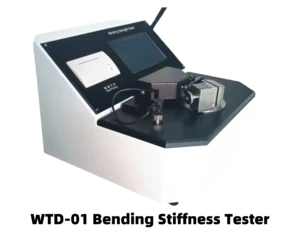 Na stránkách WTD-01 Tester tuhosti v ohybu z Cell Instruments provides full compliance with ISO 2493-1 and enables precise and repeatable testing. Key advantages include:
- Automatic angle control (15° and 7.5°)
- High-resolution force sensors
- Support for both 50 mm and 10 mm bending lengths
- Intuitive software interface with statistical analysis
It is ideal for quality control labs and R&D teams in packaging, printing, and materials manufacturing industries seeking accuracy and reliability in stiffness measurement.
Závěr
Complying with ISO 2493-1 ensures accurate and standardized paper stiffness testing. By adopting the Taber stiffness test method and using a qualified paper stiffness tester like the WTD-01 from Cell Instruments, professionals can achieve trustworthy results, improve material performance, and ensure product quality. Proper test preparation, equipment calibration, and adherence to standard procedures are essential for achieving reliable outcomes.
Sekce nejčastějších dotazů
- What is the main purpose of ISO 2493 1 in paper testing?
It standardizes the method for determining the bending resistance of paper and board to ensure consistent and comparable results. - When should the 7.5° bending angle be used?
Use 7.5° for thick or stiff samples that may deform or break before reaching 15°. - Can test results from 10 mm and 50 mm bending lengths be compared?
No. Results from different bending lengths are not directly comparable and must be reported separately. - How many samples should be tested in each direction?
At least 10 samples per direction (machine and/or cross) with valid measurements. - Why is the WTD-01 Bending Stiffness Tester suitable for ISO 2493 1?
It offers automatic control, high accuracy, compliance with all ISO 2493 1 requirements, and user-friendly operation.
 CS
CS  EN
EN  AR
AR  BG
BG  DA
DA  DE
DE  EL
EL  ES
ES  ET
ET  FI
FI  FR
FR  HU
HU  ID
ID  IT
IT  JA
JA  KO
KO  LT
LT  LV
LV  NB
NB  NL
NL  PL
PL  PT
PT  RO
RO  RU
RU  SK
SK  SL
SL  SV
SV  TR
TR  UK
UK