
Understanding ISO 9187 and Its Role in Ampoule Quality
ISO 9187 defines the technical requirements and testing methods for glass ampoules used in injectable pharmaceuticals. It ensures that ampoules meet strict criteria for chemical durability, mechanical strength, and safety during use. For pharmaceutical manufacturers and quality control laboratories, compliance with ISO 9187 directly impacts product integrity and patient safety.
The standard consists of two main parts:
- ISO 9187-1: General requirements for ampoules
- ISO 9187-2: Specific requirements for one-point-cut (OPC) ampoules
These documents establish unified testing procedures, including hydrolytic resistance a ampoule break strength test, forming the backbone of ampoule quality assurance systems.
ISO 9187-1: Requirements and Testing Fundamentals
It specifies essential performance criteria for ampoules, focusing on three key aspects:
Hydrolytic Resistance Requirement
Ampoules must demonstrate high resistance to water attack on their internal surface. According to the standard, results must comply with ISO 4802 HC1 classification, ensuring minimal leaching of alkali components into injectable solutions.
Annealing Quality
Proper annealing reduces internal stress in glass. The standard limits optical retardation to ≤50 nm/mm, ensuring structural stability and reducing breakage risks during handling.
Breaking Force Performance
Na stránkách ampoule break strength test evaluates the force required to separate the neck from the body. This ensures:
- Controlled opening force
- Clean and safe break
- Reduced contamination risk
Testing requires a tensile testing machine with:
- Speed: 10 mm/min
- Force range: up to 200 N
ISO 9187-2: OPC Ampoules and Additional Requirements
It extends the requirements to OPC ampoules, widely used for safer manual opening.
Key Additions:
- Breaking point positioning: Must remain within ±1 mm of the centerline
- Thermal stability: Must withstand 120°C heating followed by water cooling
- Sterilization resistance: Must endure cleaning and sterilization processes
These criteria ensure consistent usability and reliability under real-world pharmaceutical conditions.
Ampoule Break Strength Test
Na stránkách ampoule break strength test is a critical mechanical evaluation under ISO 9187.
Princip testu
A controlled force is applied perpendicular (90°) to the ampoule axis until rupture occurs. The system records the hodnota lomové síly, which must fall within specified limits.
Why It Matters
- Ensures ease of opening for healthcare professionals
- Prevents excessive force that may cause injury
- Guarantees clean fracture without glass fragments
Recommended Solution
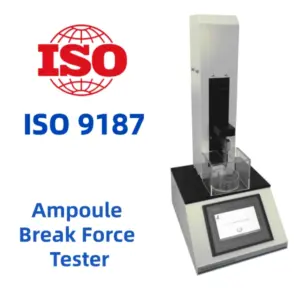
Na stránkách BST-01 Ampoule Break Force Tester provides a highly repeatable and automated approach to glass ampoules testing. Its precise speed control, interchangeable fixtures, and safety protection make it ideal for both QC labs and R&D environments. The system significantly improves testing efficiency while maintaining compliance with standard requirements.
Hydrolytic Resistance Test for Ampoule
Na stránkách hydrolytic resistance test for ampoule evaluates the chemical durability of glass under water exposure.
Princip testu
Glass is crushed into specified particle sizes and exposed to water under controlled conditions. The amount of alkali released is measured to determine resistance.
Key Standard Reference
Testing follows ISO 4802 methods, as required by ISO 9187, ensuring consistency across laboratories.
Why It Matters
- Prevents chemical interaction with injectable drugs
- Maintains drug stability and shelf life
- Ensures regulatory compliance in global markets
Recommended Solution
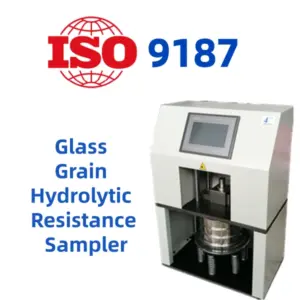
Na stránkách GHR-01A Glass Grain Hydrolytic Resistance Tester automates sample preparation and sieving, ensuring:
- Consistent particle size selection
- Improved operator safety
- Higher repeatability and accuracy
Get the Solution
Ensure your ampoules meet ISO 9187 requirements with precise hydrolytic resistance and breaking force testing. By adopting standardized methods and automated testing solutions, you can improve product safety, consistency, and compliance. Equip your laboratory with reliable instruments to streamline workflows, reduce variability, and deliver high-quality pharmaceutical packaging that meets global regulatory expectations.
Nejčastější dotazy
1. What is the main purpose of ISO 9187?
It defines quality and testing requirements for glass ampoules used in injectable pharmaceuticals.
2. What is the acceptable breaking force in ISO 9187?
The acceptable range depends on ampoule size and design, as specified in the standard tables.
3. Why is hydrolytic resistance critical for ampoules?
It prevents chemical contamination of injectable drugs caused by glass interaction.
4. How is the ampoule break strength test performed?
A tensile testing machine applies force at a controlled speed until the ampoule breaks.
5. What is the difference between ISO 9187-1 and ISO 9187-2?
ISO 9187-1 covers general ampoules, while ISO 9187-2 focuses on OPC ampoules with additional requirements.
 CS
CS  EN
EN  AR
AR  BG
BG  DA
DA  DE
DE  EL
EL  ES
ES  ET
ET  FI
FI  FR
FR  HU
HU  ID
ID  IT
IT  JA
JA  KO
KO  LT
LT  LV
LV  NB
NB  NL
NL  PL
PL  PT
PT  RO
RO  RU
RU  SK
SK  SL
SL  SV
SV  TR
TR  UK
UK  HE
HE  TH
TH  VI
VI