
ASTM D4533
Geotextiles Trapezoid Tearing Strength Test
Understanding ASTM D4533 is essential for professionals in the textile and geosynthetics industries who need to evaluate the tear resistance of geotextiles and fabrics. This standard provides a reliable way to measure the trapezoid tearing strength, ensuring product quality, durability, and compliance with international standards.
What Is ASTM D4533?
ASTM D4533: Standard Test Method for Trapezoid Tearing Strength of Geotextiles defines a procedure for determining the force required to propagate a tear in both woven and nonwoven fabrics. It is widely used in quality control, product comparison, and research involving geotextiles, industrial fabrics, and composite textiles.
The test measures the tearing strength in a controlled, repeatable way, providing valuable data on how the material behaves under stress. It applies to most geotextile materials, including woven, nonwoven, knitted, and felted fabrics.
Purpose and Importance of the Trapezoid Tear Test
Сайтът trapezoid tear test simulates real-world stress conditions where fabrics are exposed to punctures, cuts, or deformation forces. This test helps manufacturers and engineers understand how materials will perform during installation or use.
Key purposes include:
- Assessing tear resistance in different directions of fabric.
- Comparing performance among different fabric types or treatments.
- Ensuring consistency in manufacturing for quality assurance.
- Supporting product design decisions for enhanced durability.
For industries using geotextiles—such as civil engineering, environmental protection, and infrastructure—the trapezoid tearing strength test offers valuable insight into material suitability for reinforcement, filtration, or separation applications.
How the Trapezoid Tear Test Works
In this method, a specimen with an isosceles trapezoid shape is prepared and clamped between the jaws of a tensile testing machine. The nonparallel sides are gripped, and as the jaws move apart at a constant rate, the tear propagates across the sample.
Сайтът maximum tearing force recorded represents the trapezoid tearing strength. Depending on the type of fabric, several peaks may appear in the force curve as fibers stretch and rupture sequentially.
Typical test parameters (as per ASTM D4533):
- Clamp separation: 25 ± 1 mm
- Test speed: 300 ± 10 mm/min
- Sample condition: dry or thoroughly wet (tested within 2 minutes of removal from water)
- Results are expressed in Newtons (N) or pound-force (lbf)
Factors Influencing Trapezoid Tearing Strength
Several factors affect the test results:
- Fiber composition – Synthetic fibers like polyester or polypropylene offer higher resistance.
- Fabric structure – Woven fabrics rely on yarn strength, while nonwovens depend on fiber bonding and orientation.
- Moisture content – Wet samples may exhibit lower tear strength due to reduced friction between fibers.
- Clamping method – Proper gripping avoids slippage or premature failure near the jaws.
ASTM D4533 recommends adjusting clamping techniques for strong or slippery materials, such as using padding or surface coatings under the jaw area.
Recommended Equipment: Cell Instruments Tensile Tester
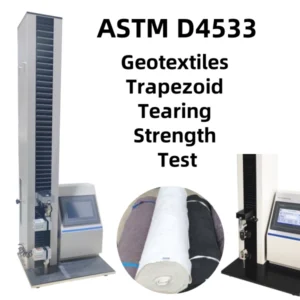 For accurate and repeatable results in ASTM D4533 trapezoid tear tests. Инструменти за клетки Тестер за опън is an ideal solution.
This advanced testing system offers:
- High-precision load cells for reliable force measurement.
- Customizable fixtures for trapezoid and other fabric tear tests.
- PLC-driven motor control ensuring stable and repeatable test speeds.
- User-friendly software for automatic data recording and analysis.
Whether testing geotextiles, nonwoven fabrics, or technical textiles, Cell Instruments provides robust and customizable testing solutions that meet ASTM and ISO standards.
Често задавани въпроси (ЧЗВ)
Q1: What does ASTM D4533 measure?
ASTM D4533 measures the trapezoid tearing strength of geotextiles and fabrics — the force required to propagate a tear under controlled conditions.
Q2: Why is trapezoid tearing strength important for geotextiles?
Tear resistance determines how geotextiles behave during installation and use. A higher trapezoid tear strength means better durability, reliability, and performance in the field.
Q3: What type of equipment is needed for ASTM D4533 testing?
A tensile testing machine with appropriate trapezoidal tear grips is required. The Cell Instruments Tensile Tester is specifically designed for this type of test.
Q4: Can ASTM D4533 be used for all fabrics?
Yes, it applies to most woven, nonwoven, and knitted fabrics, though adjustments to clamping may be needed for very strong or slippery materials.
Q5: How is the trapezoid tearing strength calculated?
It is determined as the maximum force recorded during tearing, typically expressed in Newtons (N) or pound-force (lbf), and averaged across multiple specimens.
Q6: Is the test suitable for wet samples?
Yes. ASTM D4533 specifies testing of wet specimens within 2 minutes of removal from water to evaluate performance under moisture exposure.
 BG
BG  EN
EN  AR
AR  CS
CS  DA
DA  DE
DE  EL
EL  ES
ES  ET
ET  FI
FI  FR
FR  HU
HU  ID
ID  IT
IT  JA
JA  KO
KO  LT
LT  LV
LV  NB
NB  NL
NL  PL
PL  PT
PT  RO
RO  RU
RU  SK
SK  SL
SL  SV
SV  TR
TR  UK
UK